Commission a Jaunt
Featured Build · One of One

A polished bathtub with the performance of a hot hatch.

One of fifty stainless steel Mokes hand-fabricated in Queensland in the 1980s. Found half-restored on the coast after sixteen years. Now electric. Now built to last another forty.

Stainless Steel Moke1980 Super S Moke platform
2024 — 2026Build duration, Brimbank workshop
72 kW · 19 kWh180 km range, CCS2 DC fast charge
One offBespoke commission
CHAPTER 01
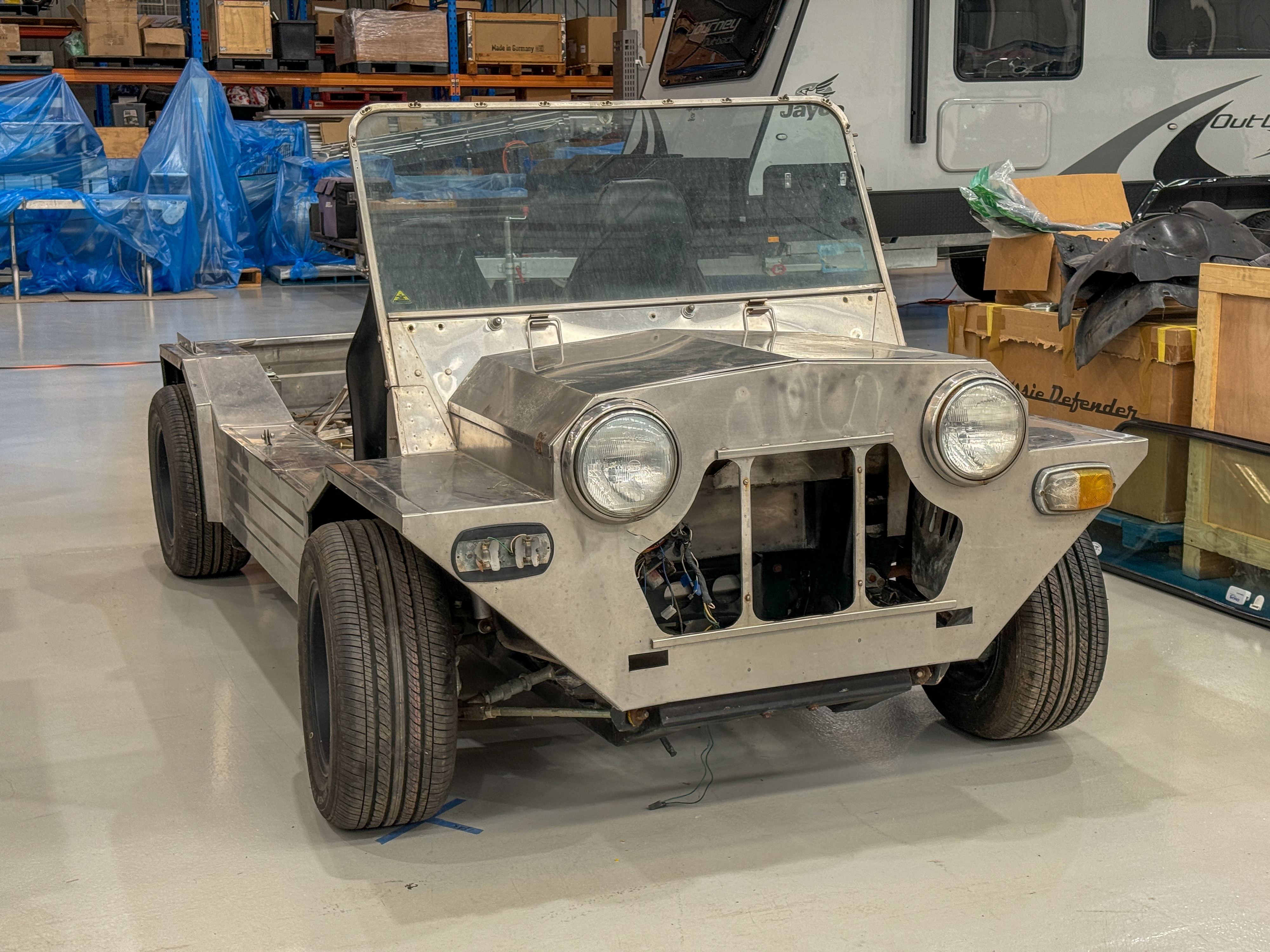
Look at this amazing stainless steel car. That's about to be an electric stainless steel car.

That's how the first video about this car opens. We were standing next to a 1980s Super S Moke. The first S is for stainless. There were maybe fifty made, hand-fabricated by a refrigeration company in Queensland whose name nobody can quite remember. They were marketed to beach-house owners and yacht people who wanted a shore tender that wouldn't rust to pieces in a season.

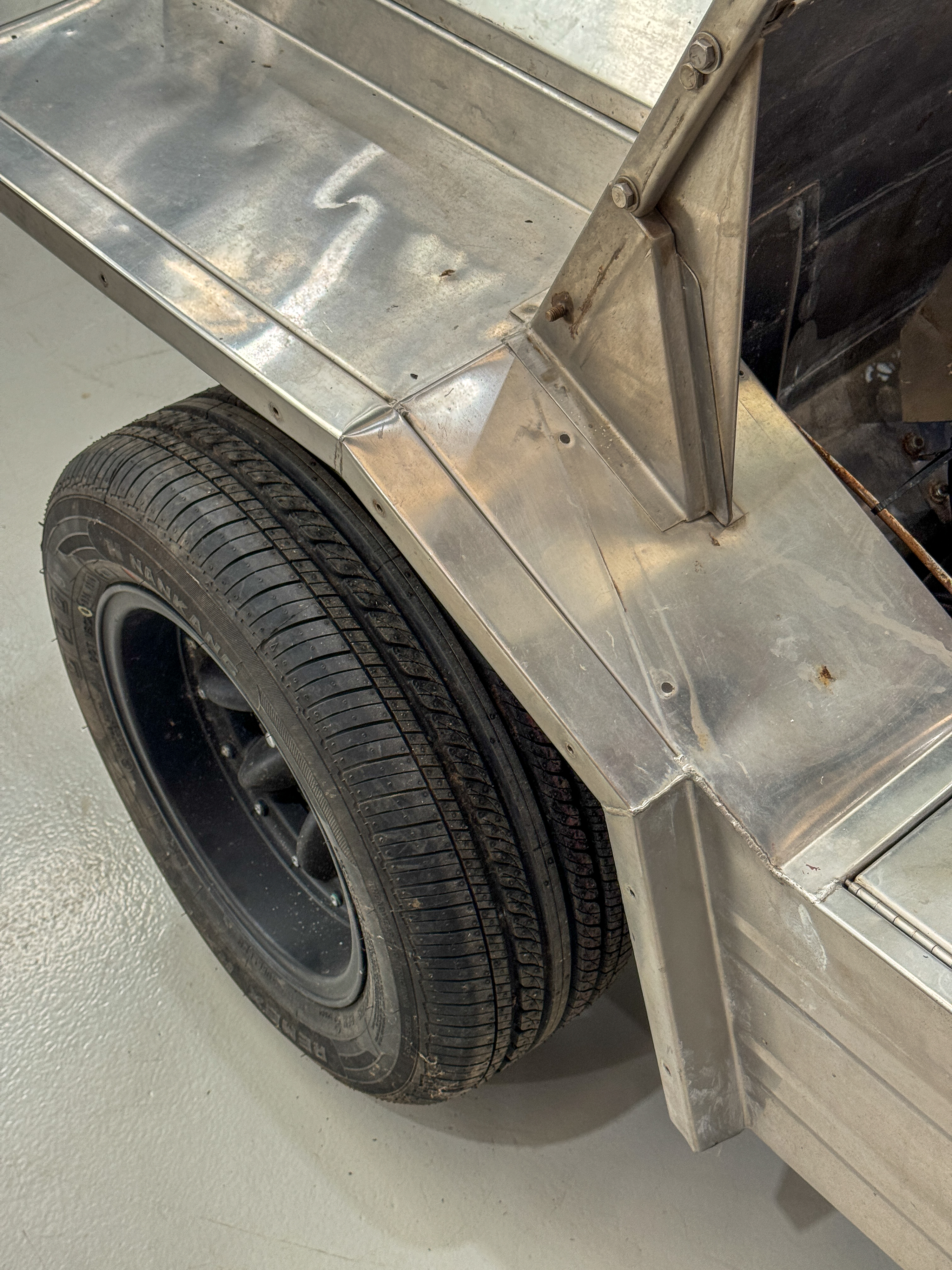
This particular one sat half-restored on the Queensland coast for sixteen years before it found its way to the Jaunt workshop in Brimbank. You can see it in the photos. The non-stainless areas have visible corrosion. The brake lines, the wiper arms, anything mild steel. The body itself has light pitting from a life lived close to the salt, and a few weld marks that weren't pickled cleanly when they were laid down forty-something years ago.

The original Moke is rolled and curved. The Super S is angular, flat, almost obstinately squared off. The factory built rolling bonnets. The Queensland refrigeration crew built a flat one. They didn't have the press tooling to do anything else, and the result is a car that looks like nothing else on the road.
If there was ever a precursor to the Cybertruck, the stainless steel Moke is it.
Dave Budge · MOKE 00 · Beginning
Front view of the partially restored stainless body on its original wheels as it arrived at the Jaunt workshop, before any conversion work began.
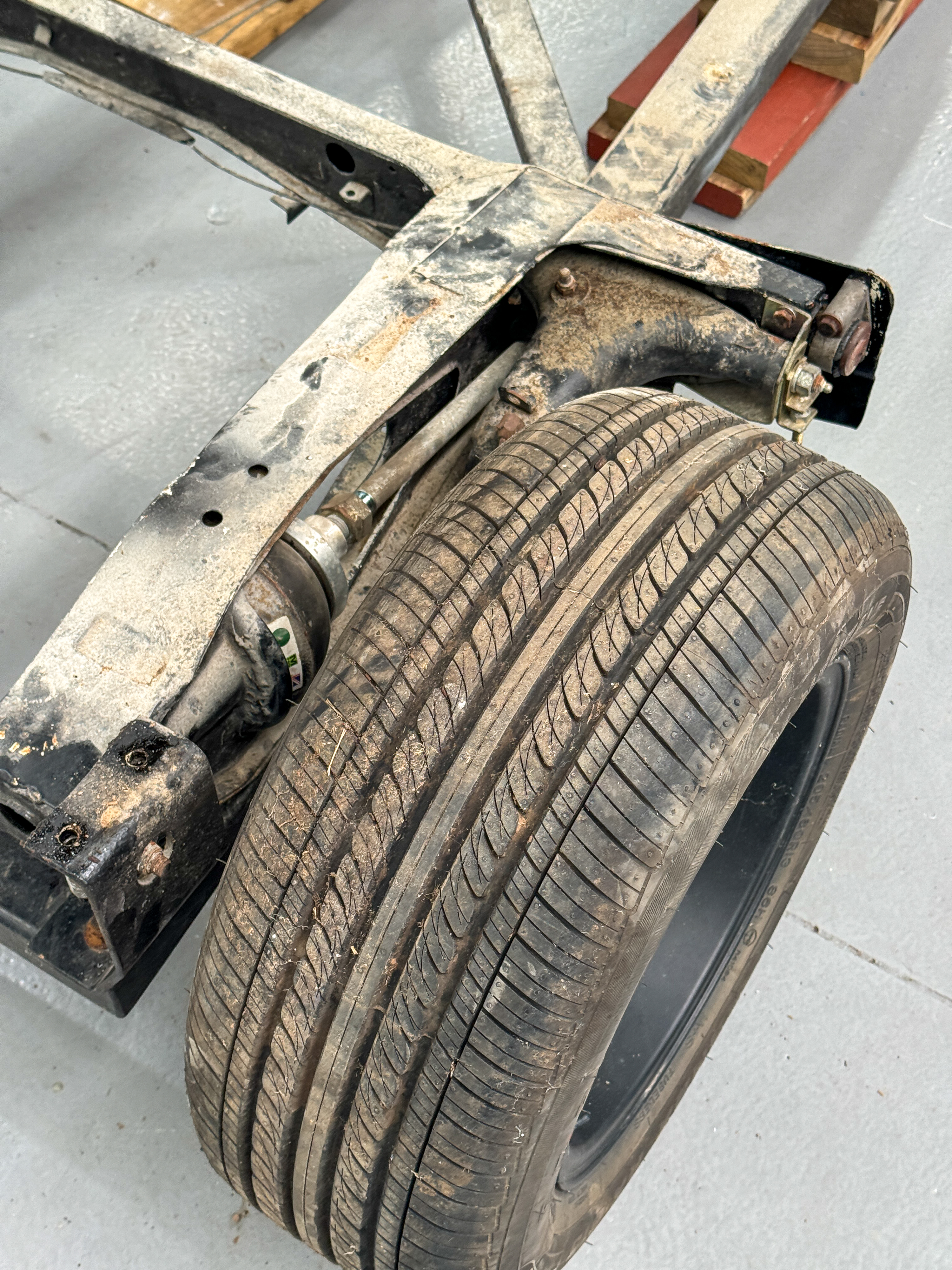
Close view of the original corroded chassis rail and front suspension components on the bare rolling chassis, after sixteen years exposed to coastal weather.
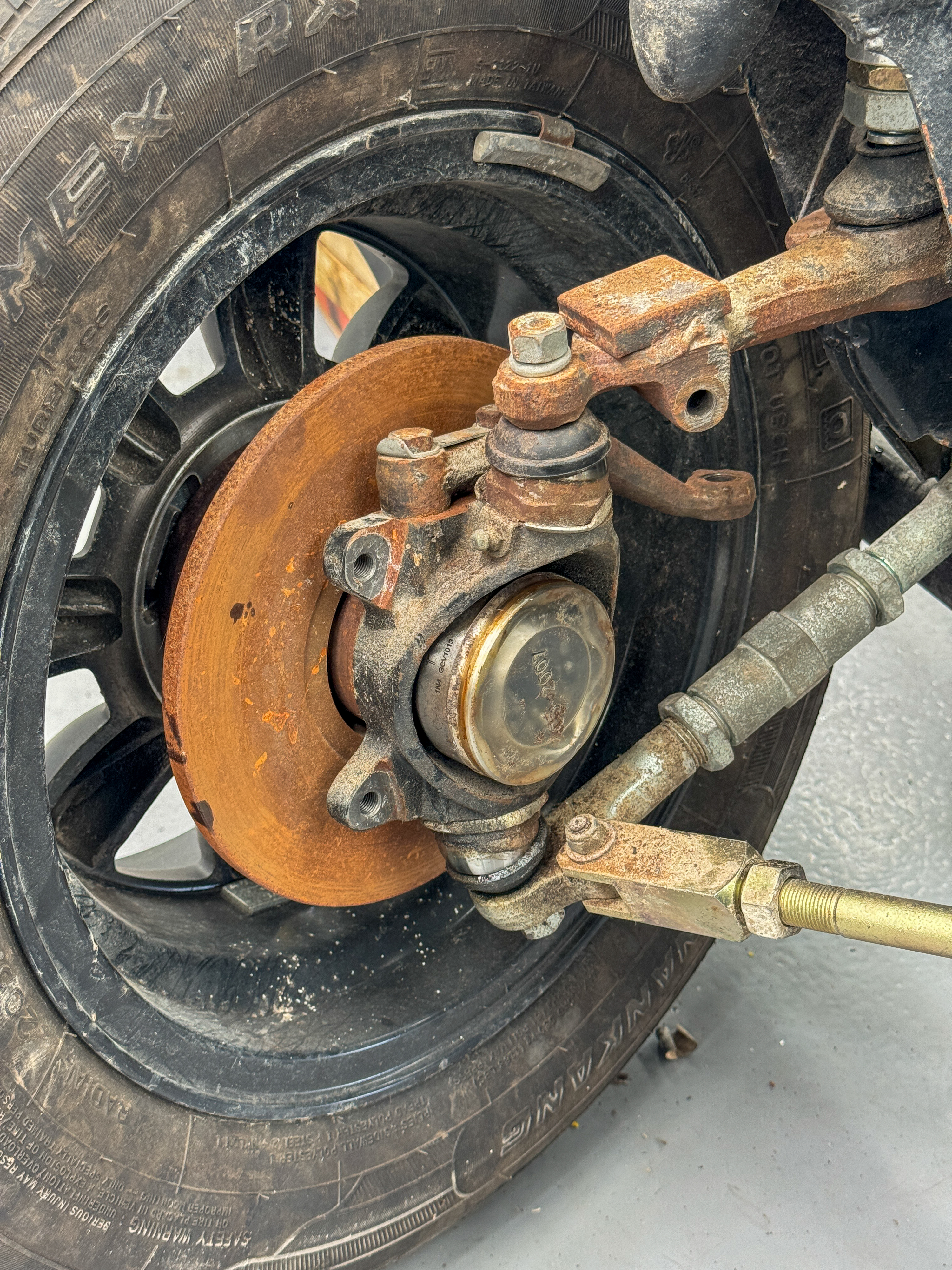
Original brake disc and caliper showing heavy surface rust and wear, photographed as part of the pre-build assessment.
Reel · Episode 00
Beginning
// Paste IG reel embed here
// instagram.com/jauntmotors/reels/
CHAPTER 02
Brittle metal. And one structural answer.

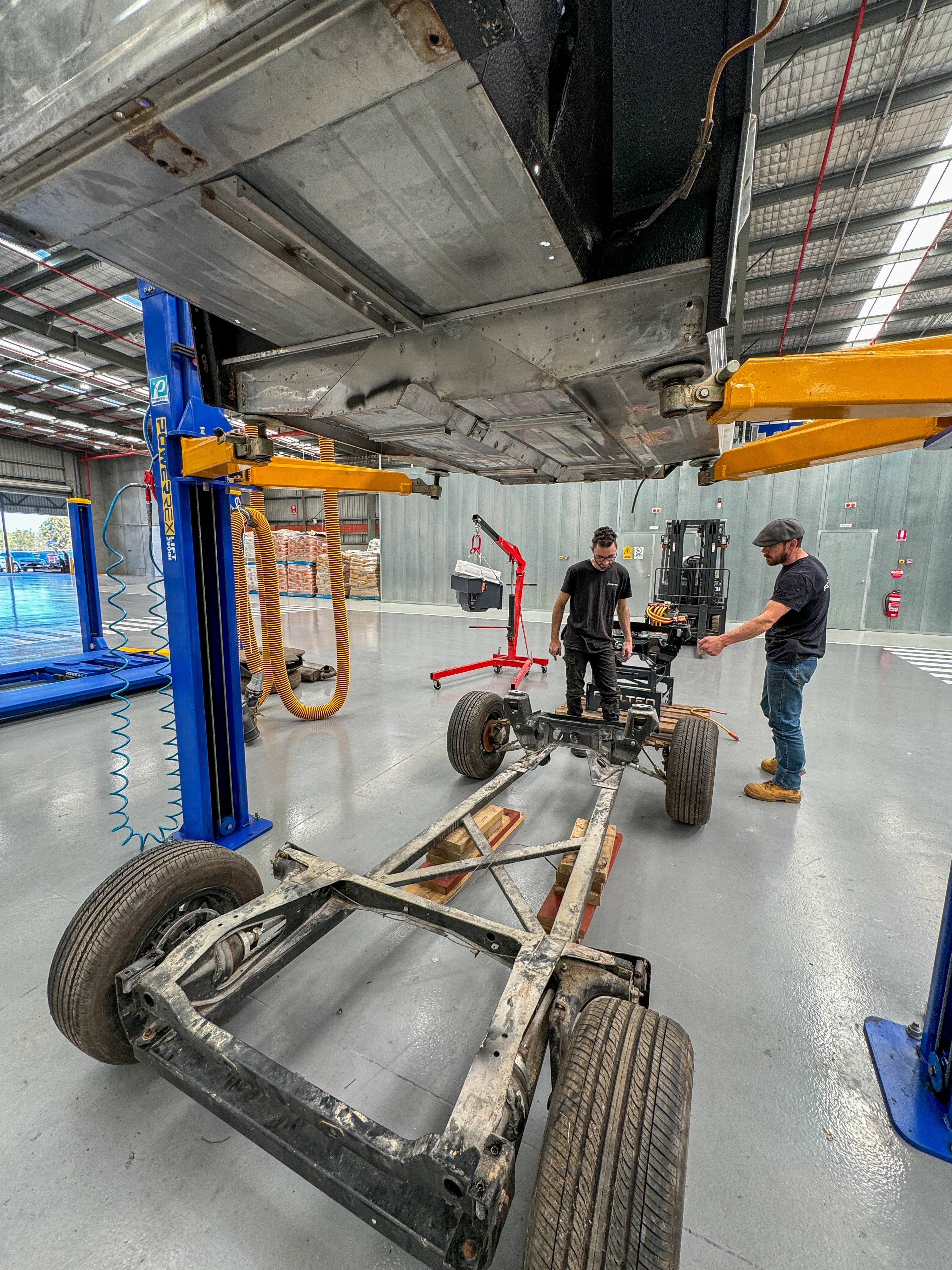
Stainless steel is harder to work with than the mild steel that the standard Moke is pressed from. It is more brittle. It stretches and moves in different ways. So instead of letting the body carry the load between the front and rear subframes, the original Queensland engineers added a box-section chassis tying the two together. No standard Moke has this. It makes the Super S stiffer, slightly lower in ground clearance, and structurally a different car. Their problem became our opportunity.

The brief from there was simple to say and harder to deliver. Make it ADR compliant. Preserve the original silhouette. Hide every piece of EV hardware. Build something that will be serviceable in twenty years.

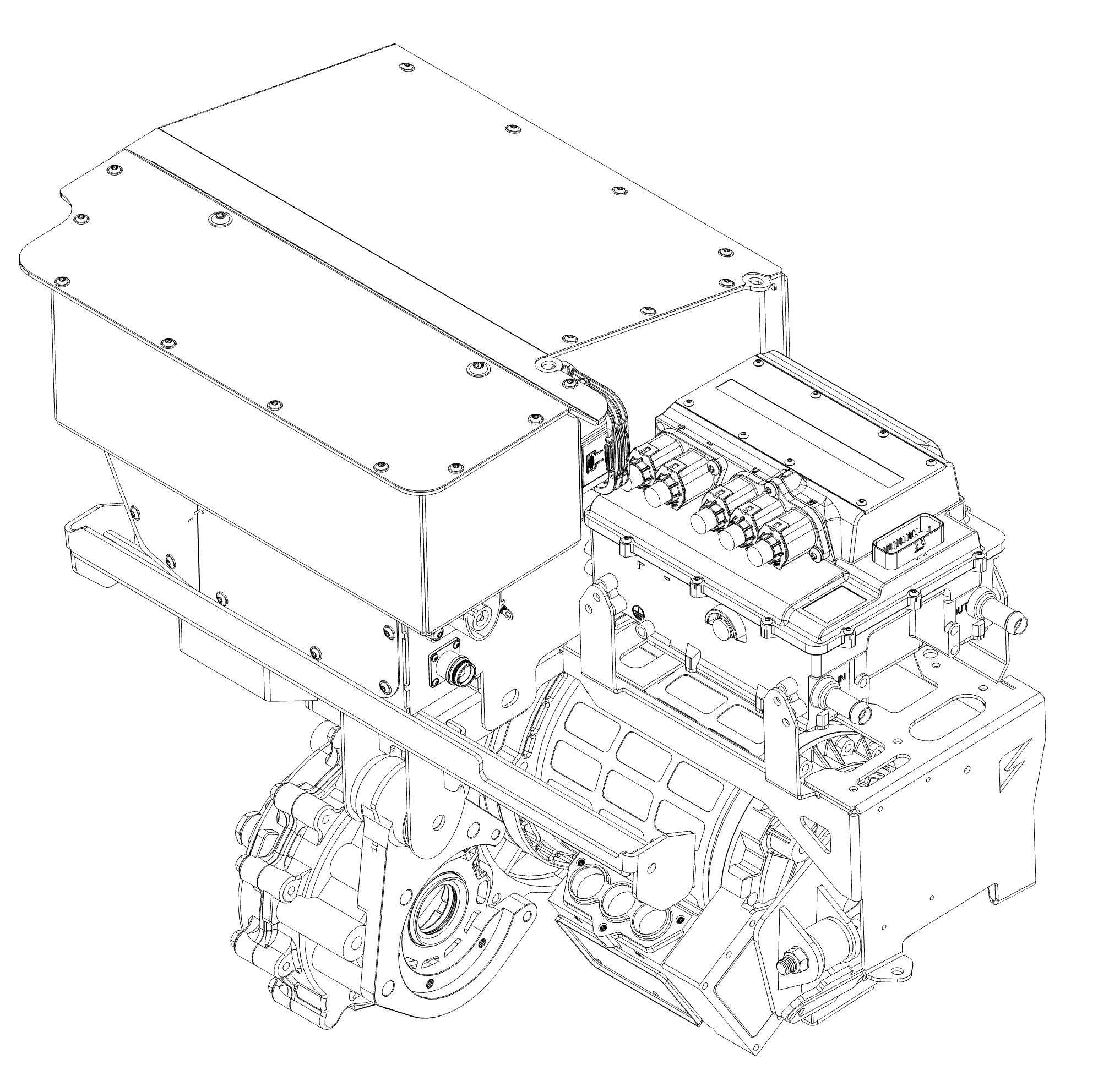
The hardware list is small but it pulls its weight. A 72 kW permanent magnet AC motor making 175 Nm. A 19 kWh battery split front and rear, thirteen up front under the bonnet, six in the rear sub-frame area. A single-speed reduction gear running through the original CV drive shafts. Upgraded disc brakes. CCS2 DC fast charging, which to our knowledge makes this the first Mini or Moke globally with that capability. Bidirectional output: the car becomes a mobile generator at 240V, 15A.

It weighs 580 kg. That is lighter than the Moke this body left the factory as.
72 kW
Peak Power
175 Nm
Torque
19 kWh
Battery
180 km
Range
580 kg
Weight
CCS2
DC Fast Charge
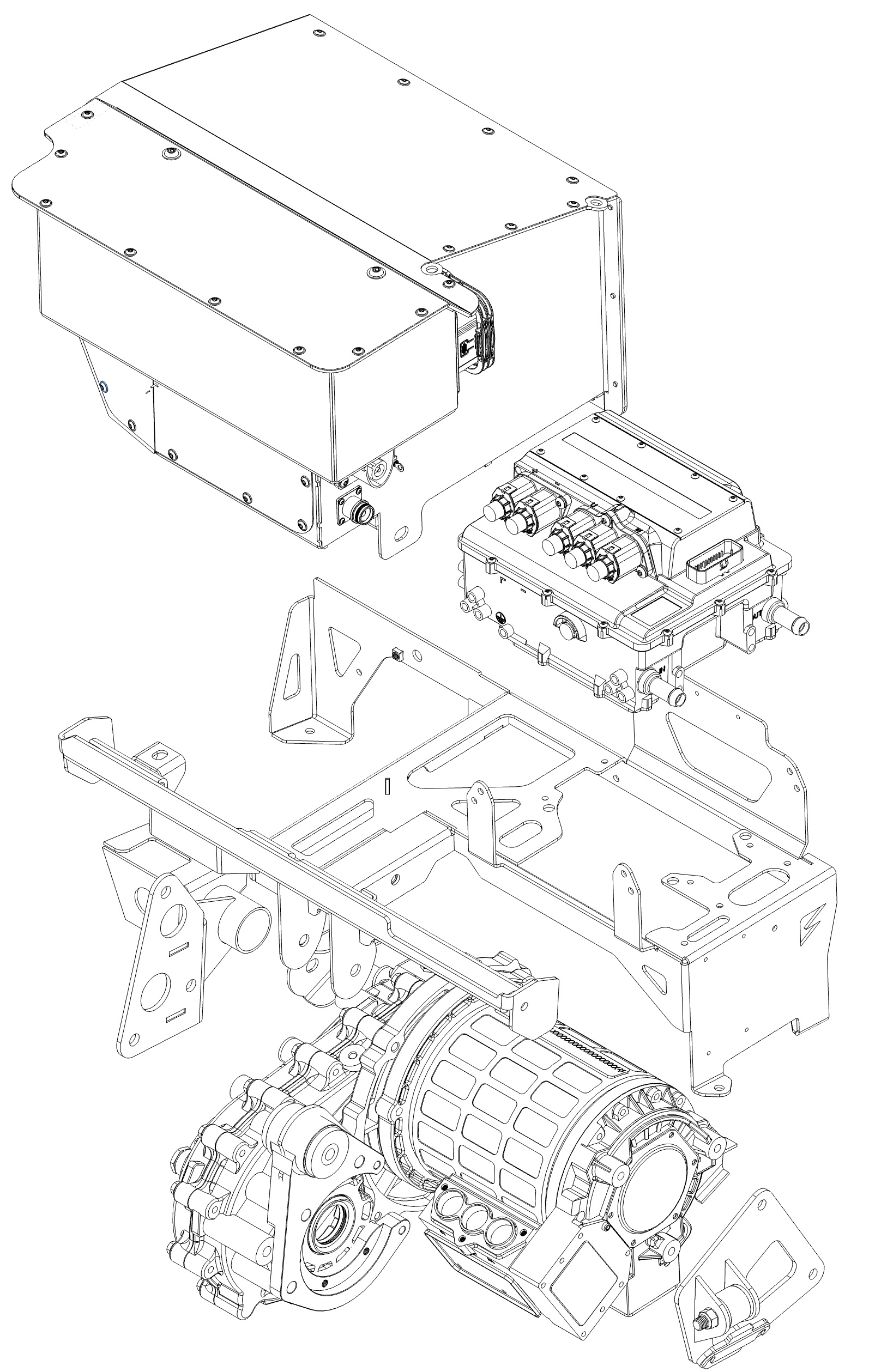
Fusion 360 drawing of the front drivetrain assembly, showing motor, gearbox, and front battery layout
front-assembly.pngAssembled view
Exploded view of the front drivetrain assembly showing component breakdown
front-assembly-exploded.pngExploded view
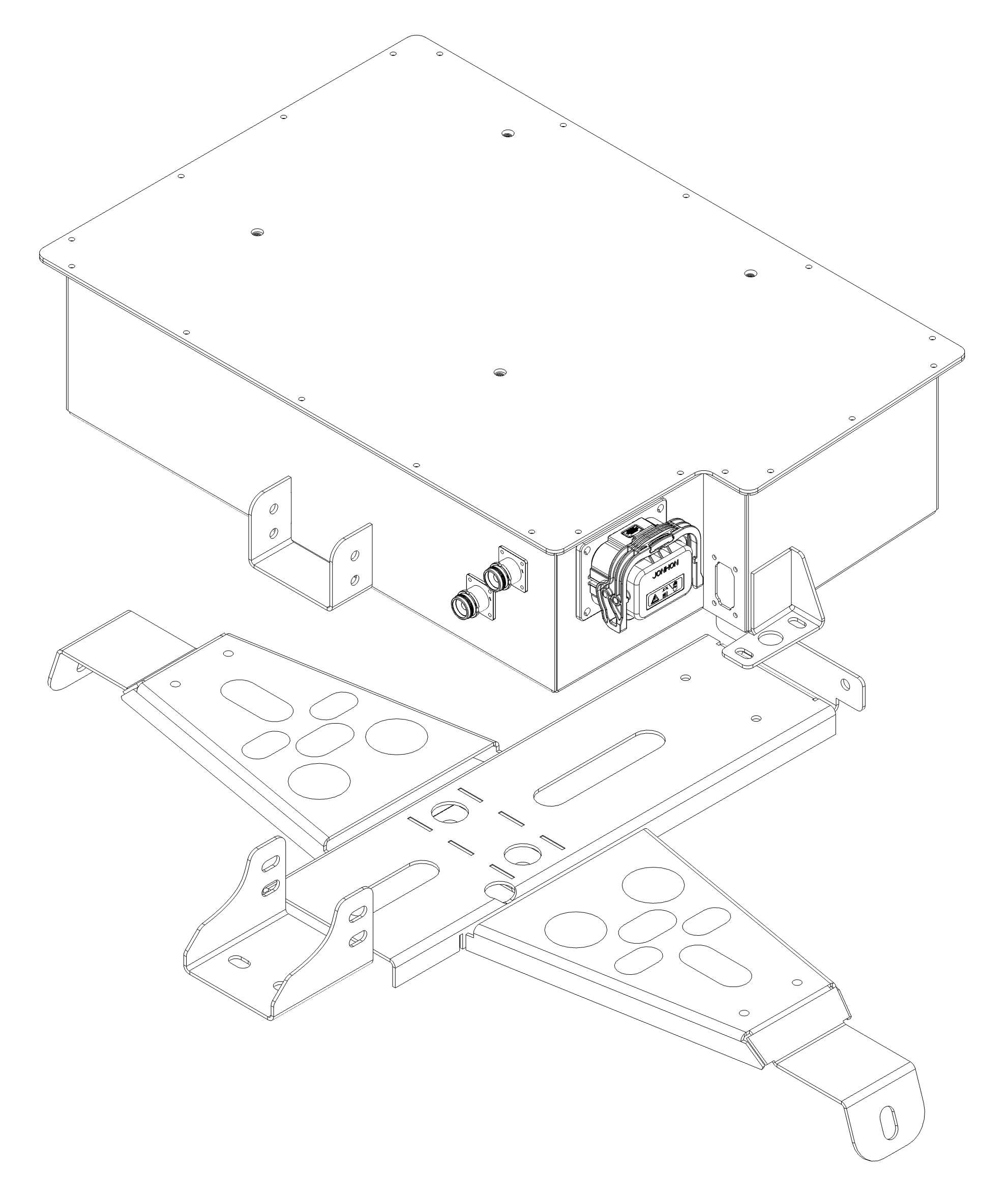
Fusion 360 drawing of the rear battery pack and its mounting plate, designed to bolt up into the Super S chassis
rear-battery.pngRear battery + mounting plate
A car that has no roof, has no walls, and is going to live by the ocean in Queensland. The most corrosion-resistant parts are the best.
— Dave Budge, on building a vehicle for its environment
CHAPTER 03
A year in the workshop. Episode by episode.
It took just over a year. Here are the moments we documented along the way: laser alignment, polish, the bonnet rebuild, the wiring loom, the rear battery, and a body drop that took twenty minutes while one of us was getting coffee.

The lasers. Rand started by establishing a true centreline. With a body that has had forty-something years of life, including some sitting half-restored on the coast, you cannot assume anything is square. Every measurement that follows depends on that first laser-aligned baseline.

The polish. The body went out. It came back a lot shinier. The pitting was reduced, the weld marks worked over, the mirror finish you see in the hero shots starts here. Until this stage you don't really know whether the car is going to look like the dream version or something more compromised. It came back better than we'd hoped.

The bonnet. The original was floppy and worn out. Hugo rebuilt it from the ground up: new internal chassis structure for stiffness, three-piece hinges with little beauty caps so nothing visible has a fastener through it, all bonded with adhesive instead of welded so the panel shape stays true. The surface had ghost imprints of its rental life. "Earn frequent flyer points when you rent this Moke" was still faintly visible under the polish in some lights. We painted it satin black in the end, both to hide that history and to kill the reflection that would otherwise bounce straight off a mirror-finish bonnet into the driver's eye-line.

Hugo has fabricated for these hinges this nice little pivot pin, bolted on little tabs and these support pieces. When it's black on black and a shadow line, it all blends in. A simple looking form that hides the complex engineering and thought that's gone into it.
Dave Budge · MOKE · Bonnet Design

The wiring loom. Dylan fitted the back loom over a couple of long days. The control wiring on a vehicle like this is more complex than the high-voltage side. Hundreds of wires running from the front control unit through to interior lights, USB ports, indicators, tail lights, the Anderson plug, the soundbar speaker, the bidirectional charger interface. We work with a supplier now who labels every wire along its entire length. Park light. Left indicator. Anderson plug. So in twenty years, when somebody opens this loom for service, they can read what every wire does.

Everything is multi-strand tinned copper, run inside conduit, and the conduit is taped over a tape-wrapped harness underneath. Three layers of abrasion resistance. The tinning stops the copper oxidising in the salt air this car will live in.
One day you're going to thank us that those are labelled in this way. We just want to build the cars that we want to own.
Dave Budge · MOKE 10 · Wiring Upgrade
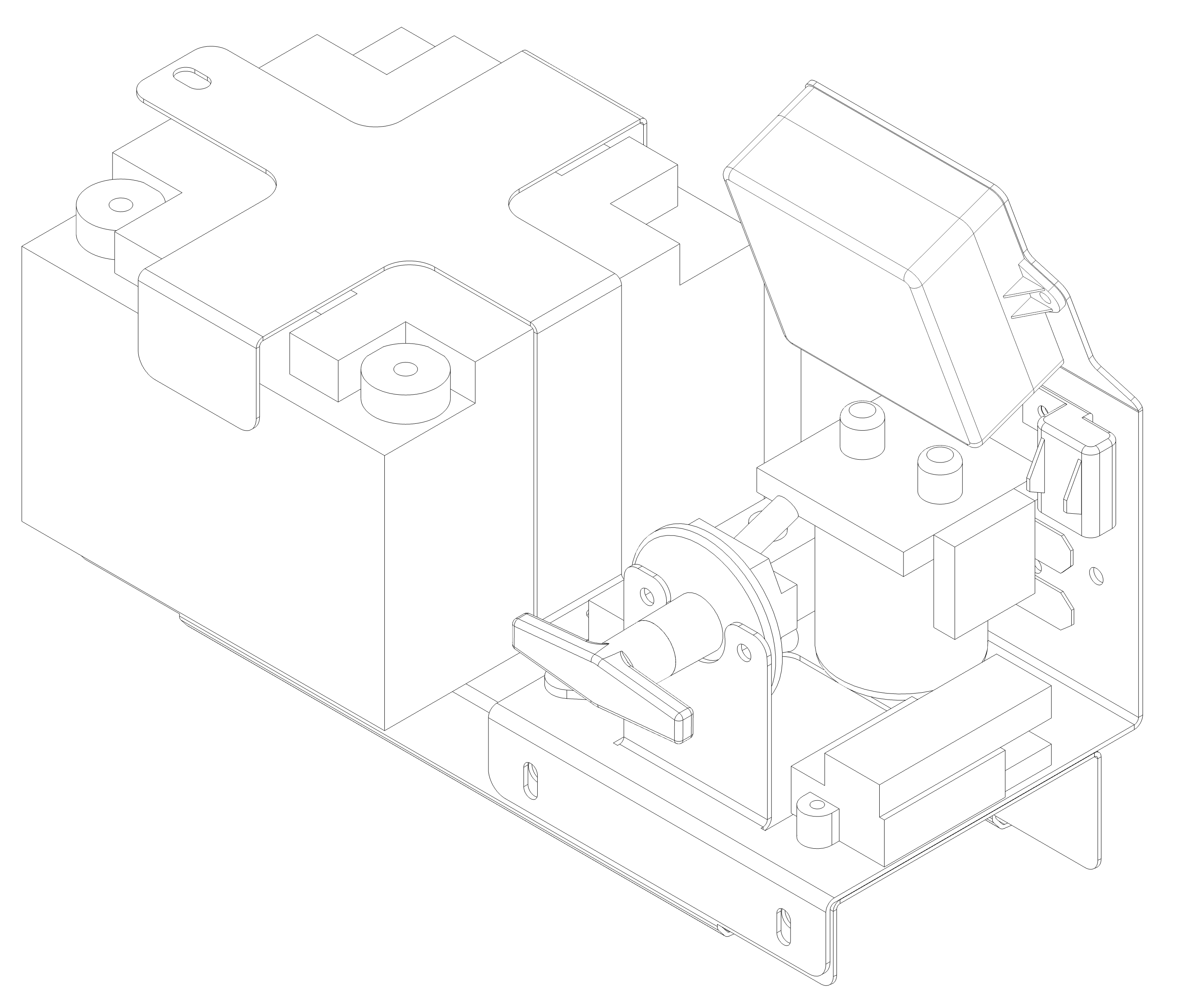
Fusion 360 drawing of the 12V auxiliary battery pack assembly
12v-battery.png12V auxiliary pack
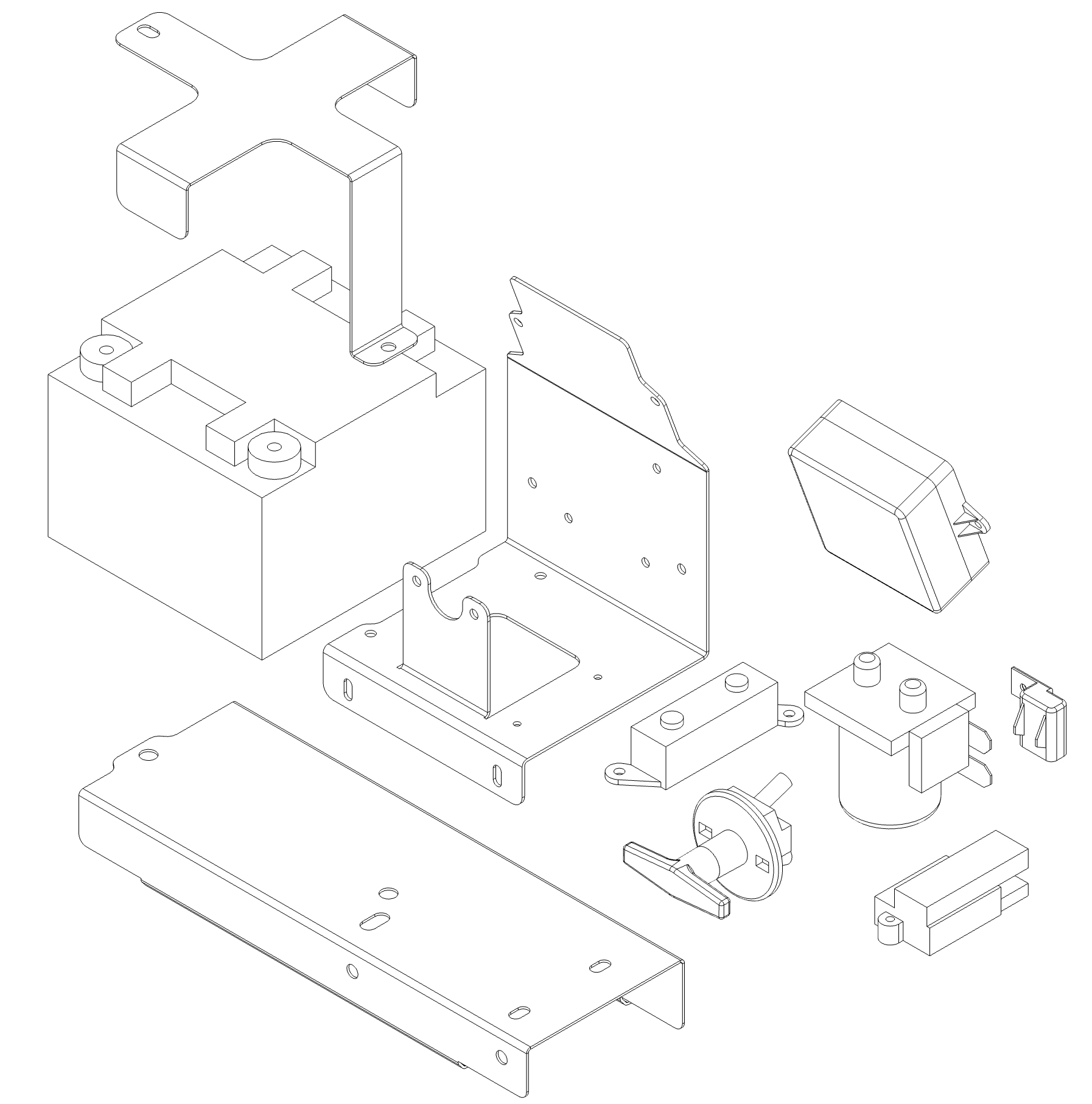
Exploded view of the 12V auxiliary pack showing internal components
12v-battery-exploded.pngExploded

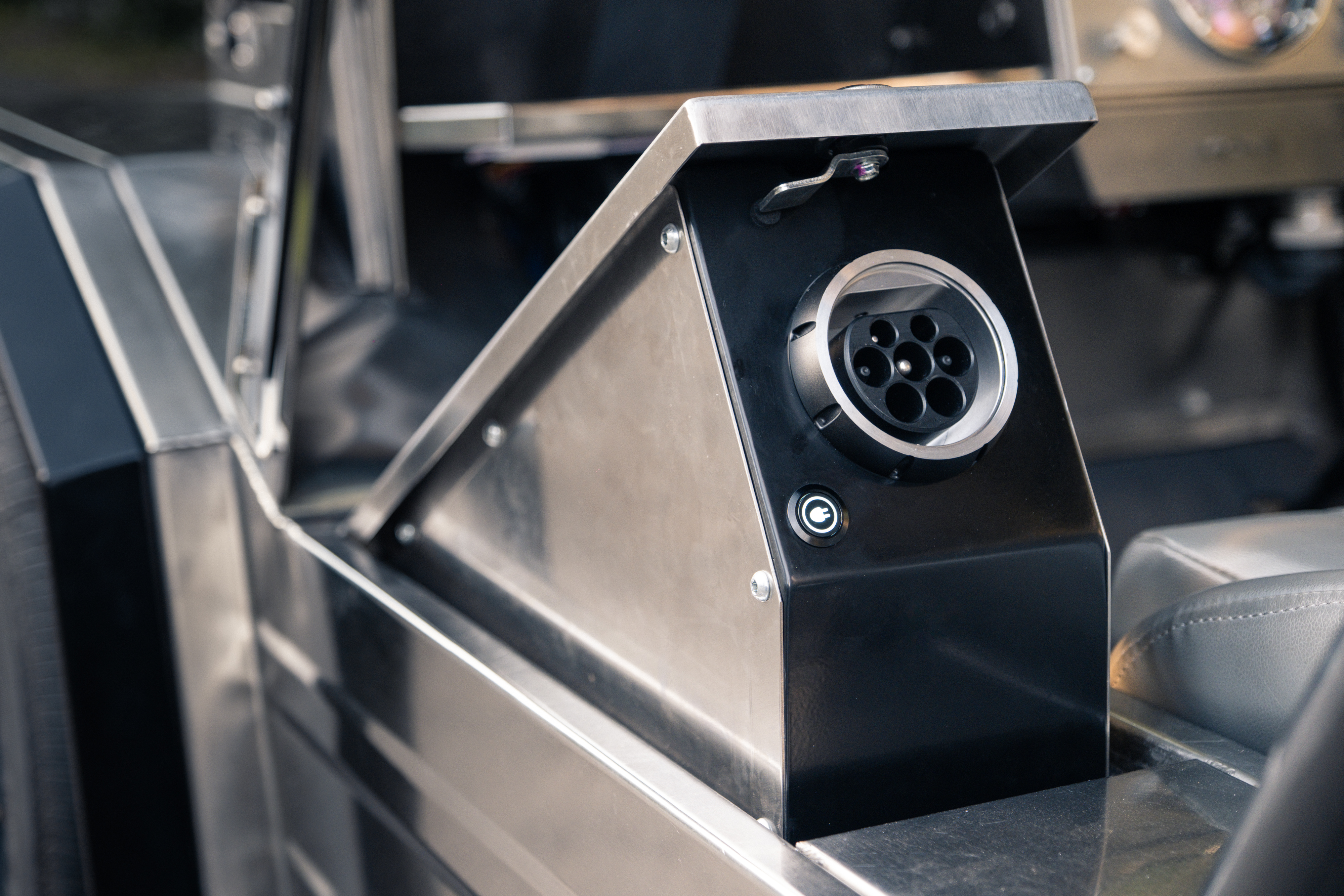
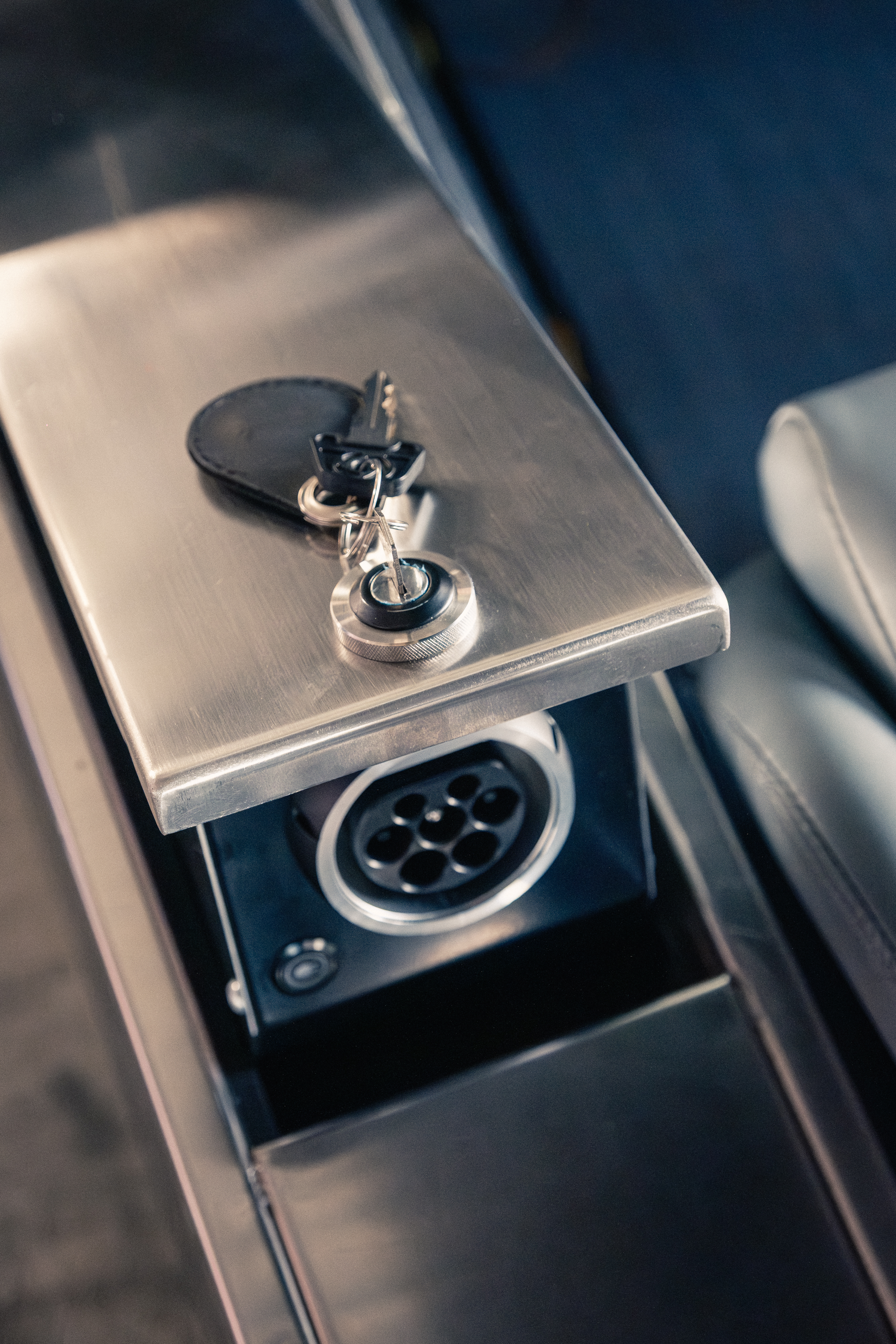
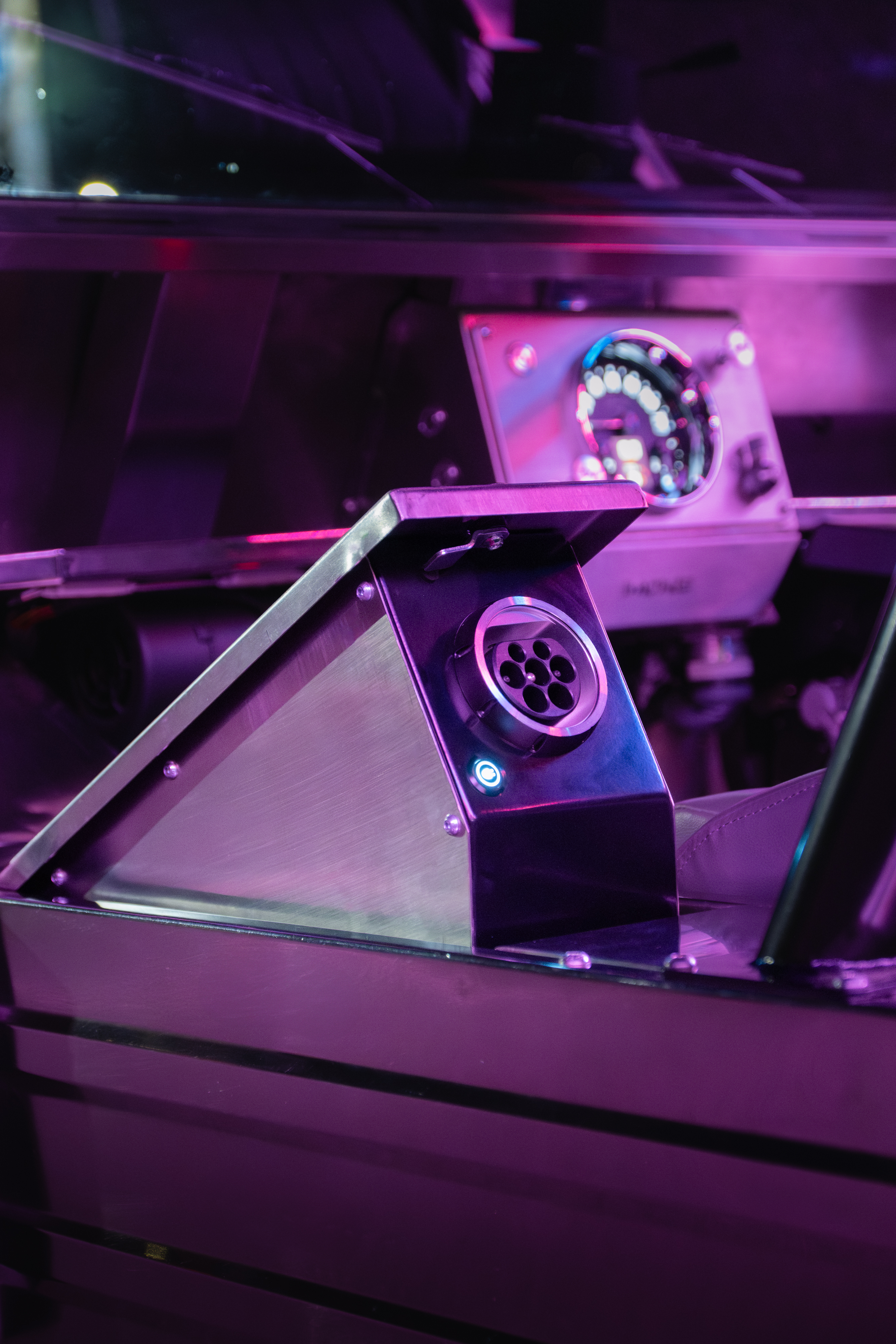
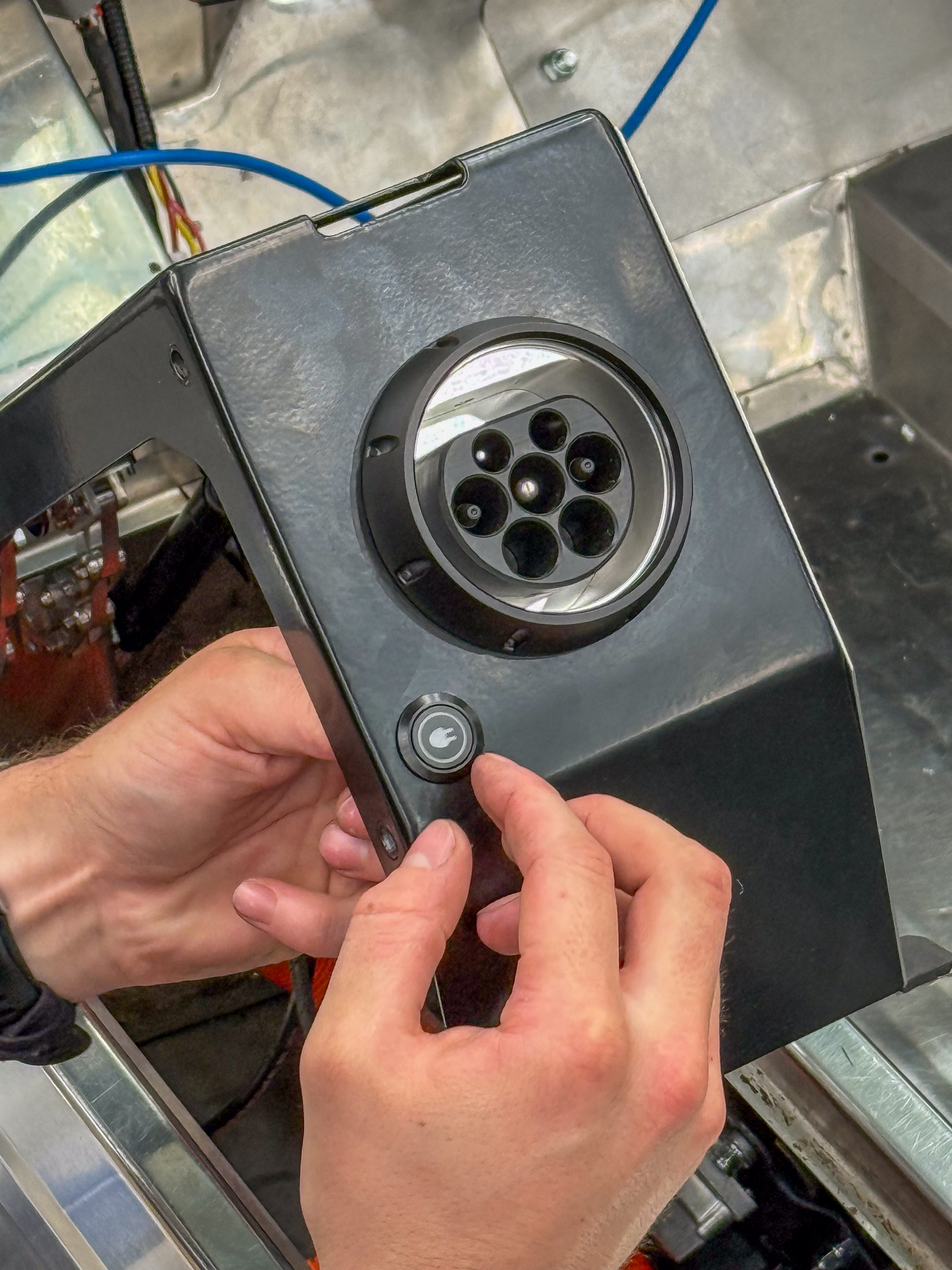
The charge port. We did not want to put a big hole in the side of a polished stainless steel body. The Super S already had storage pockets in the side pods that flip up on lids. So the charge port lives behind one of those lids on a gas strut. When the car is parked and closed, you cannot see it. When you want to charge, you flip up the lid. It is the kind of thing you only notice on the second look.
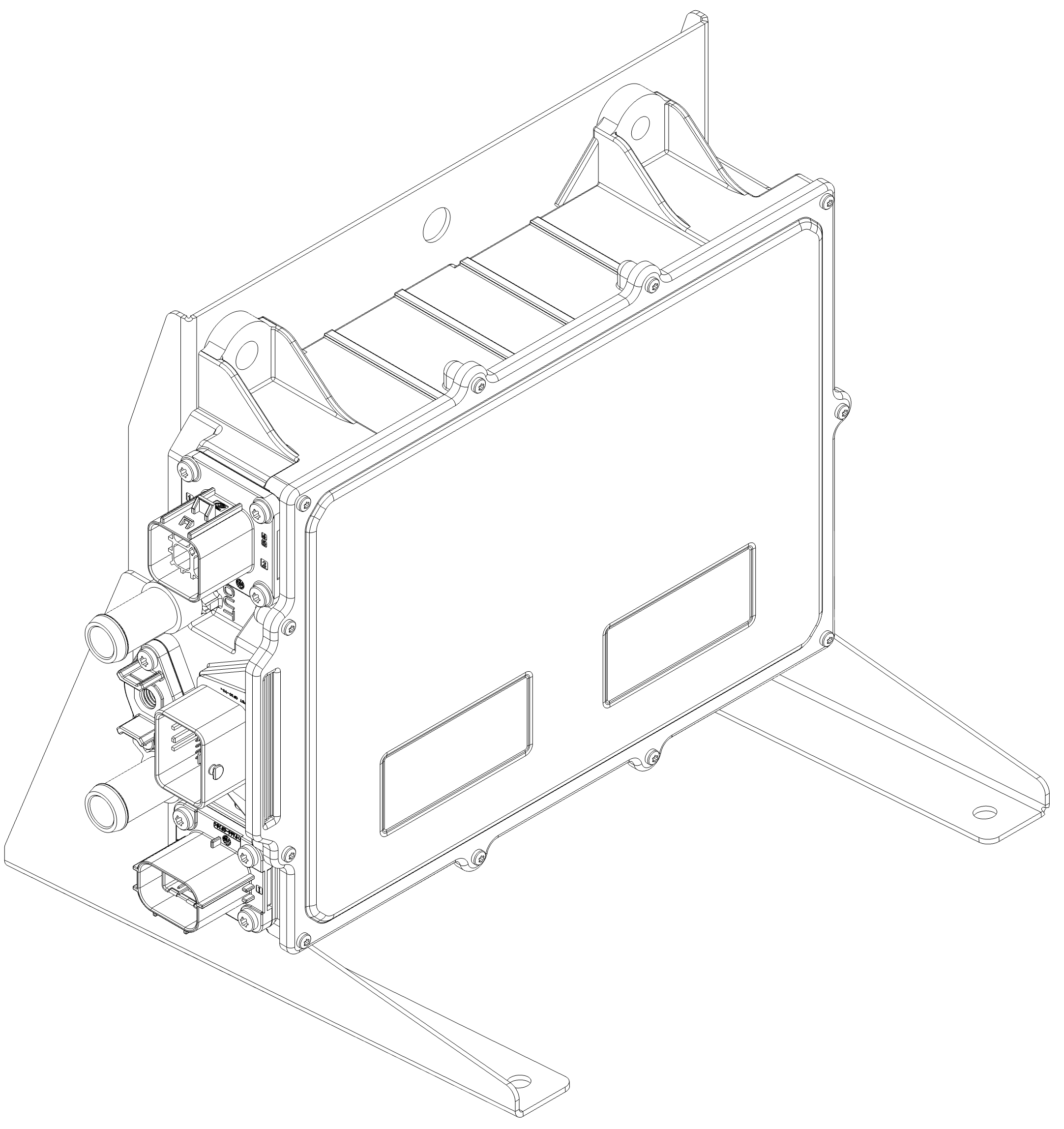
Fusion 360 drawing of the bidirectional charger unit hidden under the side pod
charger.pngBidirectional charger, side-pod mounted

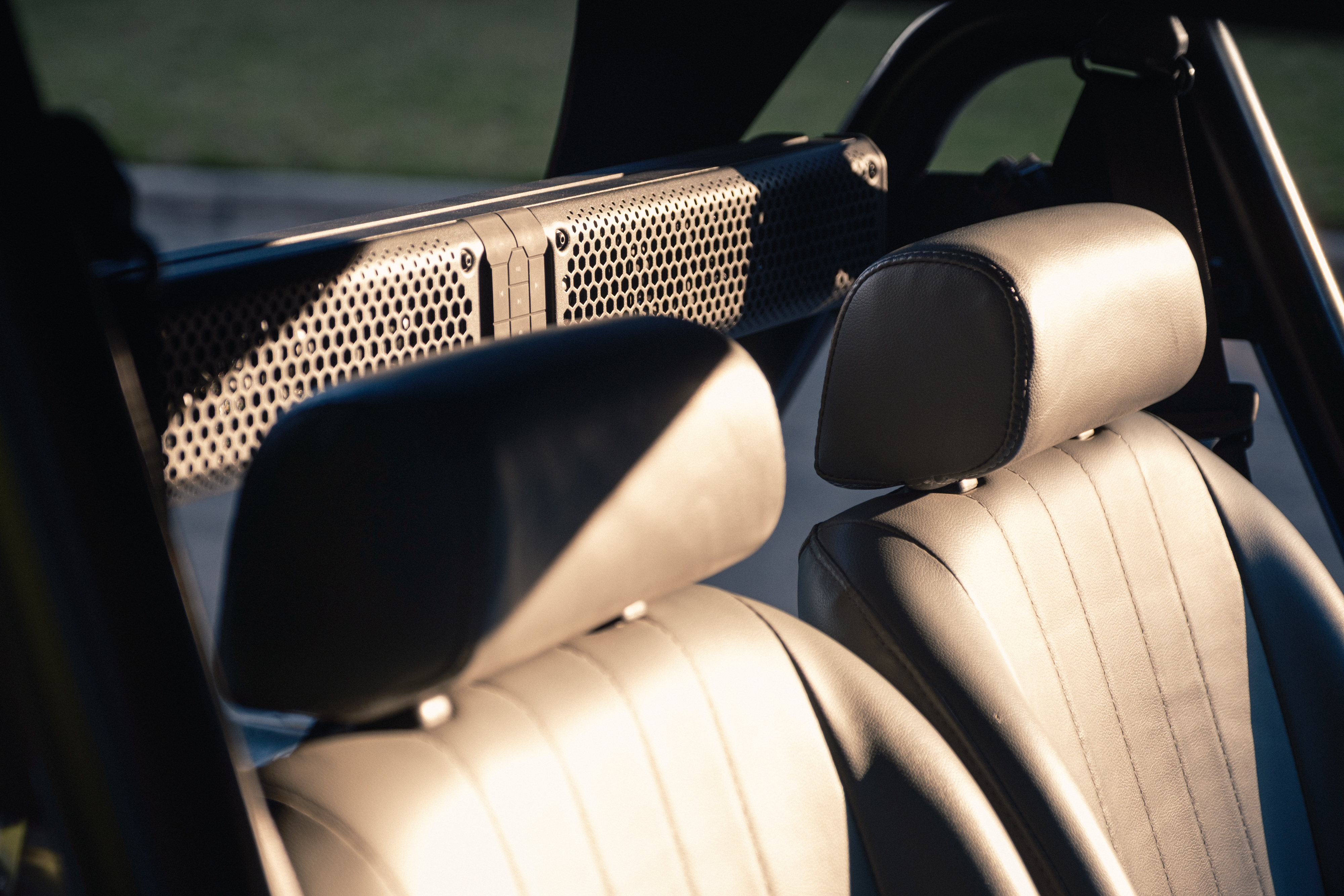
The seat-belt structure. The Super S did not come with a seat-belt hoop the way later Mokes did. We built a tubular stainless one with welded domed caps, three-piece pivots so it folds out of the way for trim service, and a custom-machined boss for the seat-belt threads. The same hoop hides the speaker for the soundbar, which is a weatherproof off-road buggy unit running off Bluetooth. Roof-down at 100 km/h, the Moke and you will be the only ones who hear it.
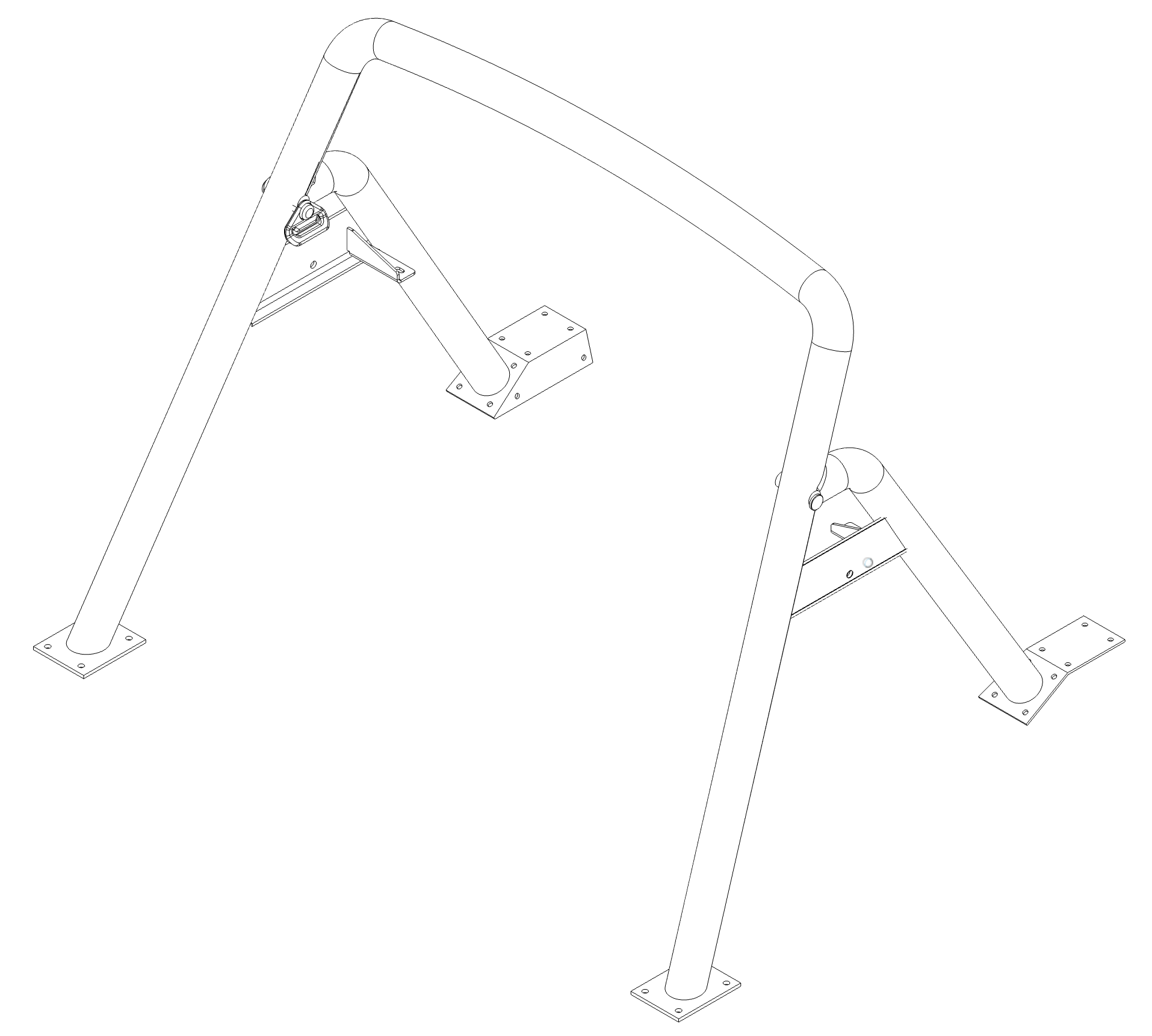
Fusion 360 drawing of the bespoke seatbelt hoop, three-piece hinge pivot, and machined boss
seat-belt-bar.pngSeat-belt hoop assembly

The side screens and trim. Mokes are open cars by design. The side screens are the only weather they get. We rebuilt them with new tensioning, sail-track mounts on the body, and a centre strap so they sit cleanly when the car is parked and only flap a little at high speed. Ninety-eight percent of a Moke's life is slow, so we optimised the look at slow.
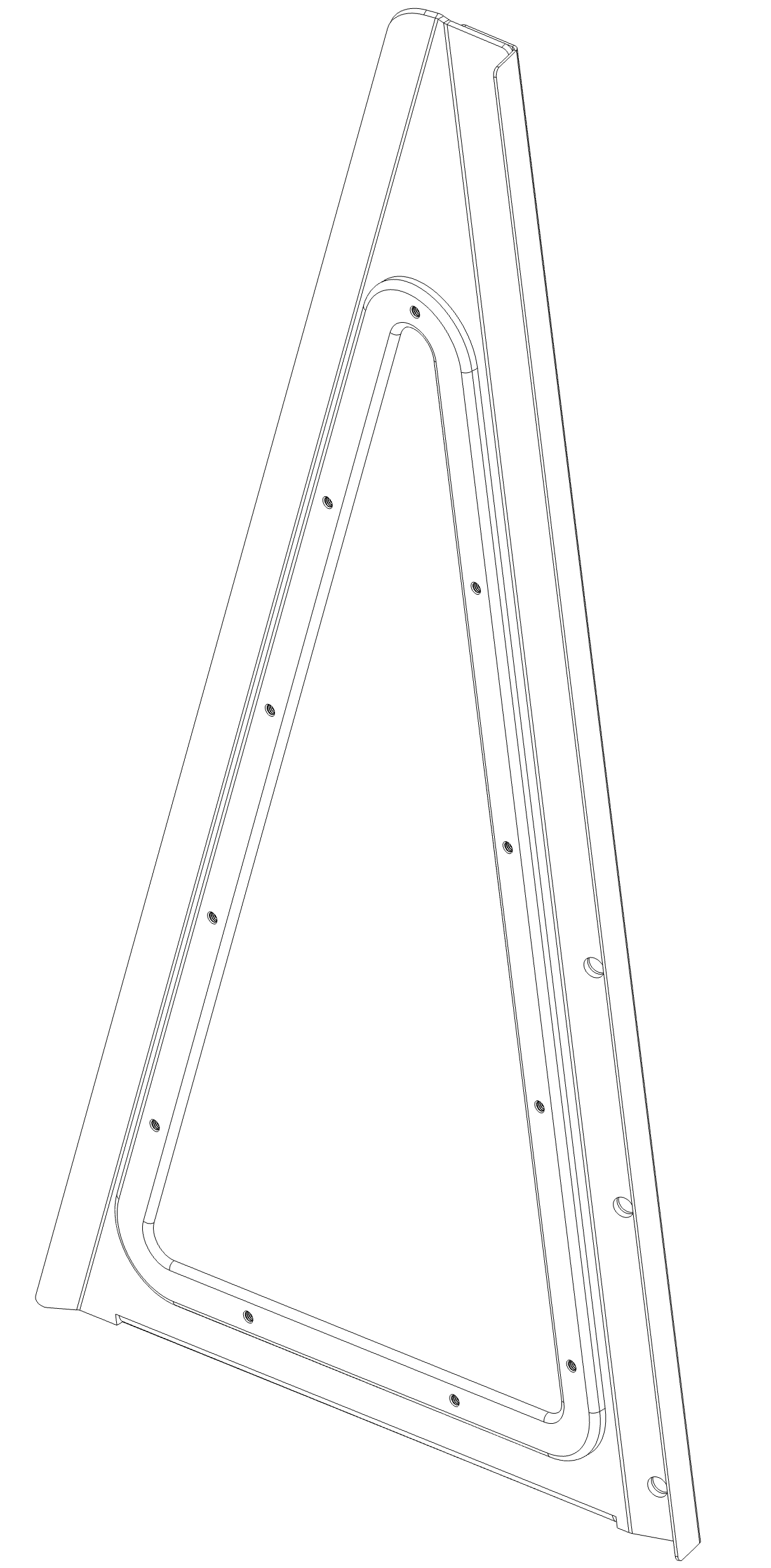
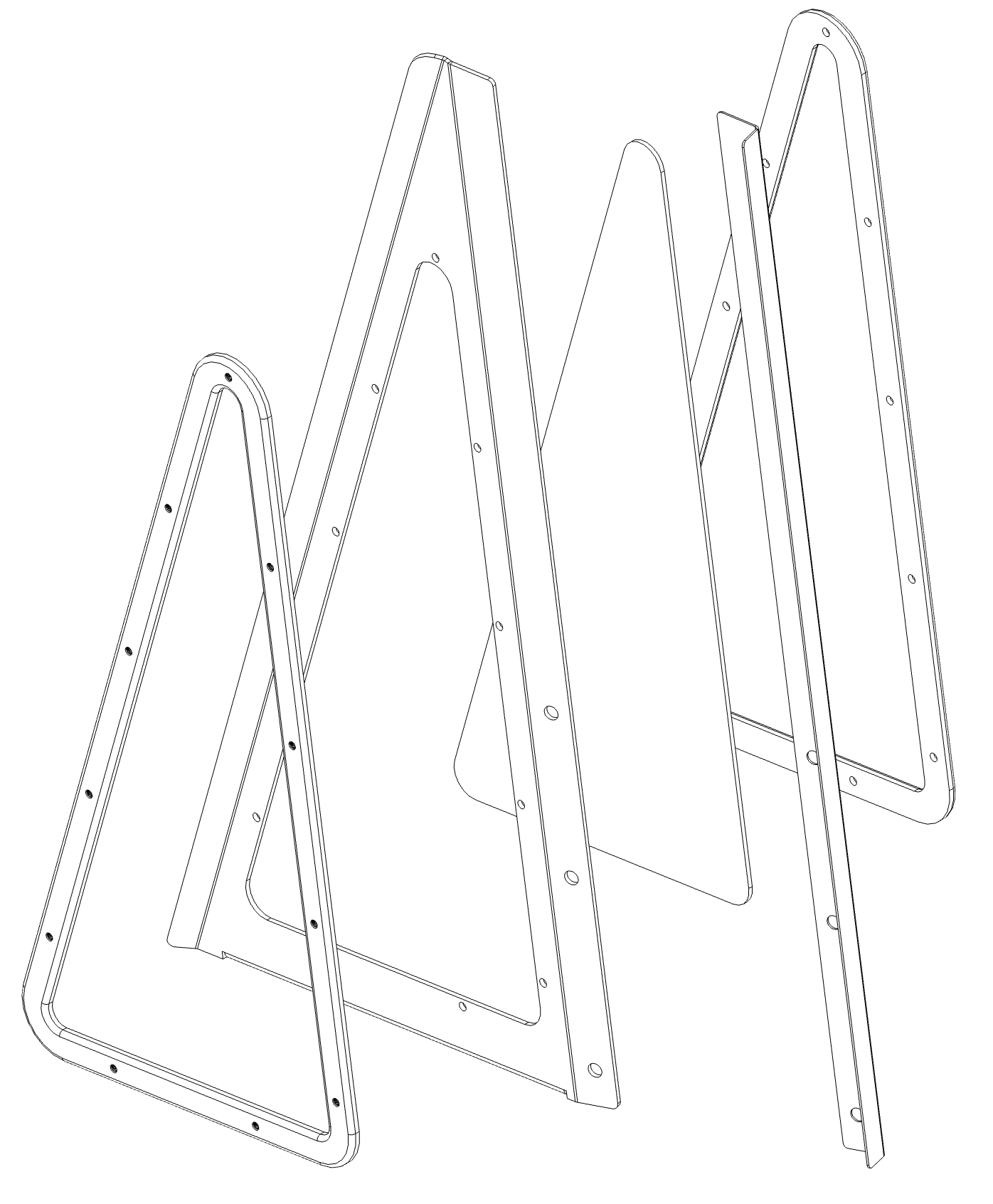
Fusion 360 drawing of the rebuilt side-screen panels
side-screens.pngSide screens, assembled
Exploded view of the side-screen panels showing tensioning and mount components
side-screens-exploded.pngExploded

The body drop. One of us left the workshop for twenty minutes to get coffee. By the time we came back, the entire body had been lifted onto the chassis and bolted down. That is partly because the team is good at this and partly because the unique Super S architecture, with its connected box-section chassis, makes it easier to drop a body onto than a normal Moke would be. The first time you see it back together is the first time you really feel like it is a car again.

Reels from the build

Each placeholder maps to a published episode at instagram.com/jauntmotors/reels. Replace each card with the matching reel embed.
Reel · Episode 01
Lasers
// Centreline establishment
Reel · Episode 07
Back from Polish
// Mirror finish reveal
Reel · Standalone
Bonnet Design
// Hugo's three-piece hinge
Reel · Episode 10
Wiring Upgrade
// Labelled-every-wire loom
Reel · Episode 04
Charge Position
// Pop-up charge port
Reel · Episode 14 + 16
Rear Battery
// Pack fitted to mounting plate
Reel · Episode 15
Seat-belt Mount Boss
// Custom machined thread
Reel · Episode 08
Back Together
// Twenty-minute body drop
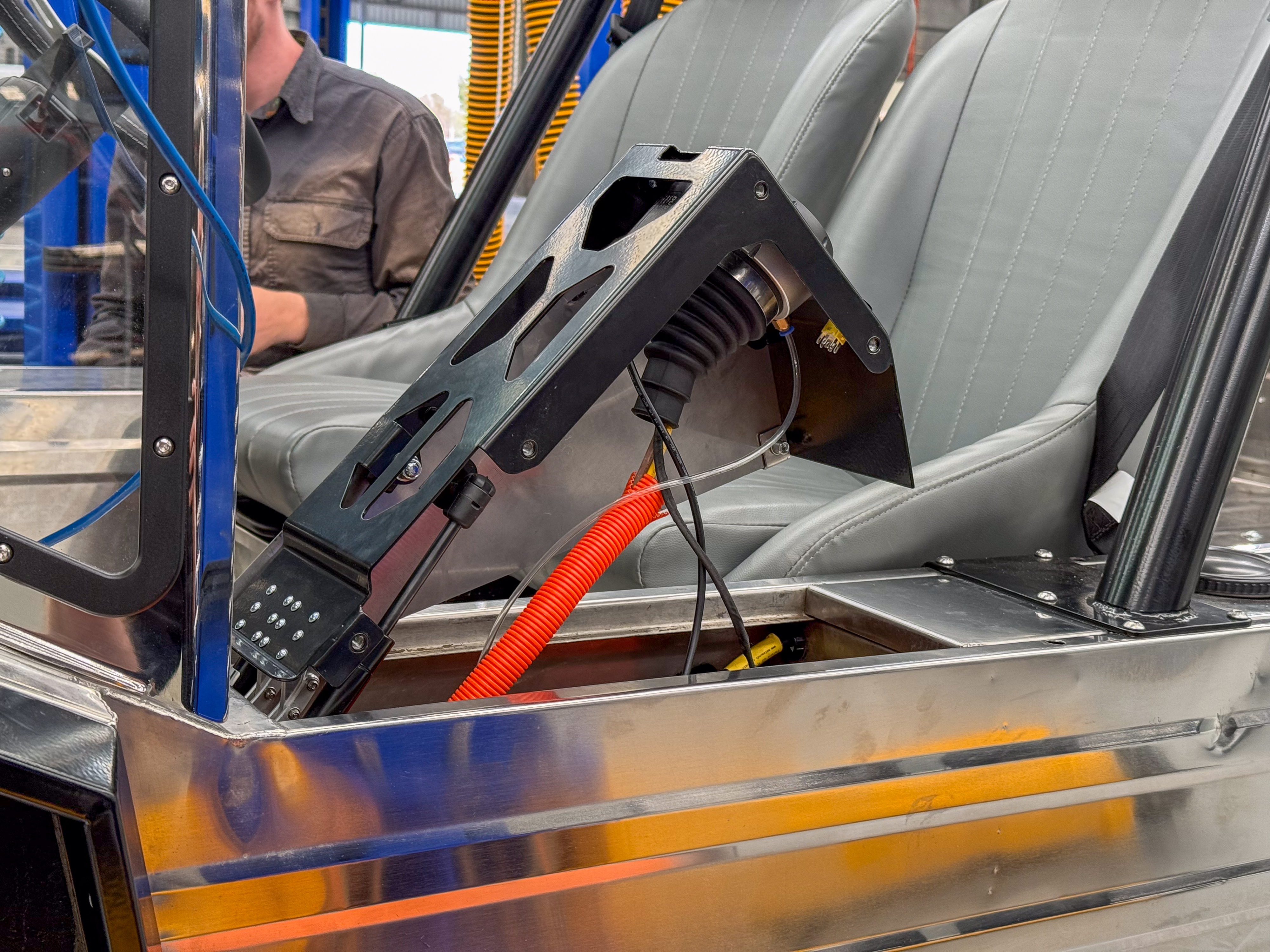
Mid-build interior showing the motor controller bracket bolted between the seats with orange and black wiring partway through installation, hoist arms visible around the body.
Technician's hands fitting the CCS2 charge port module into the side-pod housing during assembly, with blue wiring and the stainless body panel surrounding the work area.
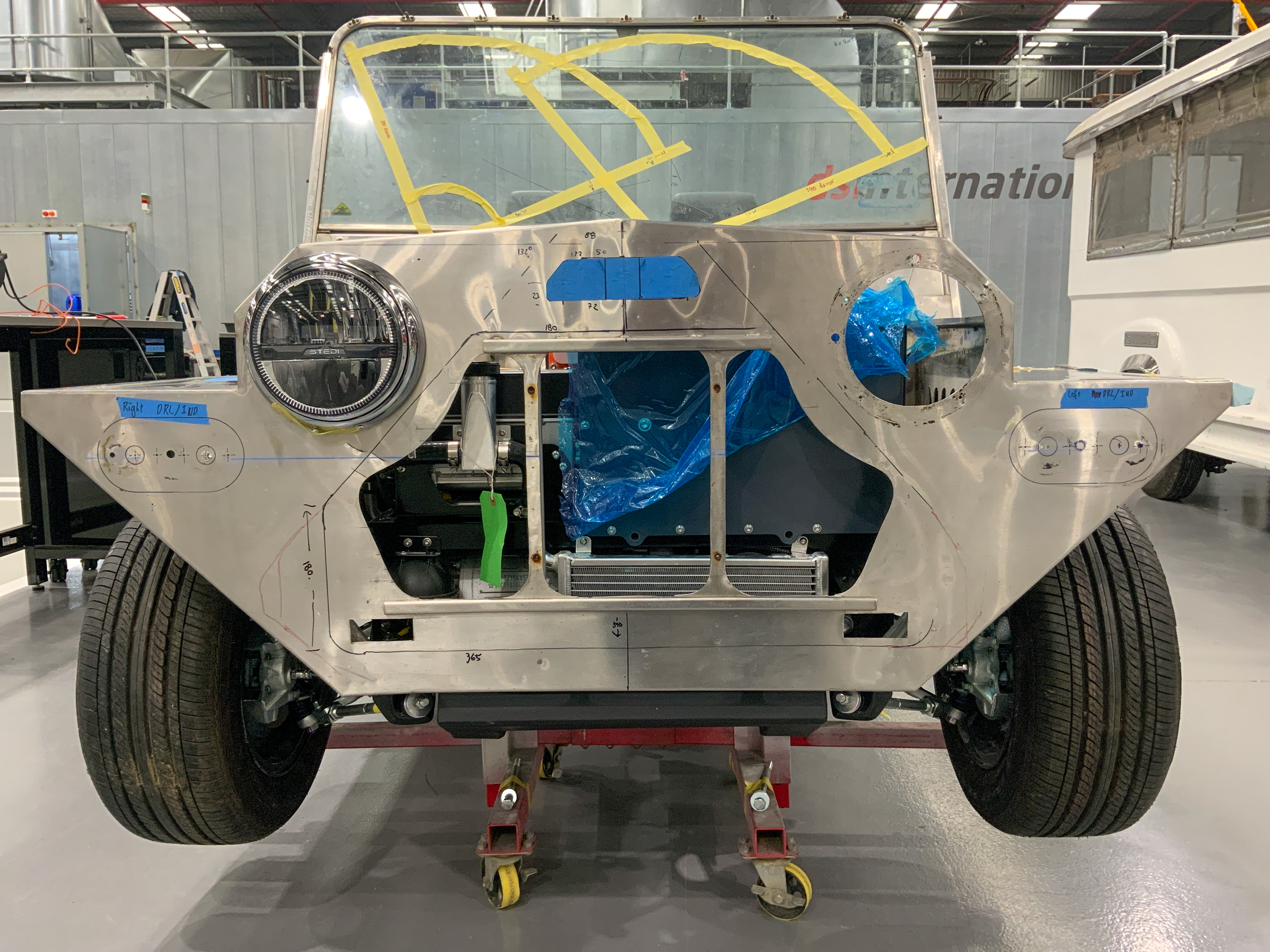
Front-on view of the bare stainless body shell with the battery bay open and protected by blue tape, masked windscreen frame, and builder's layout markings visible.
Rear quarter panel of the stainless body before polishing, showing the raw brushed finish with the rear wheel, arch edge, and tub detail visible.
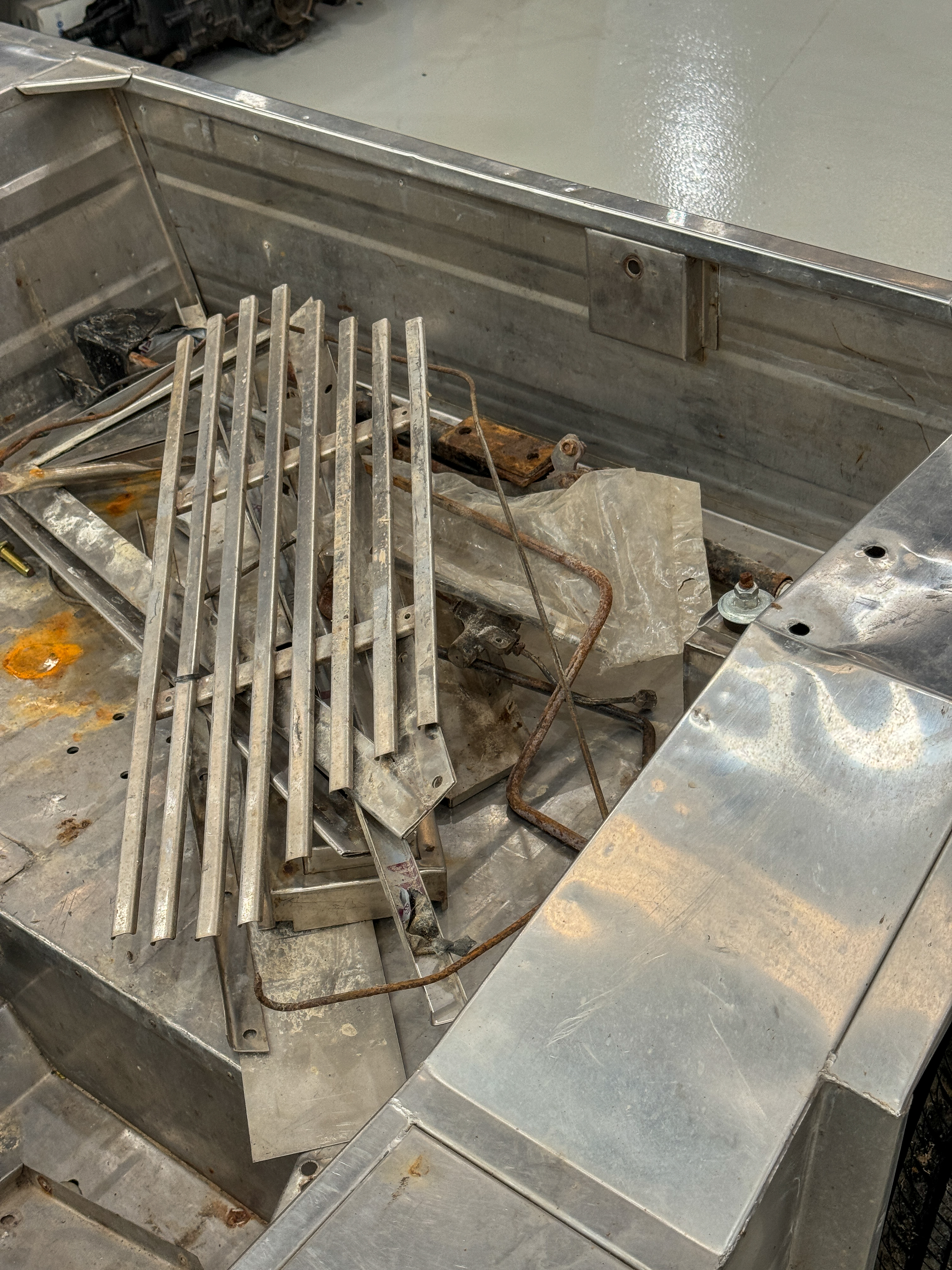
Overhead view of the stripped rear tub with original grille bars and hardware removed and piled inside, showing the raw condition of the body on arrival.
Front view of the partially restored stainless body on its original wheels as it arrived at the Jaunt workshop, with the engine bay open and original lights still in place.
Two technicians work on the bare rolling chassis after the body has been removed, with the subframe on the workshop floor and a hoist gantry overhead.
Close view of the original corroded chassis rail and front suspension components on the bare rolling shell before restoration work began.
Original brake disc and caliper showing heavy surface rust and wear, photographed as part of the pre-build condition assessment before restoration.
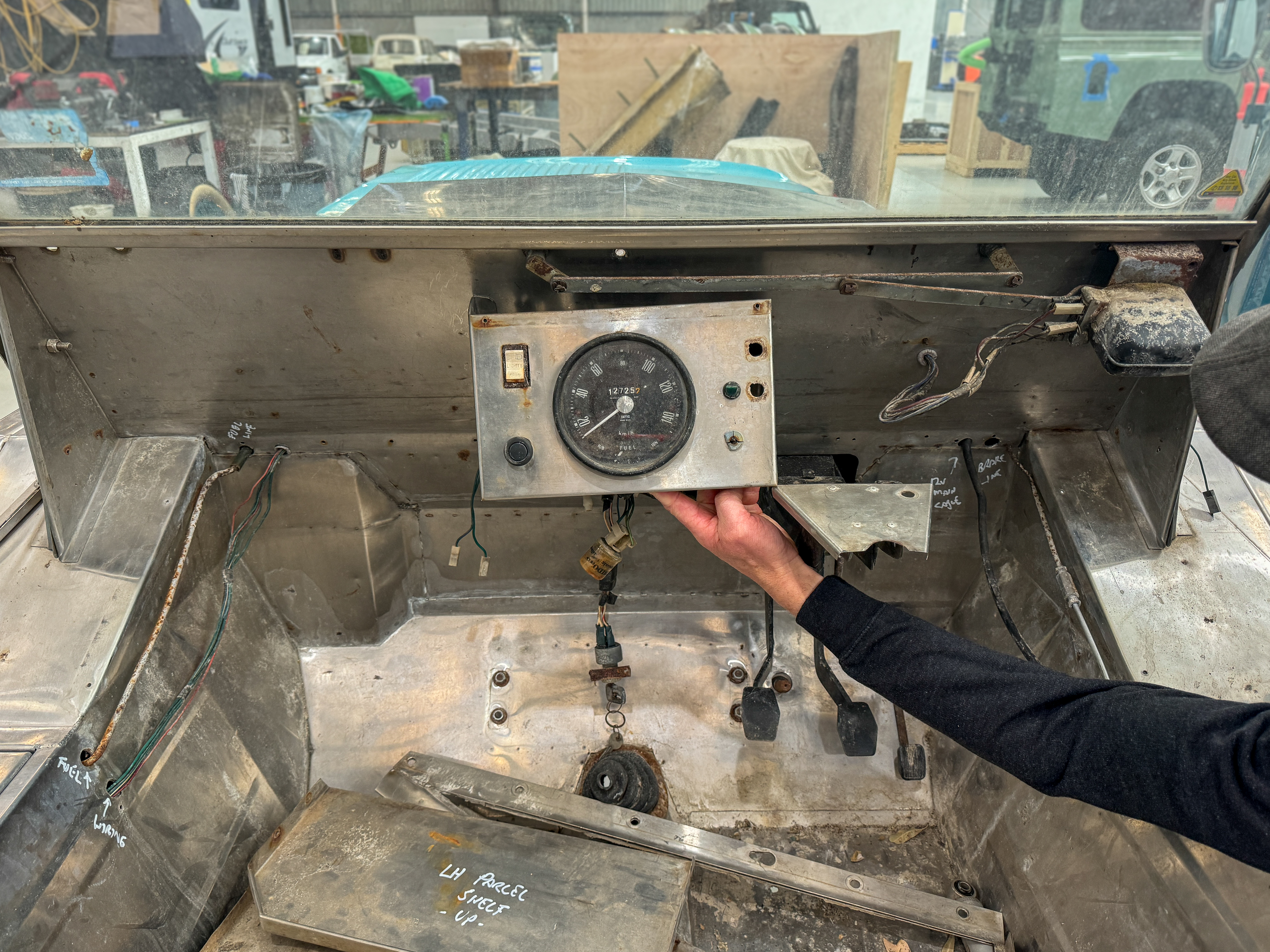
Hand holding the original analogue speedometer cluster against the stripped bare dashboard during the early disassembly phase at the Jaunt workshop.
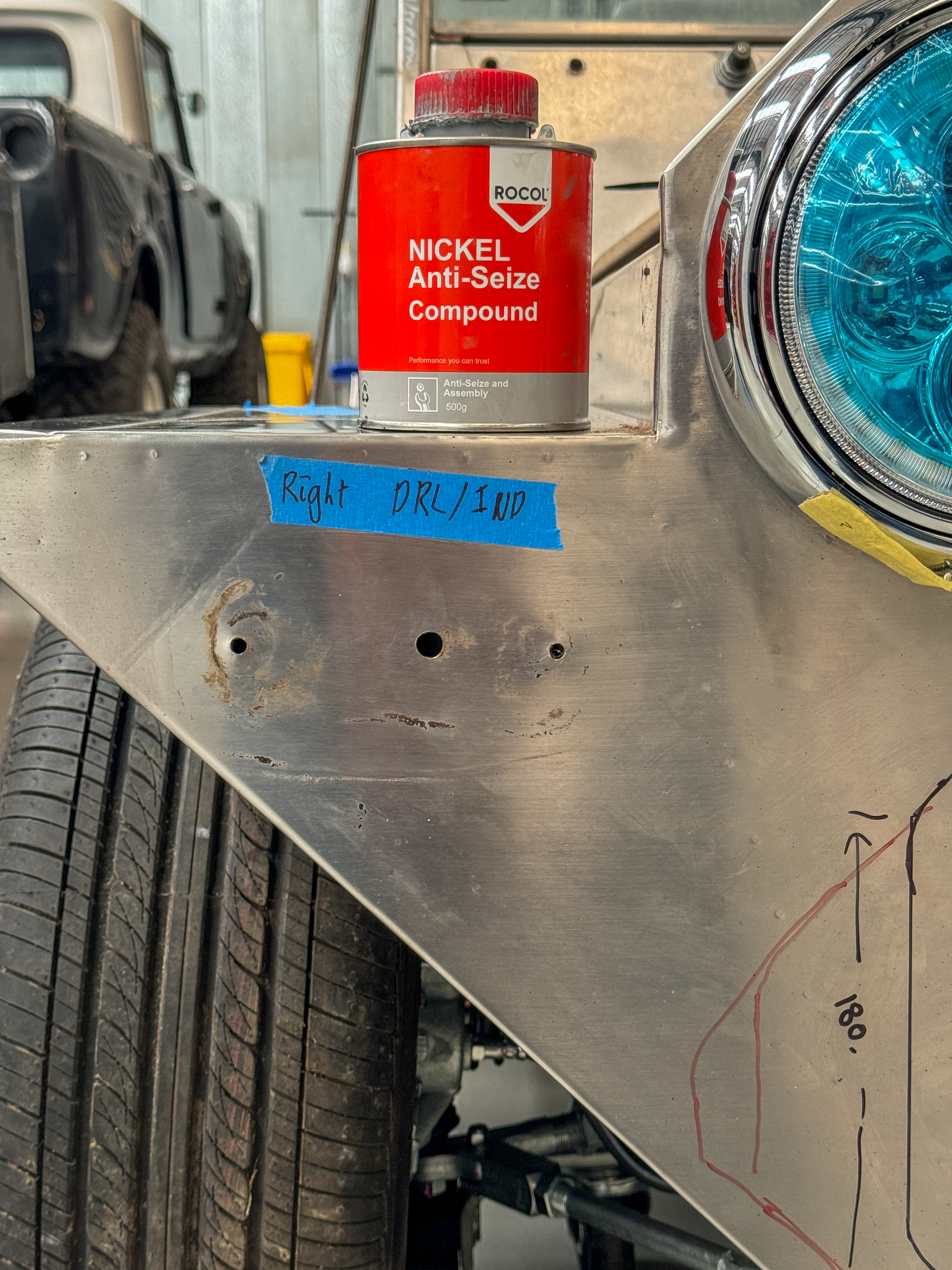
Early-build front panel with DRL and indicator positions marked in pen on masking tape, a teal-lensed headlight fitted and a can of anti-seize compound resting on the guard.
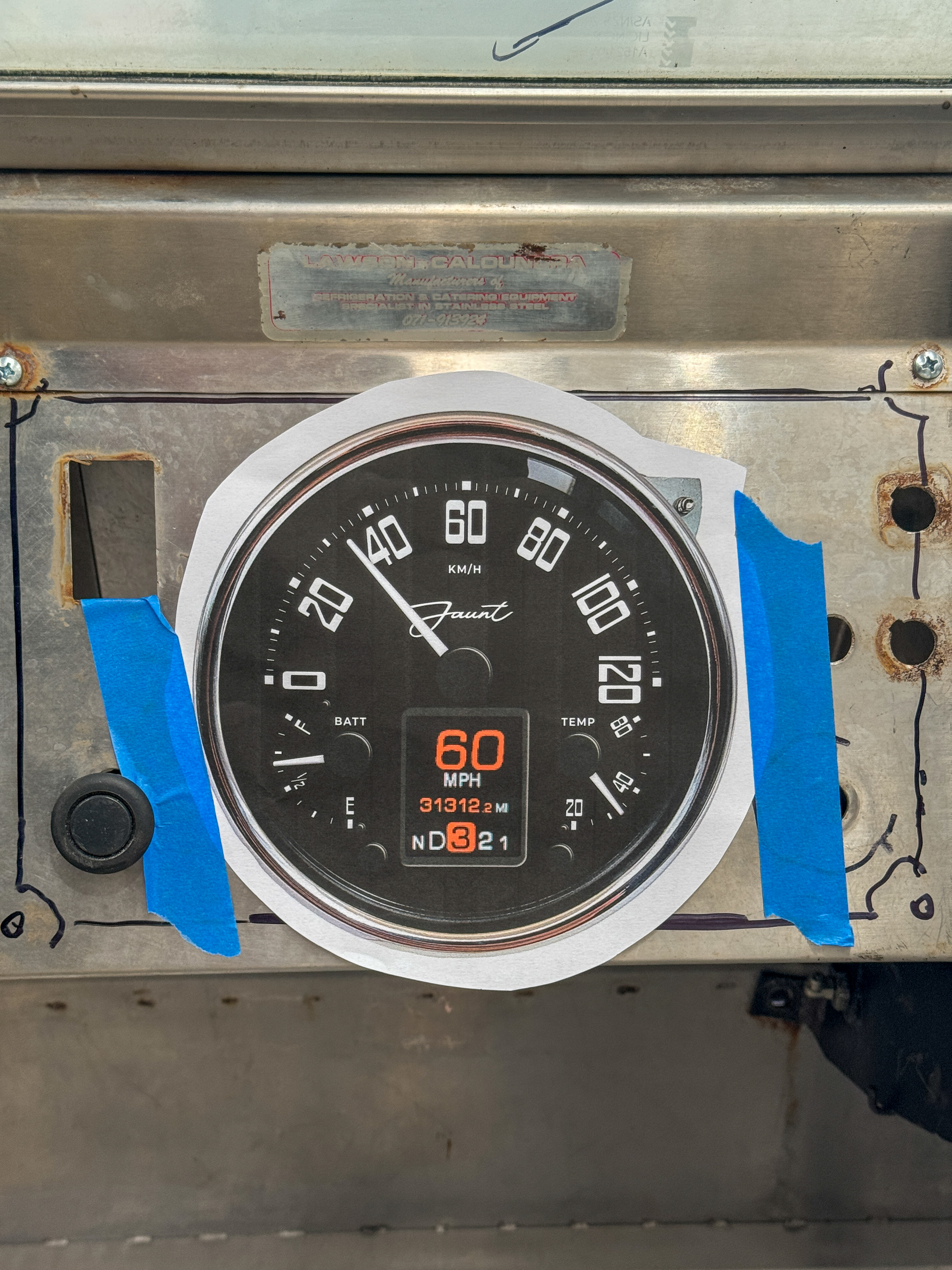
The Jaunt-branded custom speedometer face taped onto the original stainless dashboard panel during design proofing, with the original builder's plate still riveted above.
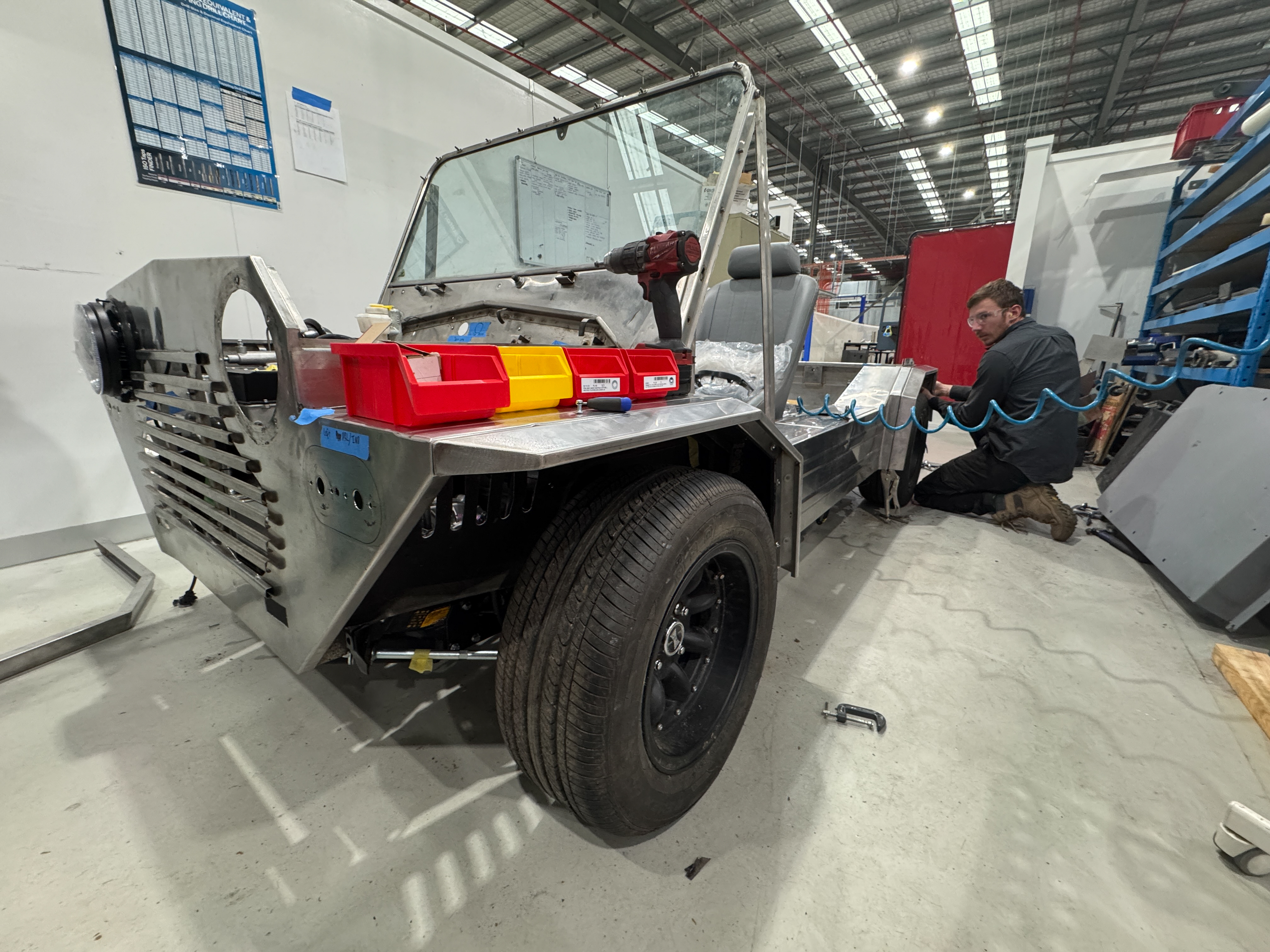
Rear view of the Moke in partial assembly in a smaller workshop, rear taillights taped in position and a technician working at the rear wheel arch.
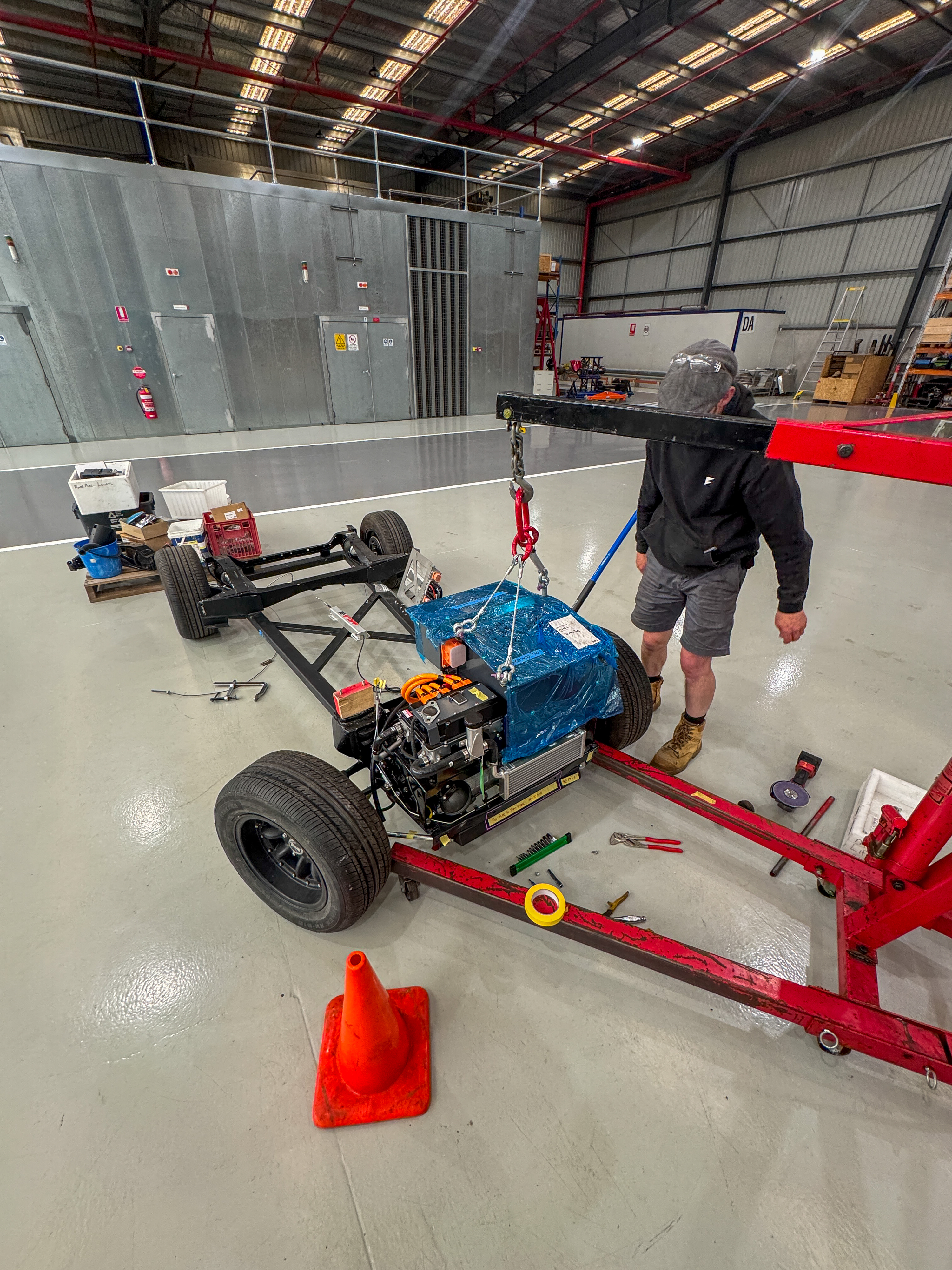
Technician operating a chain hoist to lower the electric motor unit onto the bare rolling chassis in the Jaunt workshop, with a traffic cone and tools on the floor.
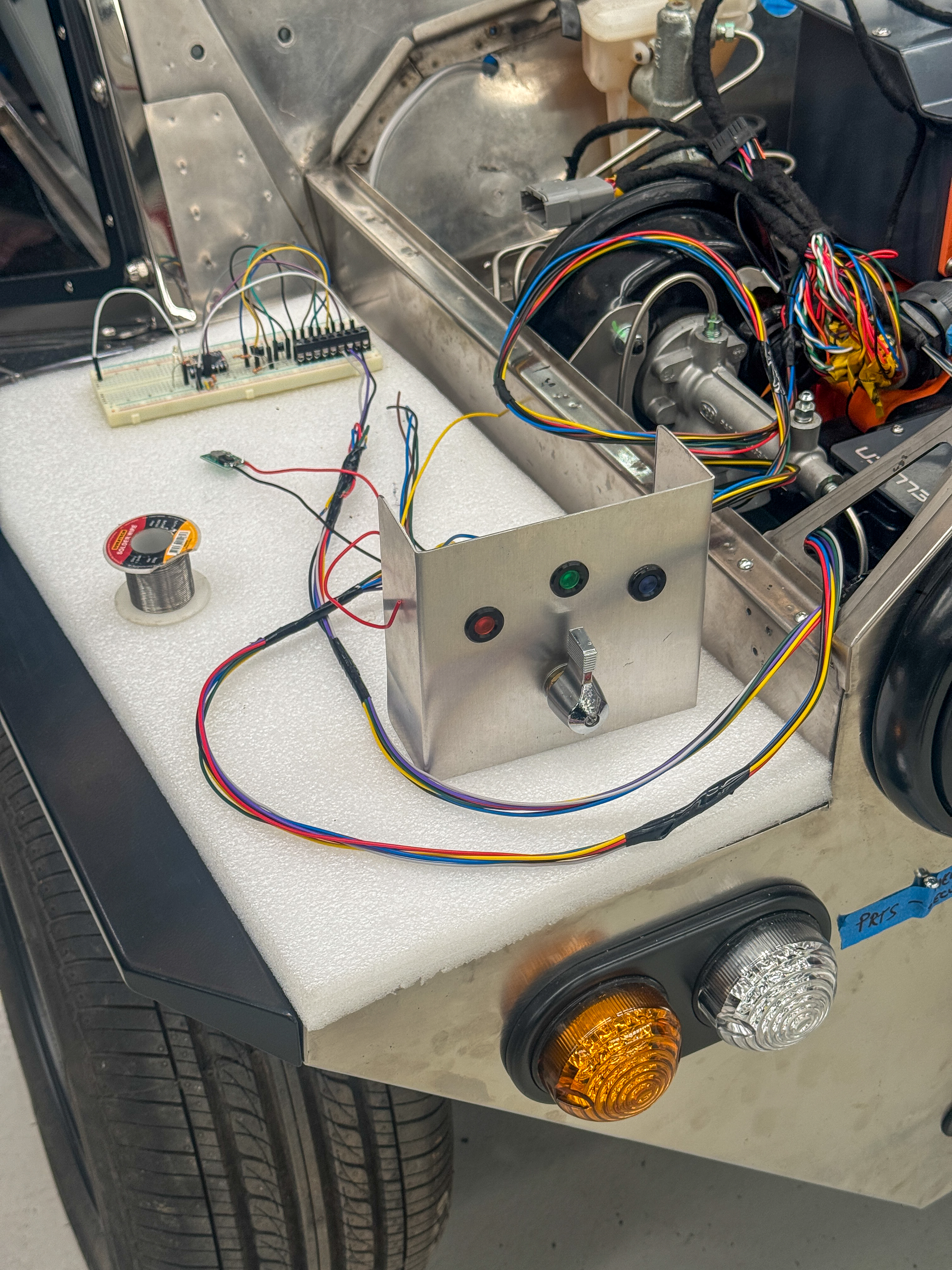
Development wiring loom and breadboard prototype mounted on the rear body panel during electrical system testing, with colourful signal wires and a test switch panel.
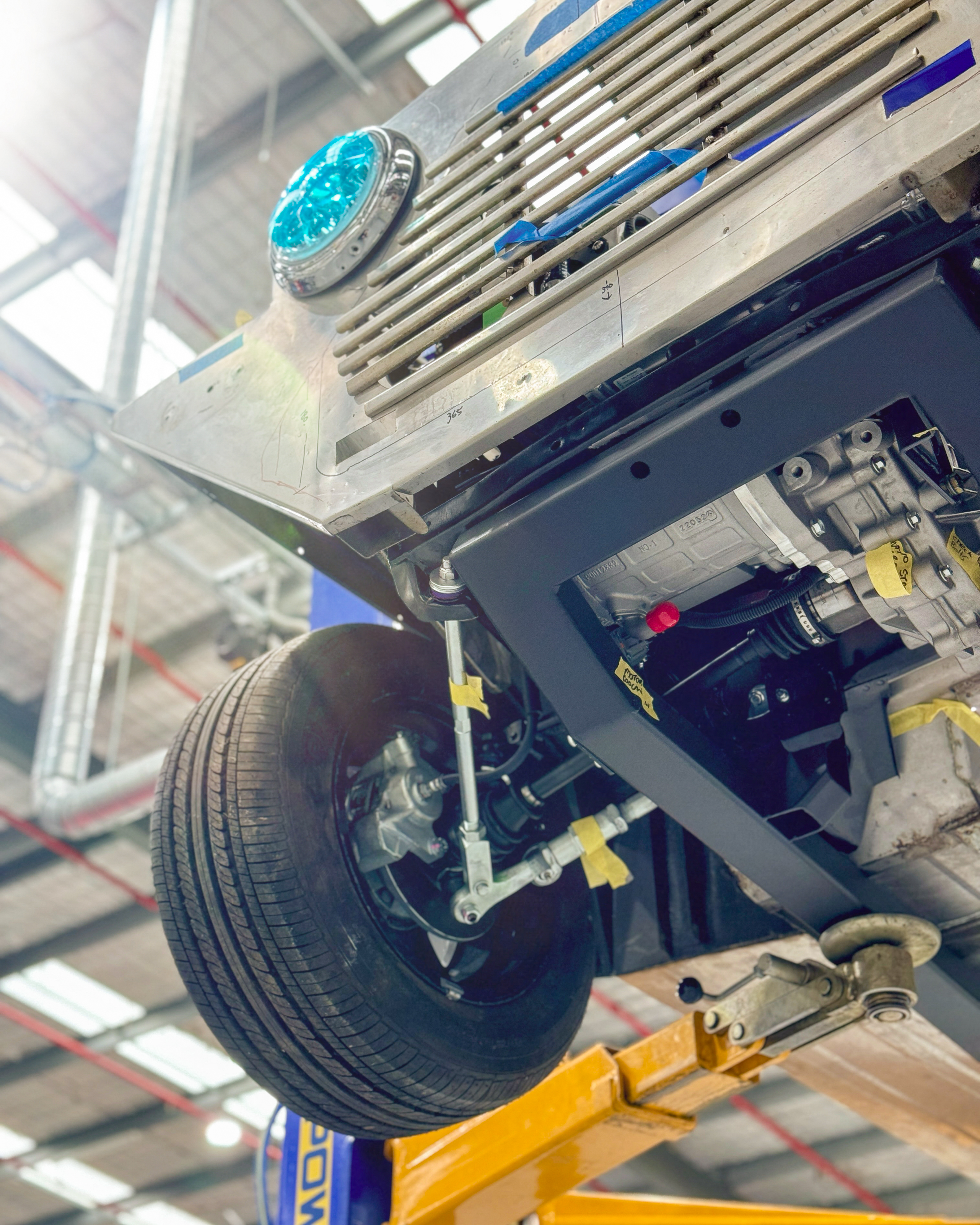
Low-angle view looking up at the front suspension and battery tray from beneath the raised Moke on a hoist, with the headlight visible above and the lift arm in frame.
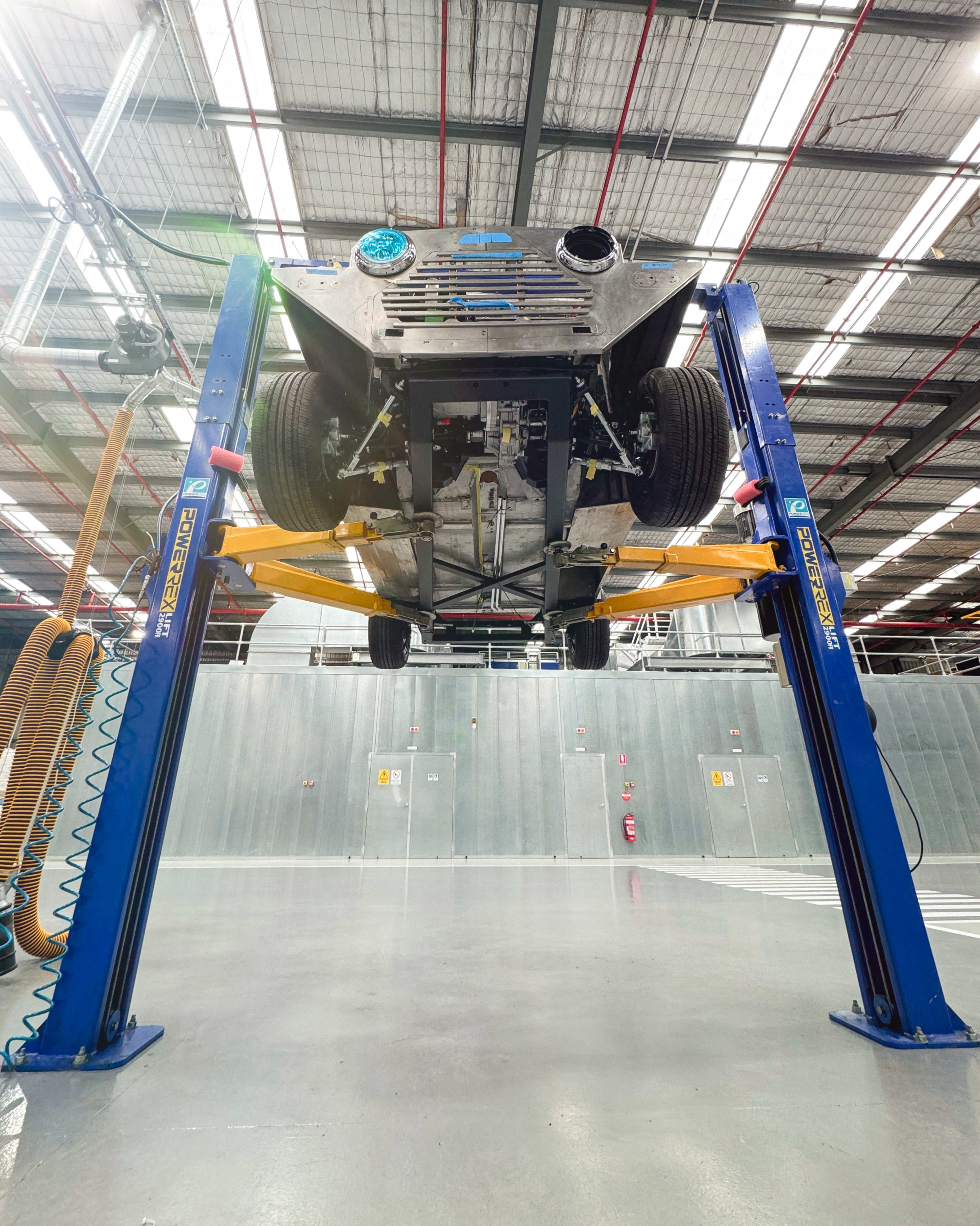
Wide view of the Moke raised on a four-post hoist in the Jaunt workshop, showing the complete underside with battery tray, suspension, and drivetrain from floor level.
Essentially we're working at a scale meaning that is almost a no-cost option to us. Very minimal cost, lots of benefit. We just want to build the cars that we love.
— Dave Budge, on the labelled-every-wire harness
CHAPTER 04
Two power modes. And a red-lit dashboard.

The dashboard runs in two modes. Daily mode is reduced power: smooth, gentle, the kind of tune you actually want when you're crawling along the foreshore at thirty. Sport mode lights the dash up red and unlocks full torque. The car will absolutely embarrass you with the wrong throttle input.

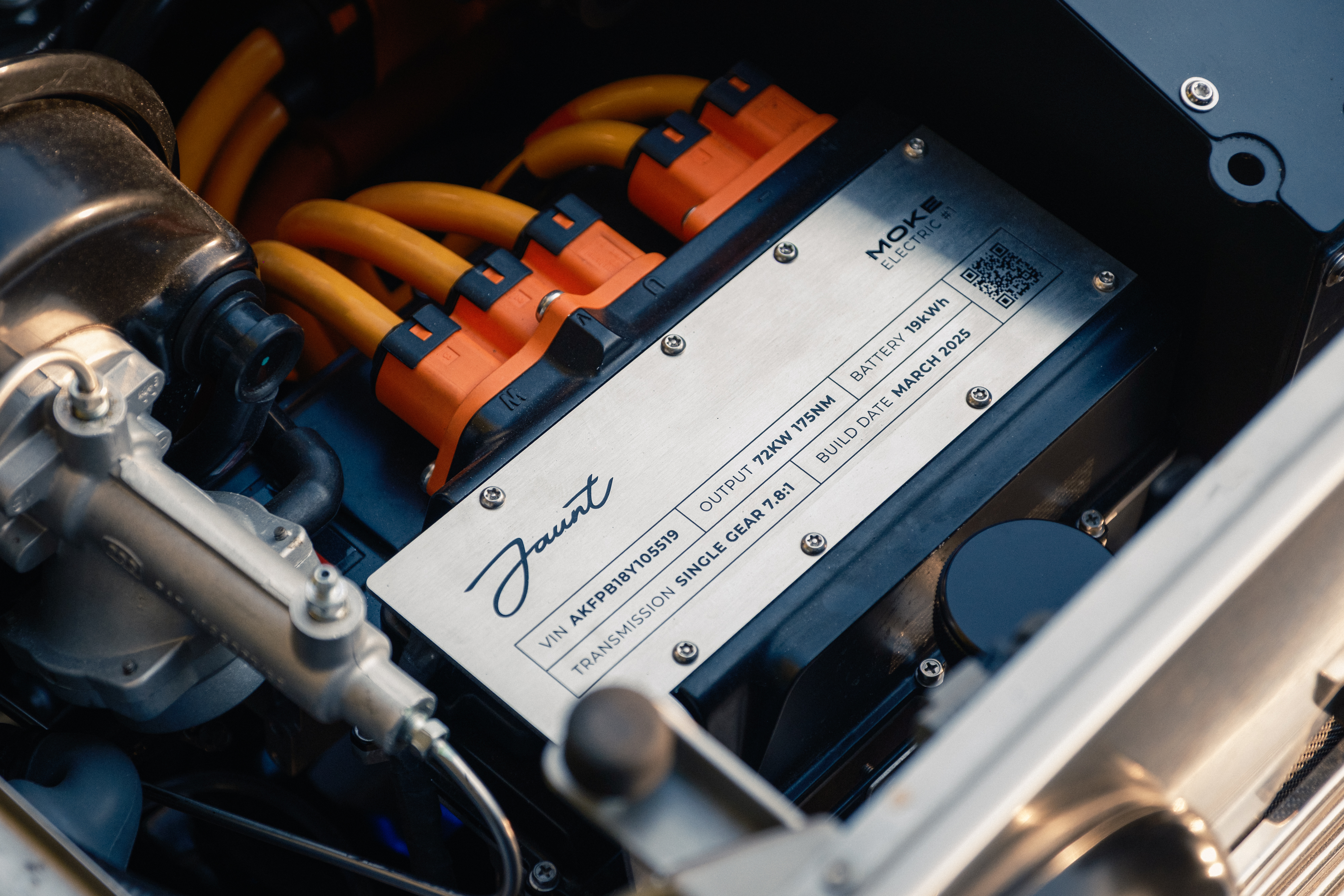
The startup sequence is a small ceremony. Hand brake, key, dash bloom. Under the bonnet sits an ID plaque with the VIN, the output, and the line "Electric Moke #1." The badging on the body uses a CNC-machined Moke wordmark with a lightning bolt anodised black, with the top surface milled back to raw aluminium and clear-coated so the metal pops under any light.

The typeface on the badge is Krana Fat. The same family the Jaunt brand uses. The car carries a quiet signature without ever shouting it.
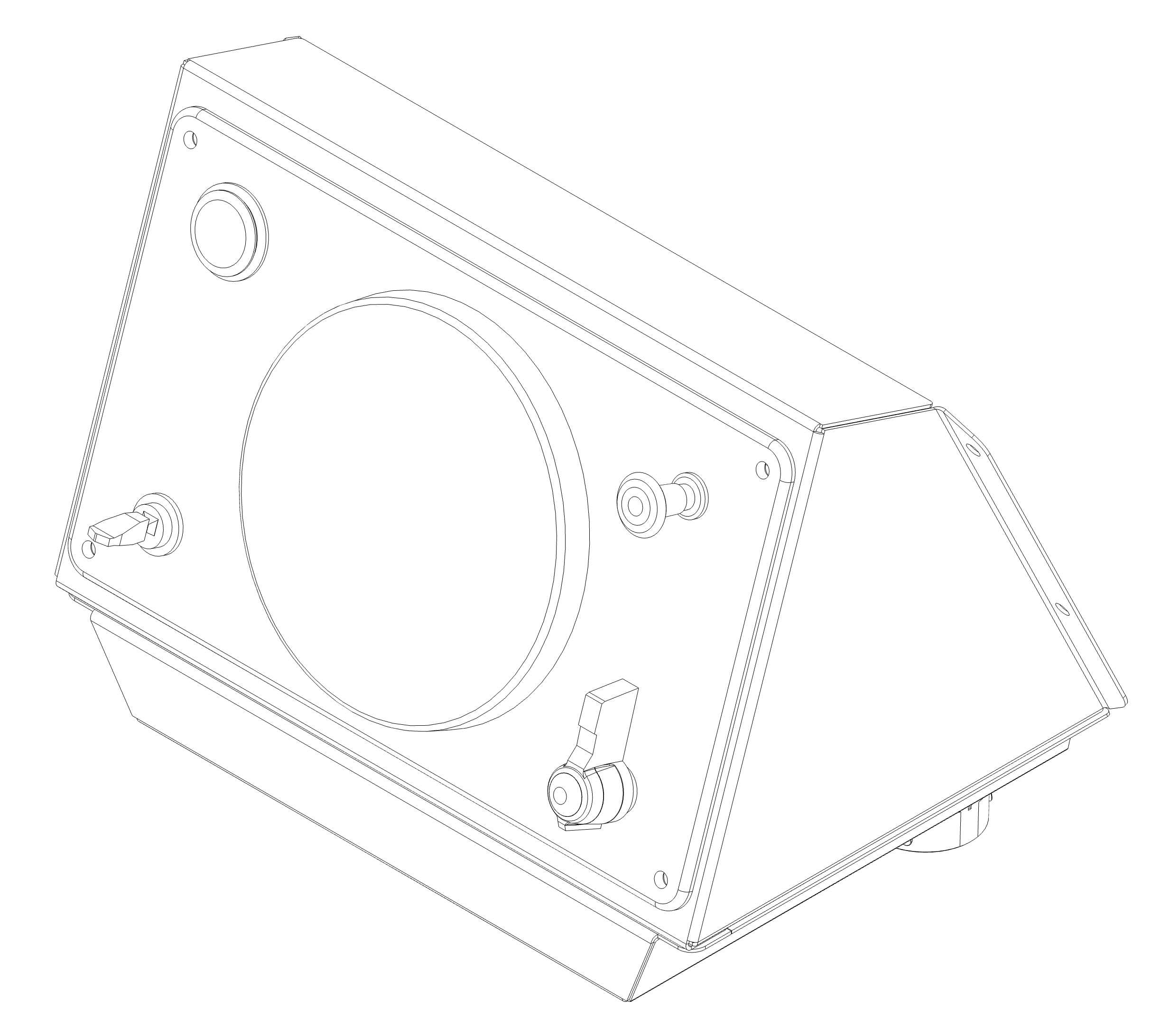
Fusion 360 drawing of the dashboard panel, assembled view
dash.pngAssembled
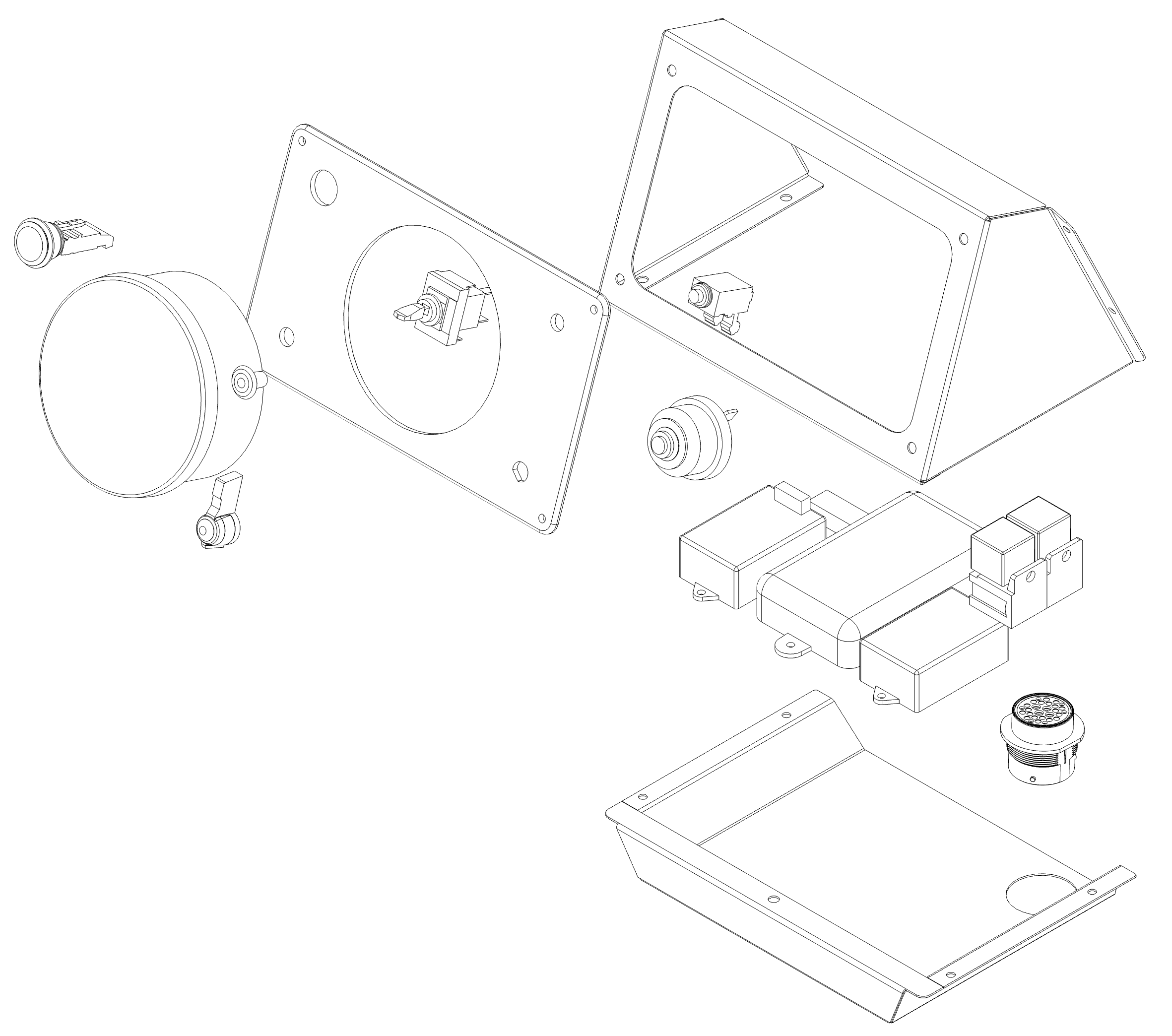
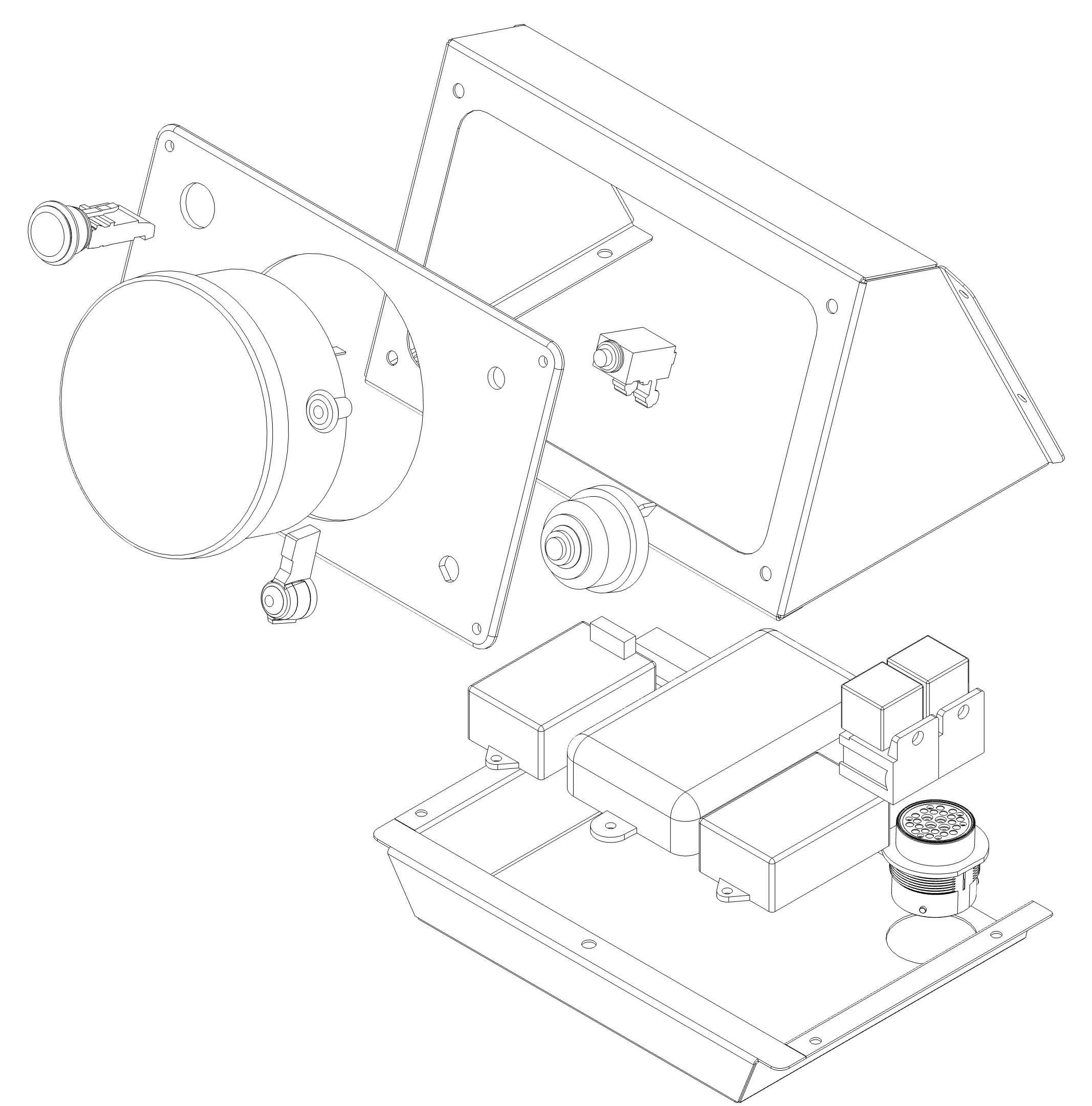
Exploded view of the dashboard showing component layers
dash-exploded.pngExploded
Detailed exploded view of the dashboard with component breakdown
dash-exploded-large.pngDetail breakdown
Reel · Standalone
Dash Assembly
// Cluster + bezel install
Reel · Standalone
Startup Sequence
// Daily vs Sport mode
Reel · Standalone
Hand Brake
// Lever + cable run
CHAPTER 05
Done. Then the cameras came.
First time the polish reads properly under shop lights. The whole object as one thing.
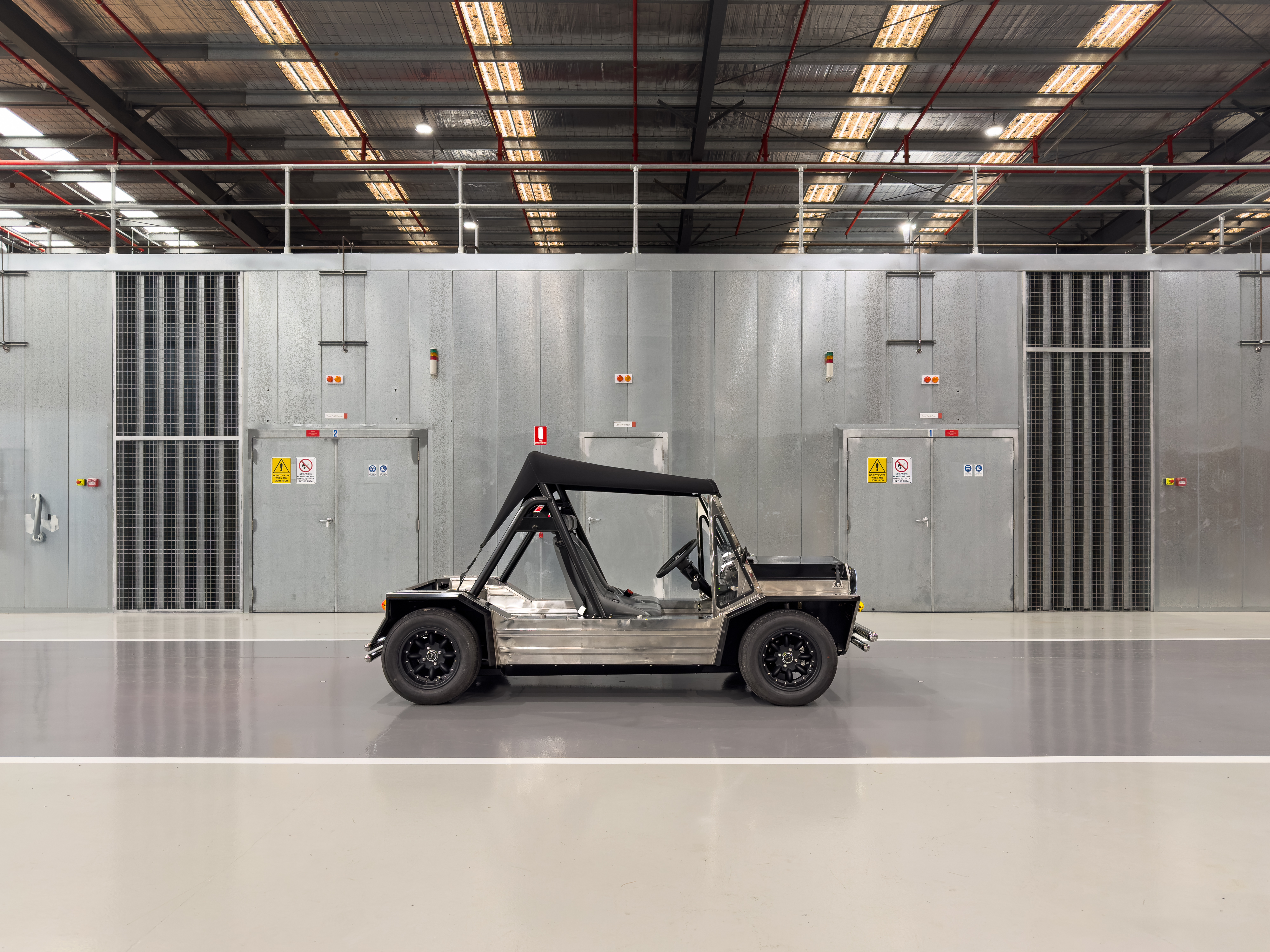
Full side profile of the stainless Moke centred on the factory floor against galvanised electrical cabinet walls, fluorescent lighting overhead.
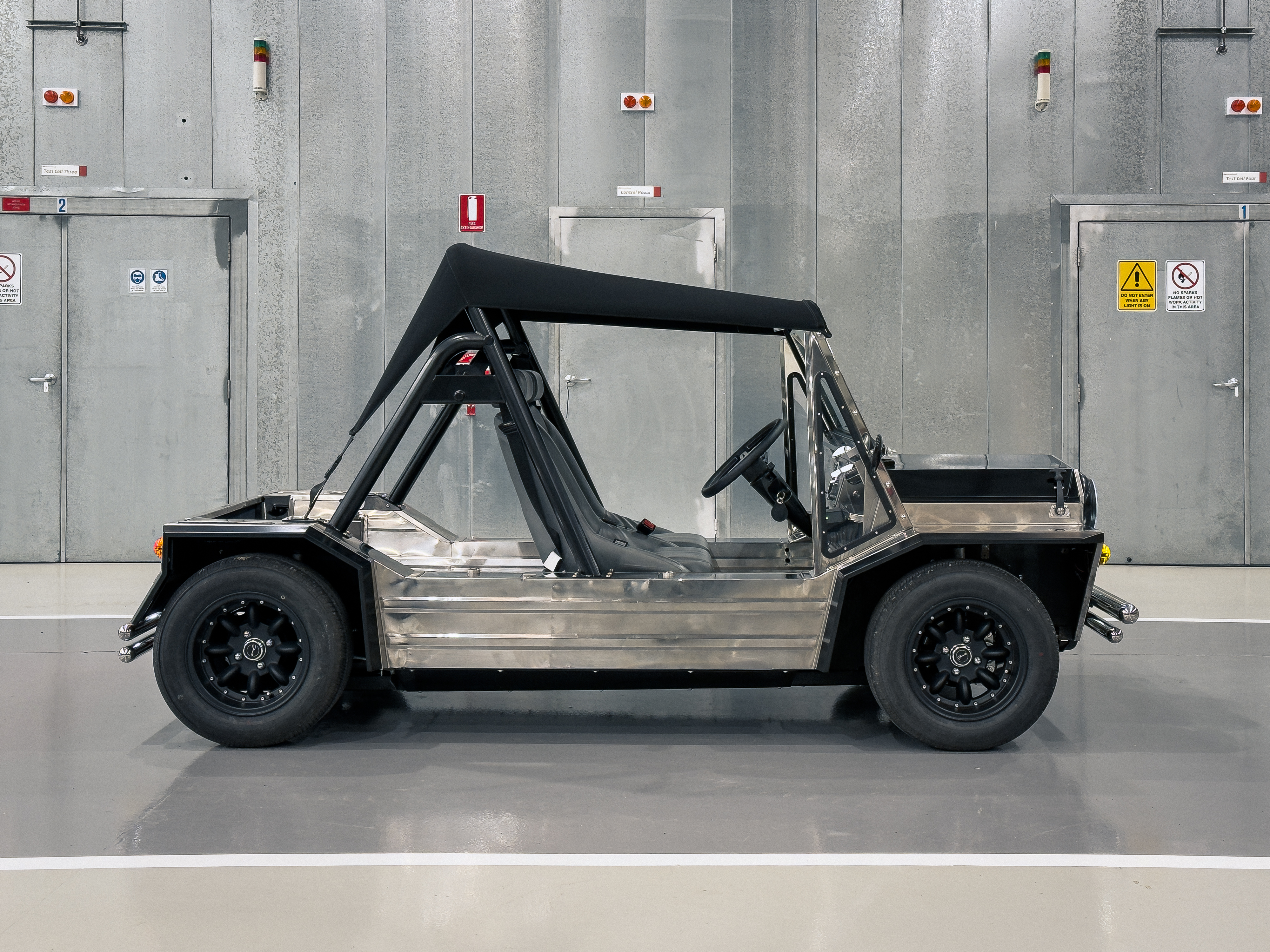
Closer side-profile shot of the completed Moke with canvas top up, showing the polished body and black alloy wheels against the industrial workshop backdrop.
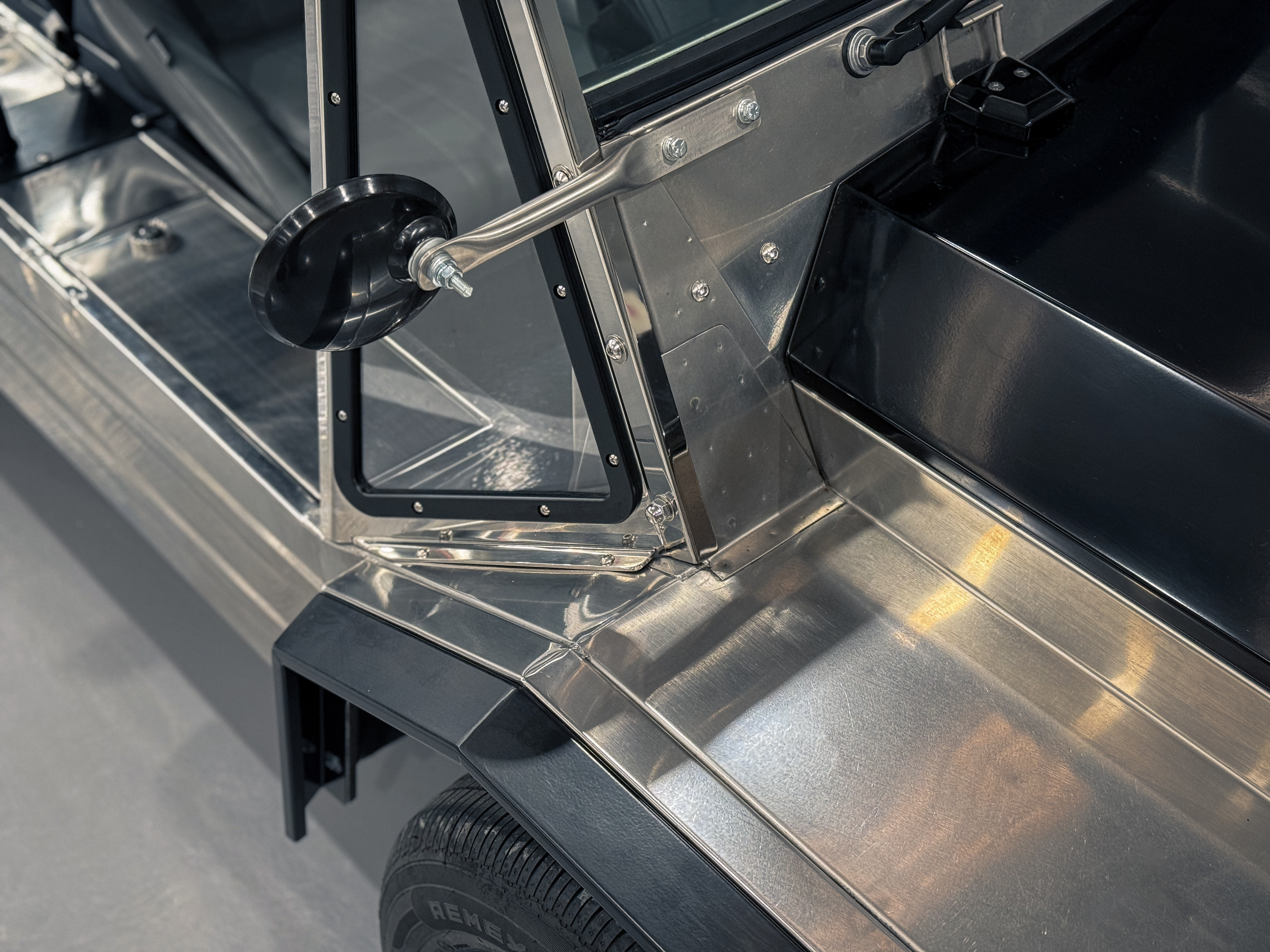
Workshop detail of the windscreen frame, side mirror, and polished stainless door sill and body panel, showing the mirror-finish of the completed body work.
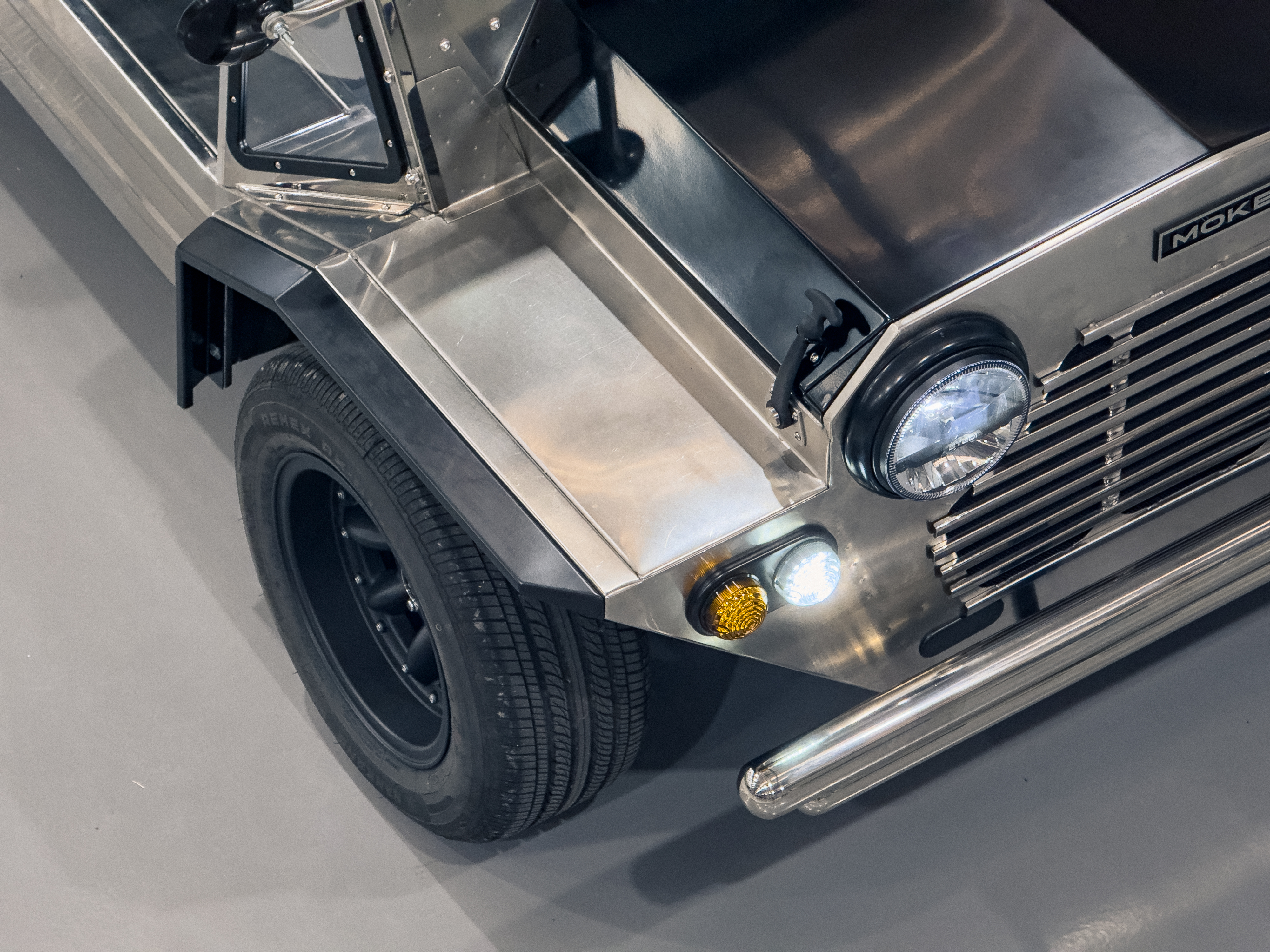
Overhead front-quarter view looking down at the headlight, guard, and indicator all illuminated, the polished stainless panels reflecting the workshop floor.
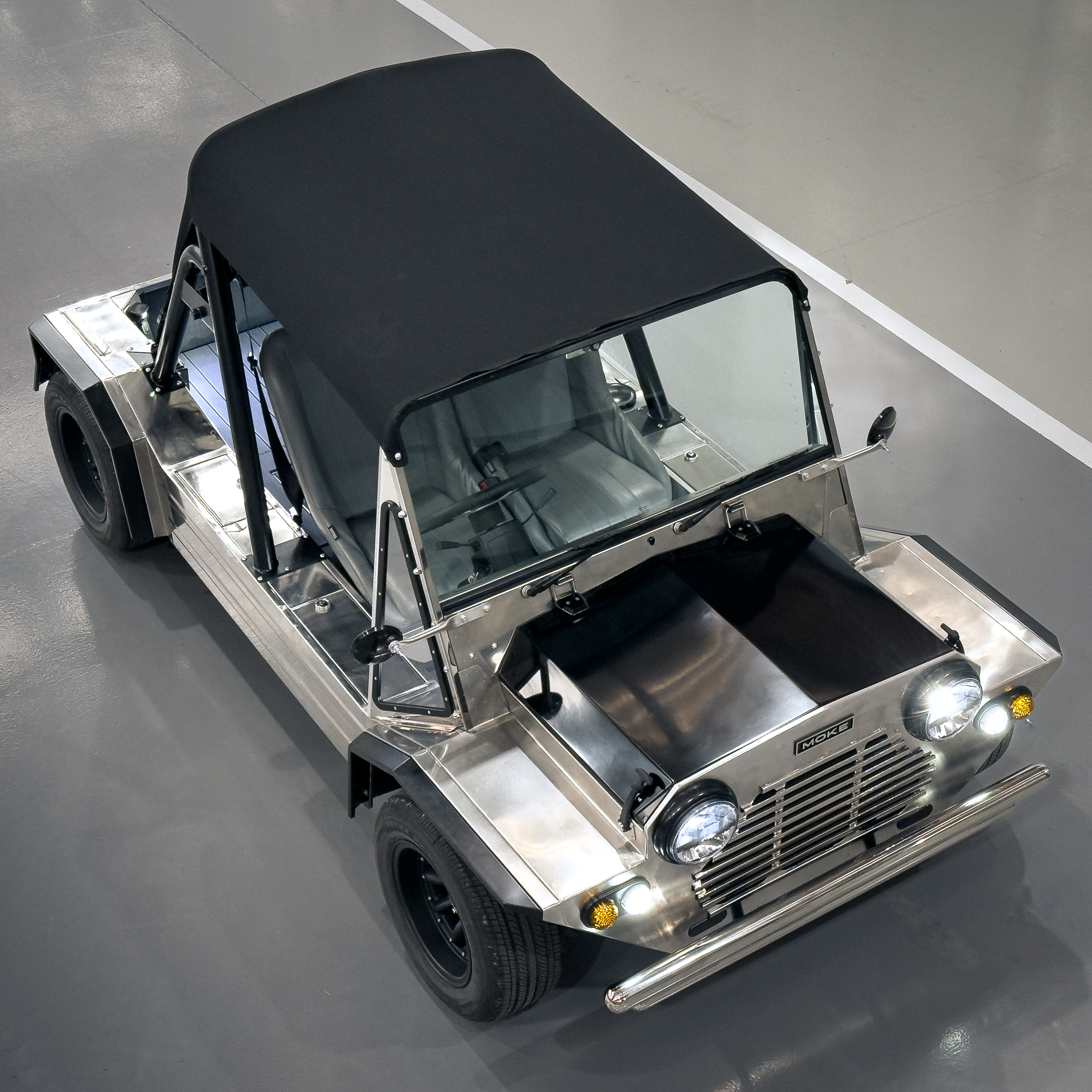
High overhead three-quarter front view of the Moke on the workshop floor with headlights and indicators on, showing the full black canvas roof and polished body.
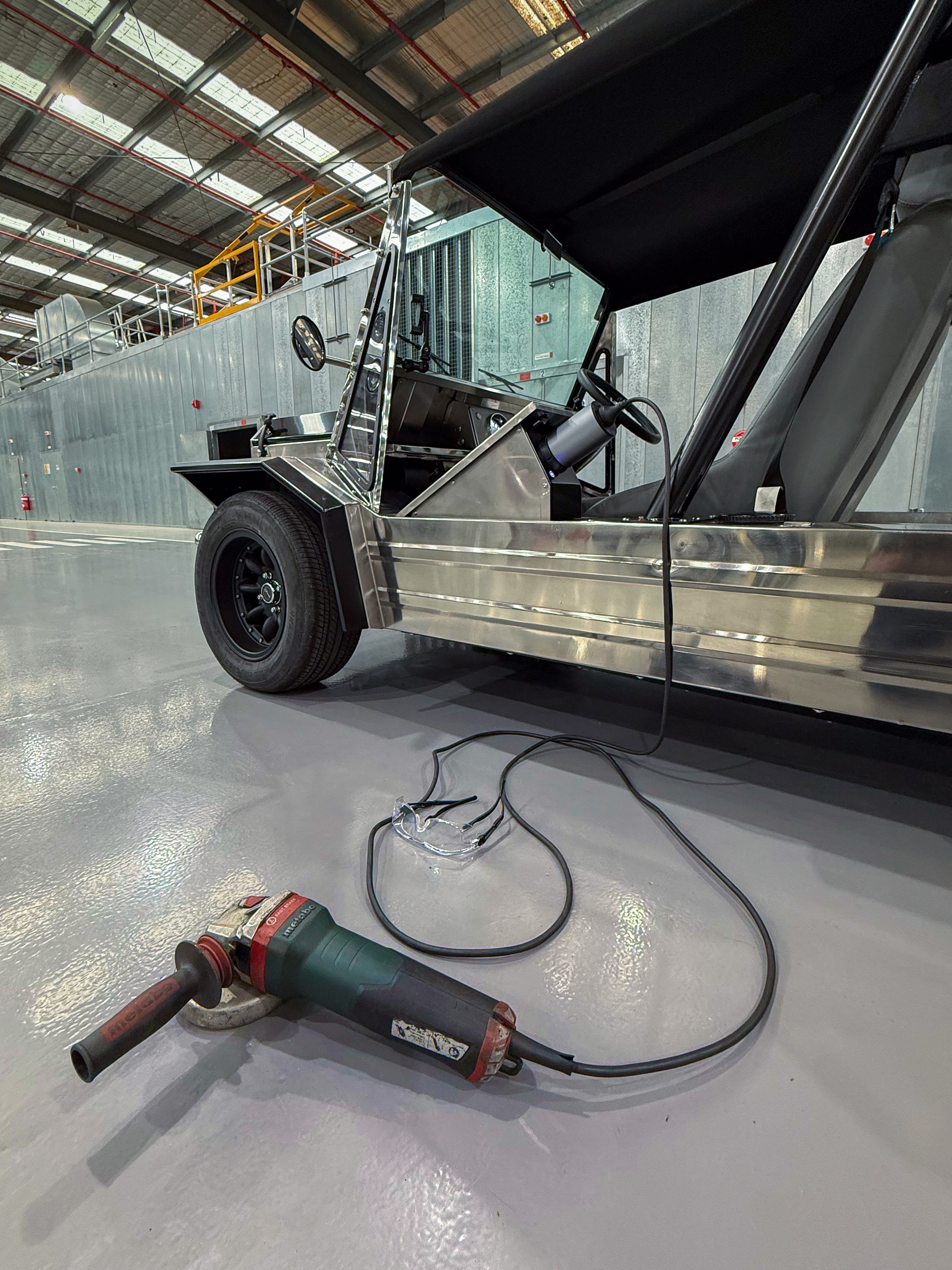
Rear three-quarter workshop view with an angle grinder resting on the floor in the foreground, the stainless body and canvas top visible behind it.
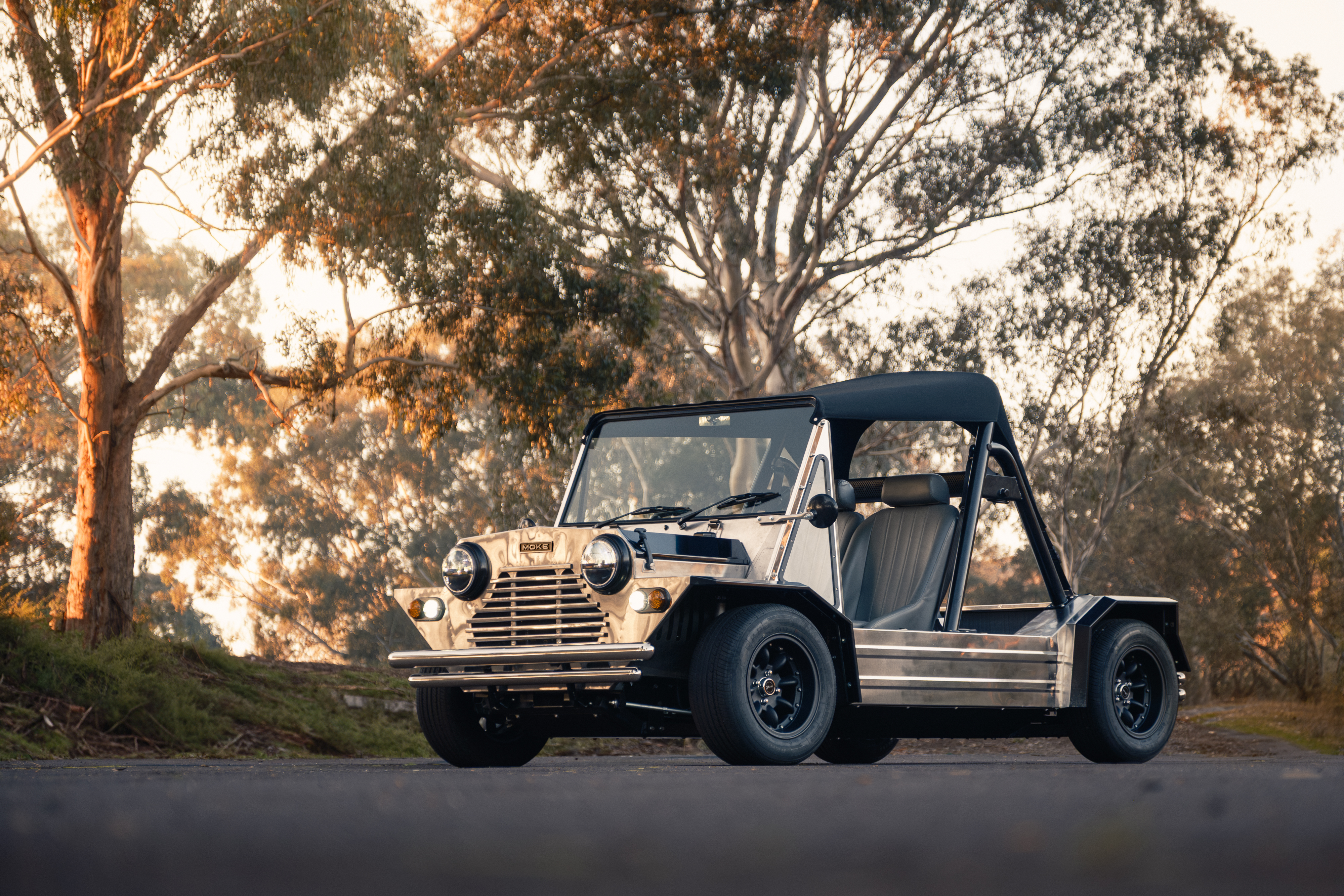
Three-quarter front view of the stainless Moke parked on a bush road, with tall eucalyptus trees glowing in the golden hour light behind it.
CHAPTER 06
Built for the beach. Pulled off into the bush.
An eighty-something Queensland coastal car among Australian ironbarks. The mirror finish picks up the dust, the late light, every leaf moving above it.
Reel · Hero shoot
Bush
// Add IG reel for the bush shoot here
Jaunt build placard inside the electric drivetrain bay showing VIN, 72kW output, 19kWh battery, and March 2025 build date, with orange high-voltage cables above.
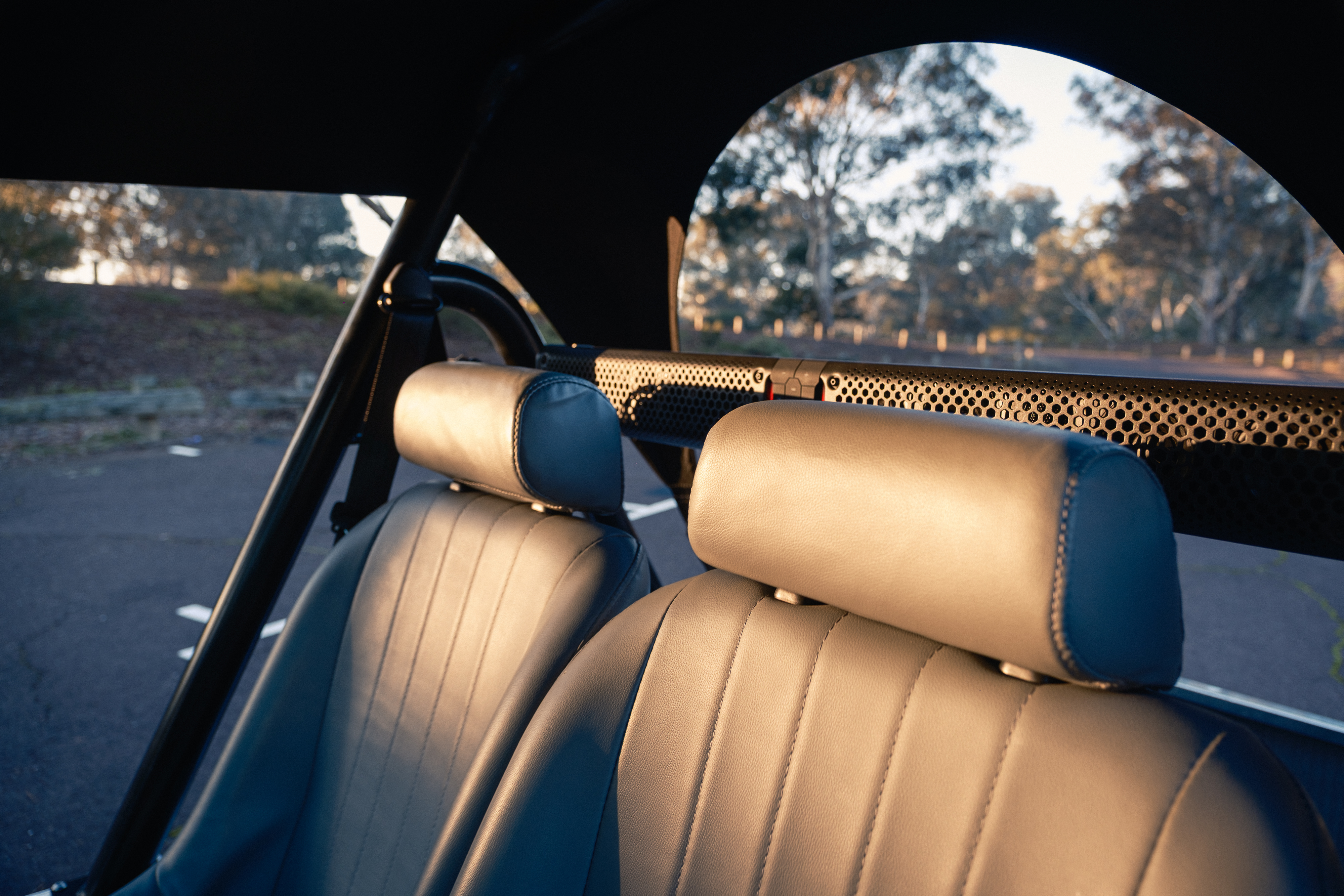
Close detail of the perforated stainless speaker grille integrated into the black tubular seat-belt hoop, with cream leather headrests in warm afternoon light.
CCS2 fast-charge port revealed behind an open side-pod storage lid, showing the brushed stainless housing and a small illuminated charge-status indicator below.
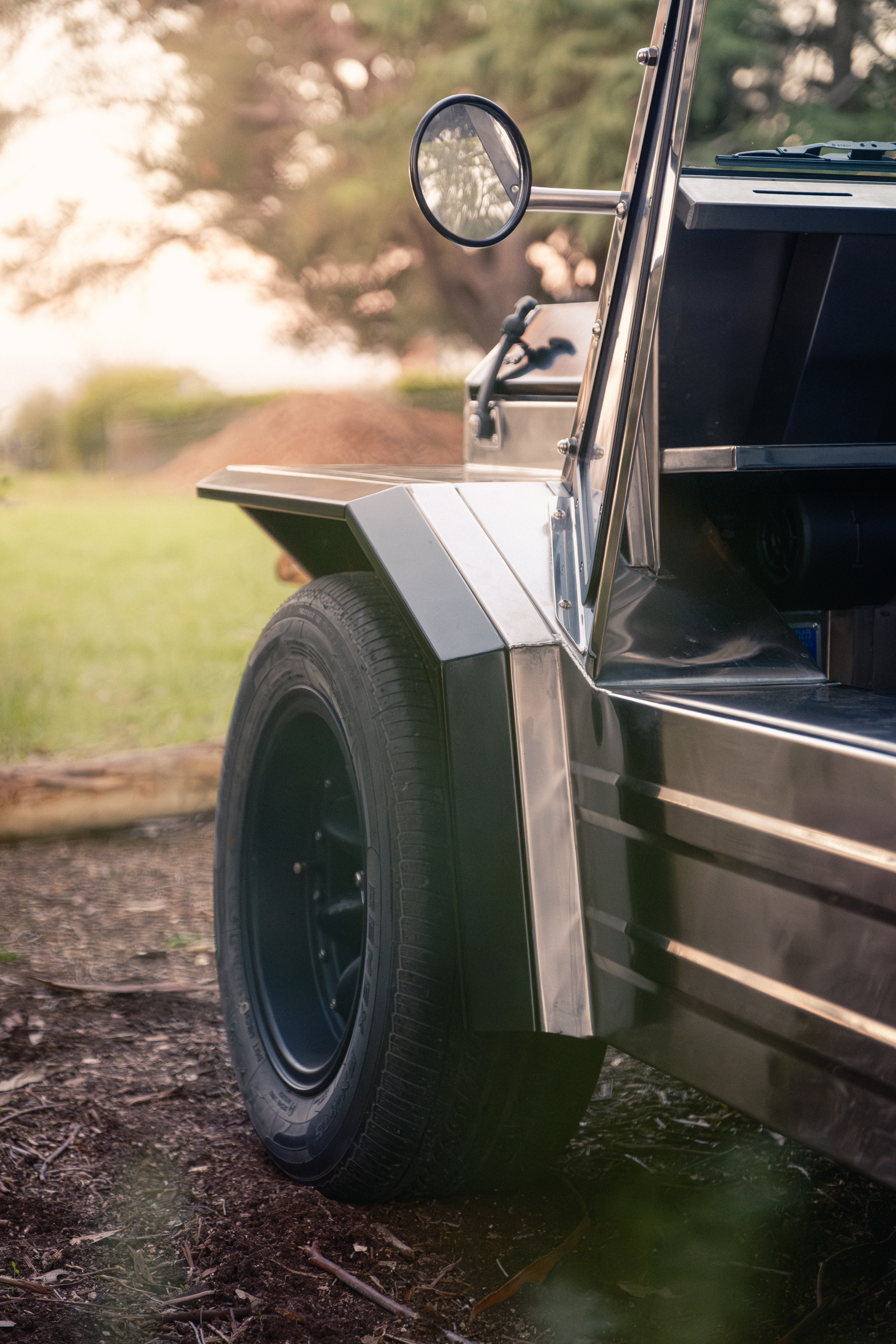
Low side-on view of the front guard and wheel in warm sunset light, polished stainless body catching the glow with eucalyptus trees soft in the background.
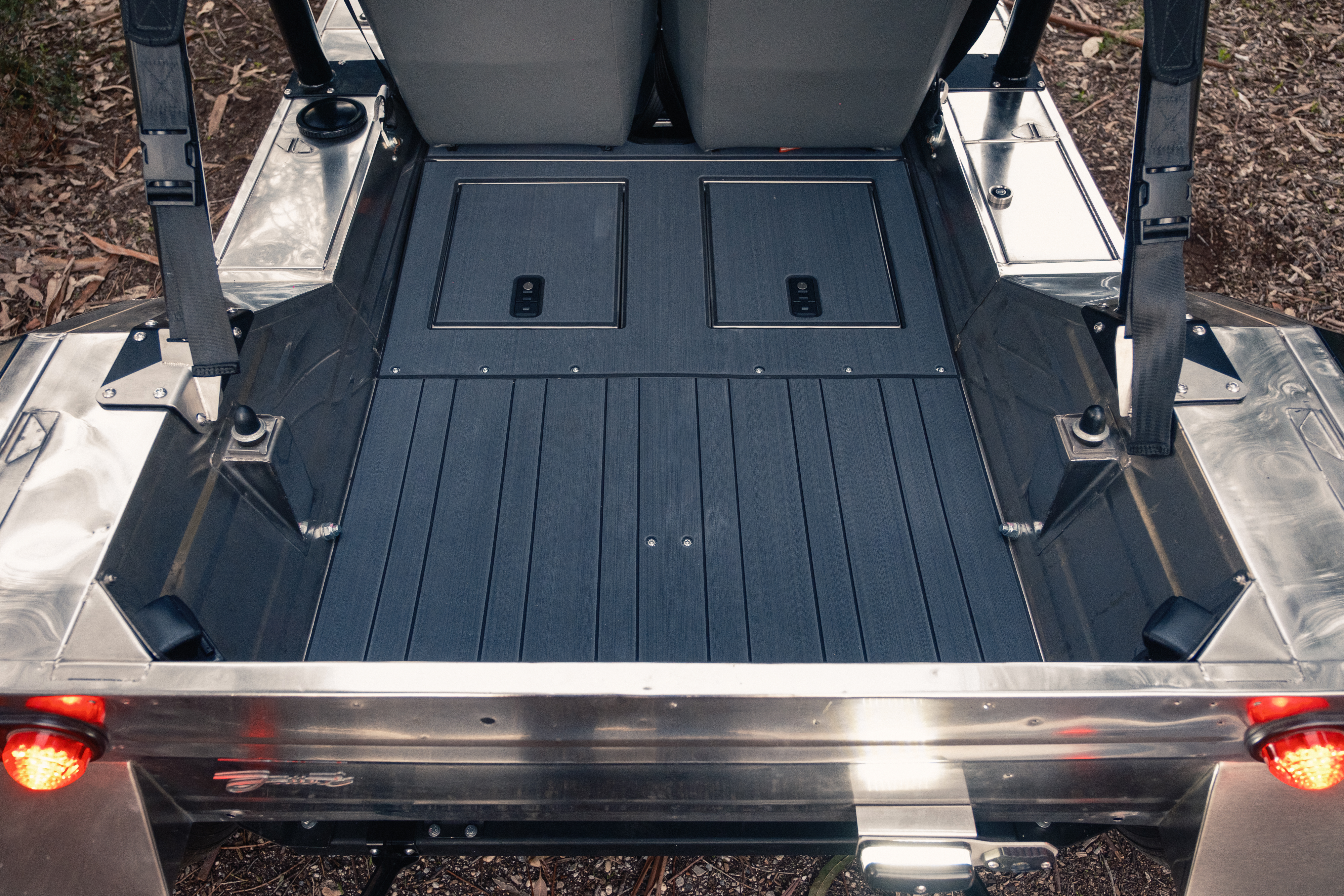
Looking down into the open rear deck tub with a dark composite floor, taillights glowing orange at the base and polished stainless sides framing the cargo area.
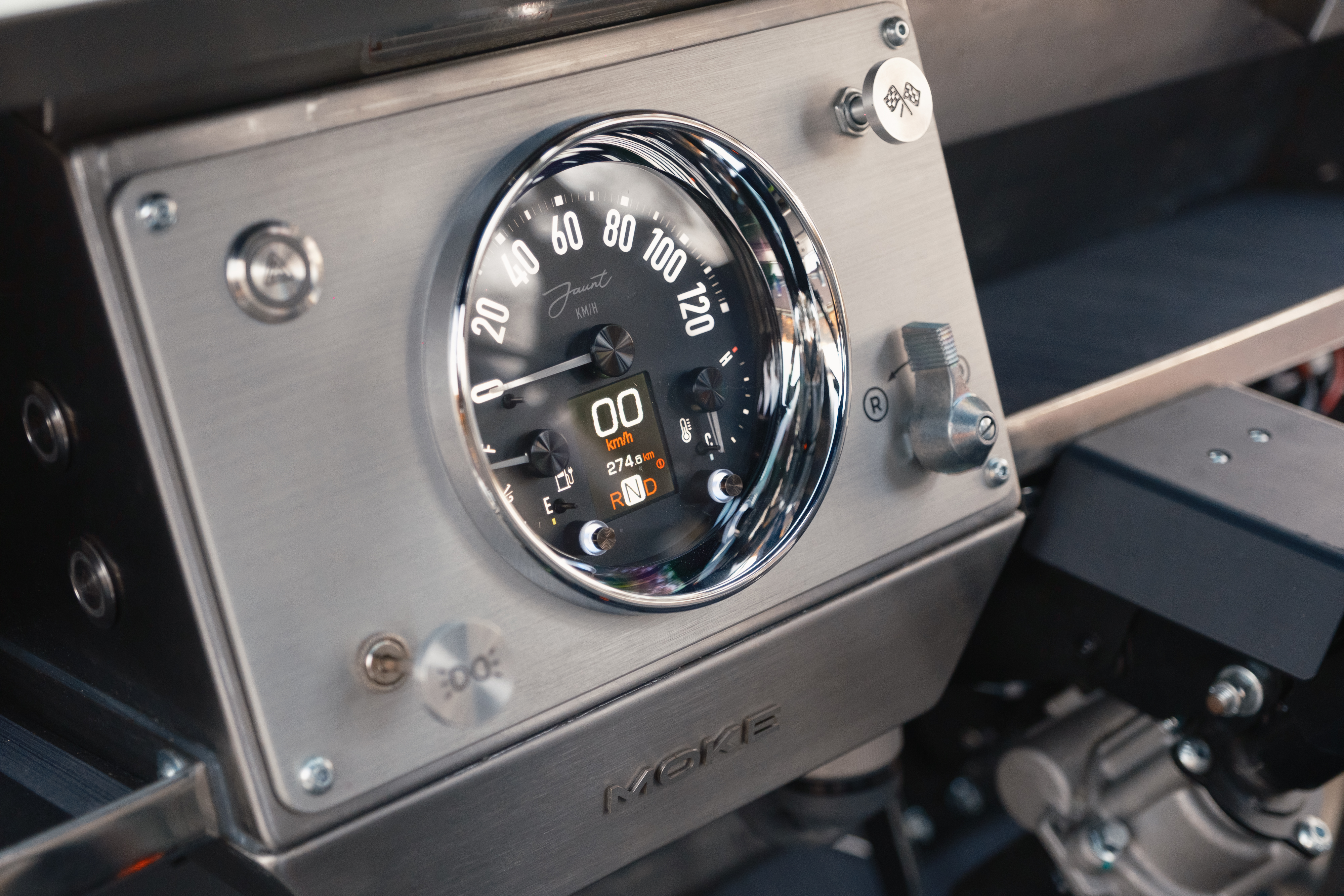
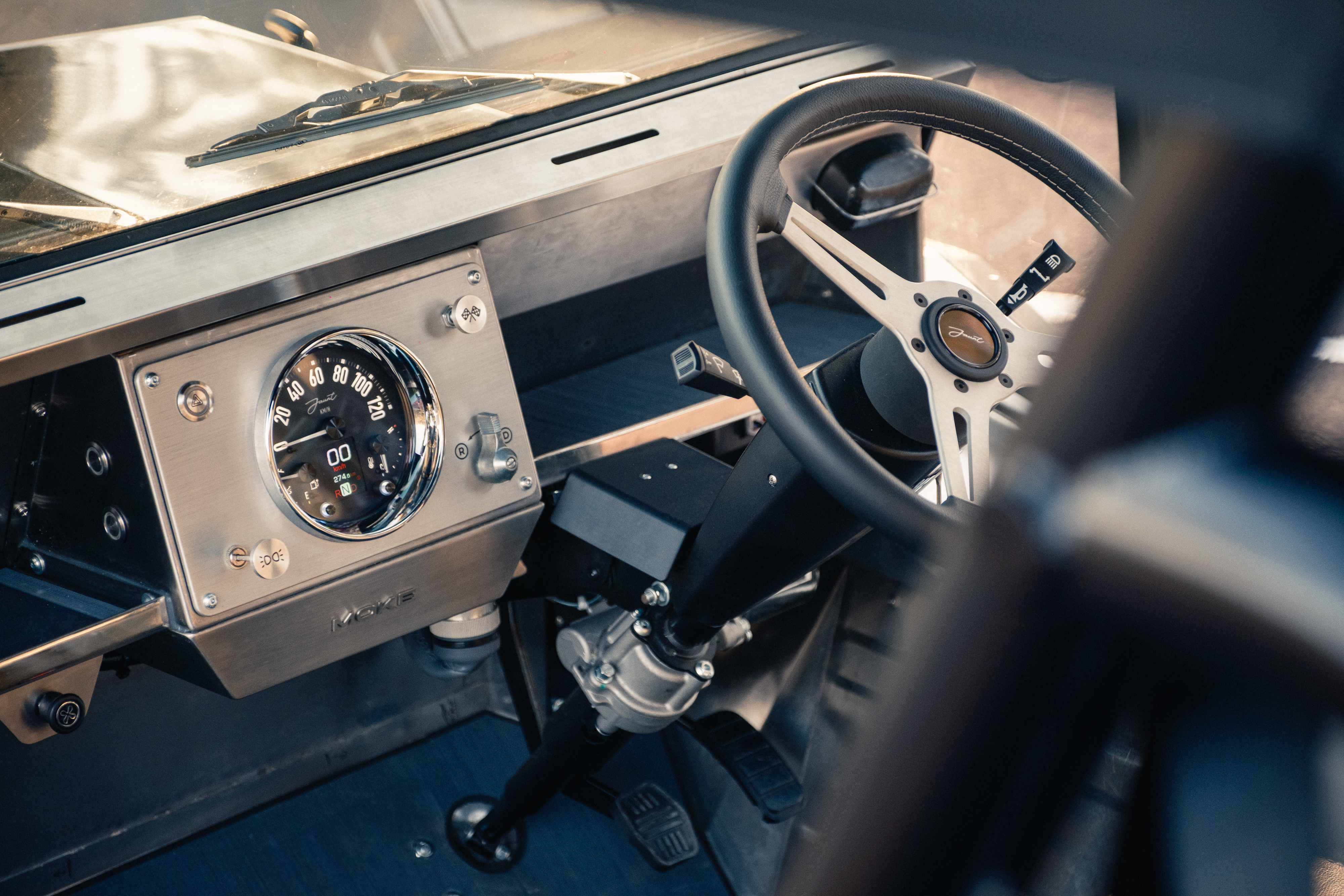
Macro view of the Jaunt-branded analogue speedometer on the brushed stainless dash panel, with the embedded digital display showing RND gear selector and odometer.
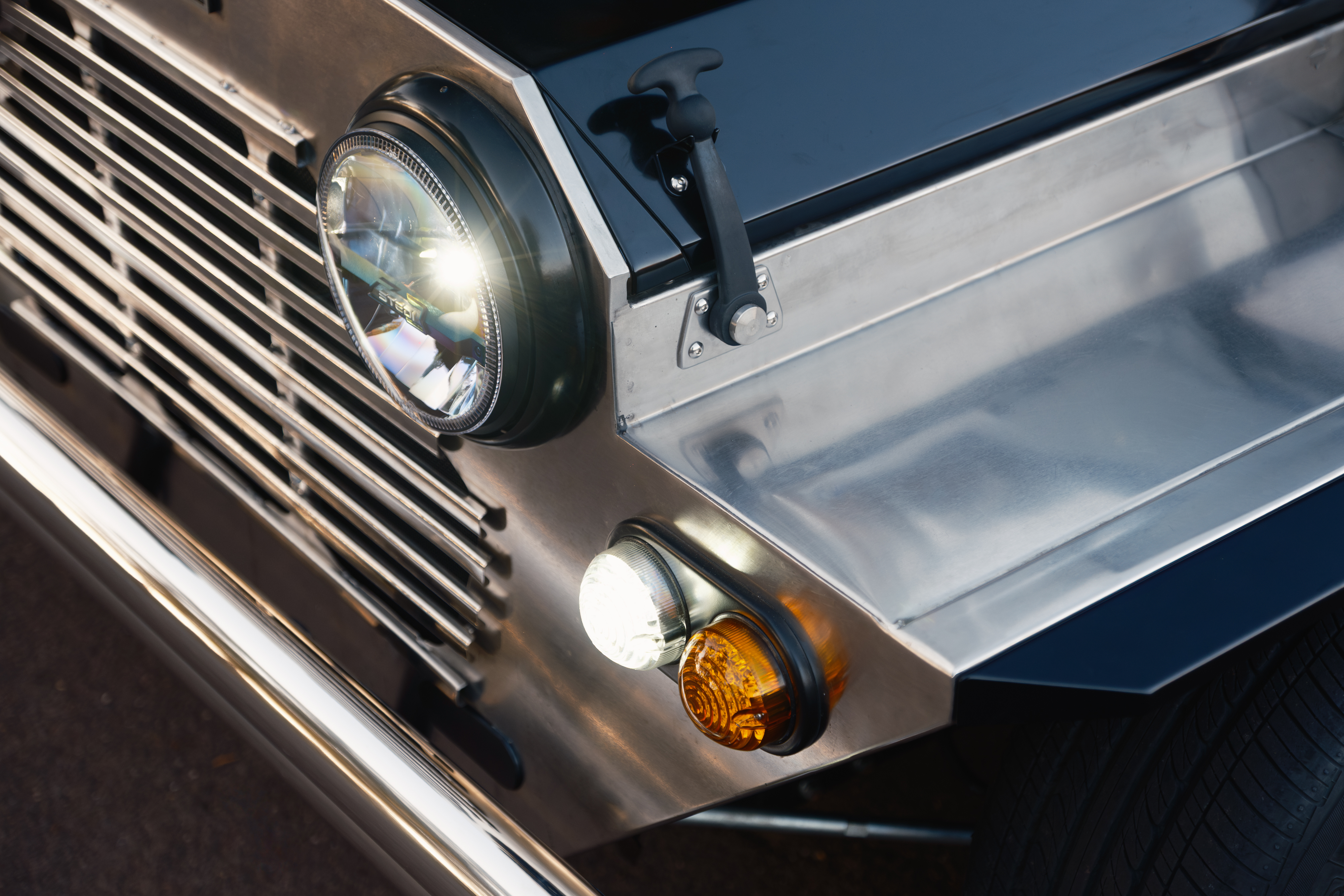
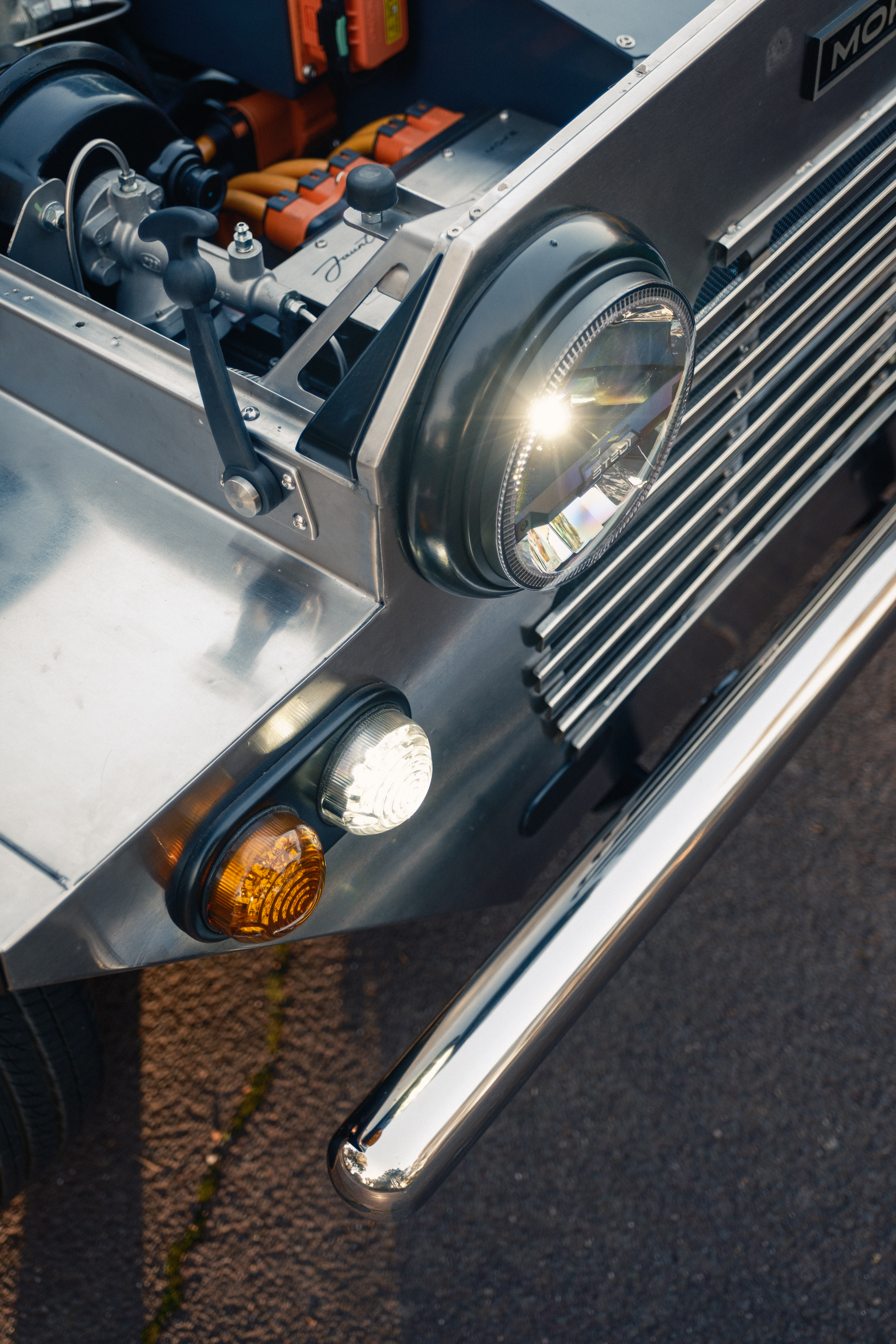
Close-up of the front corner showing the round LED headlight glowing, the amber indicator beside it, and the satin-black bonnet edge meeting the polished stainless guard.
Three-quarter front view of the stainless Moke parked on a bush road, with tall eucalyptus trees glowing in the golden hour light behind it.
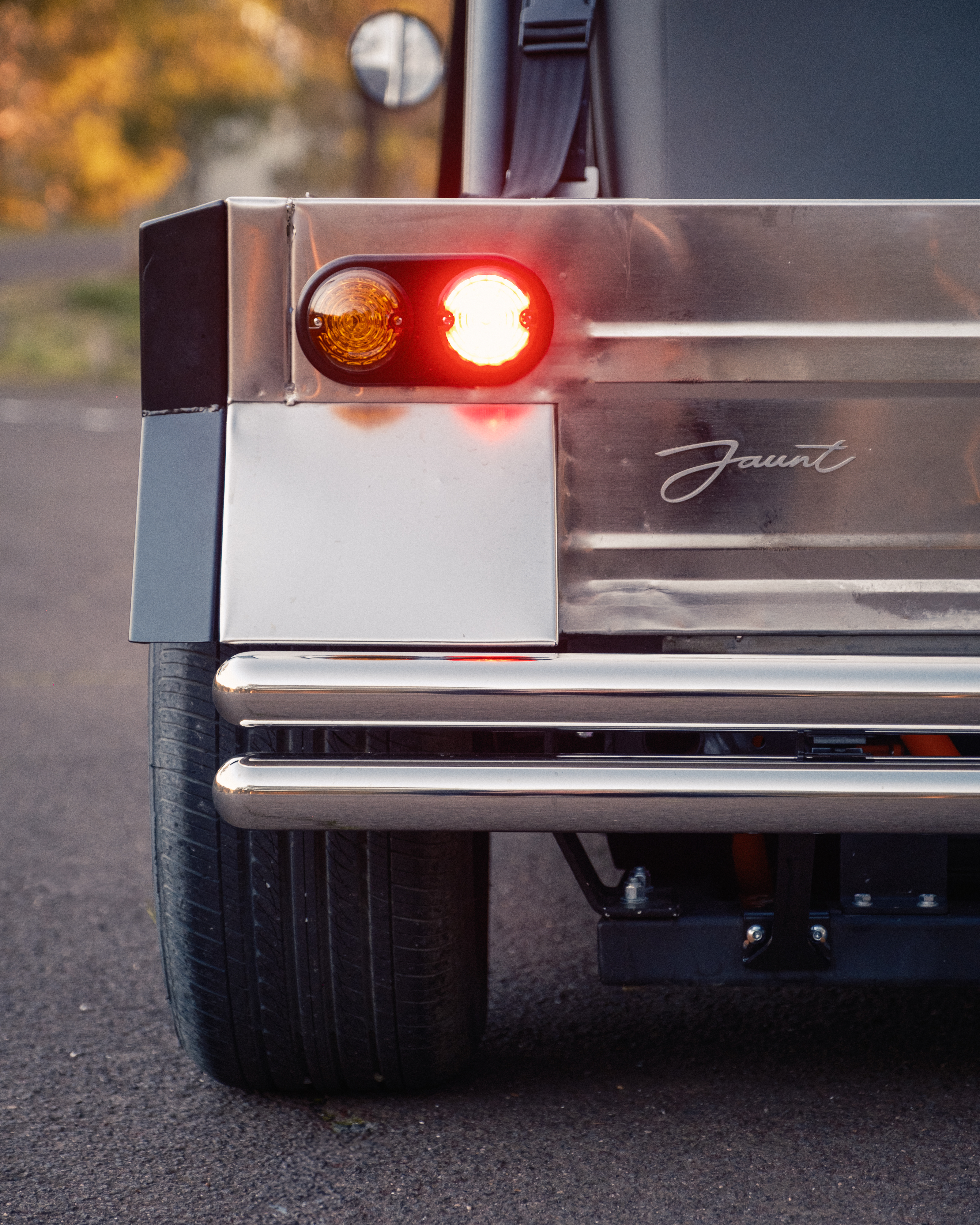
Tight rear detail showing the round LED taillight illuminated red beside the Jaunt script badge on the polished stainless body, with autumn foliage blurred behind.
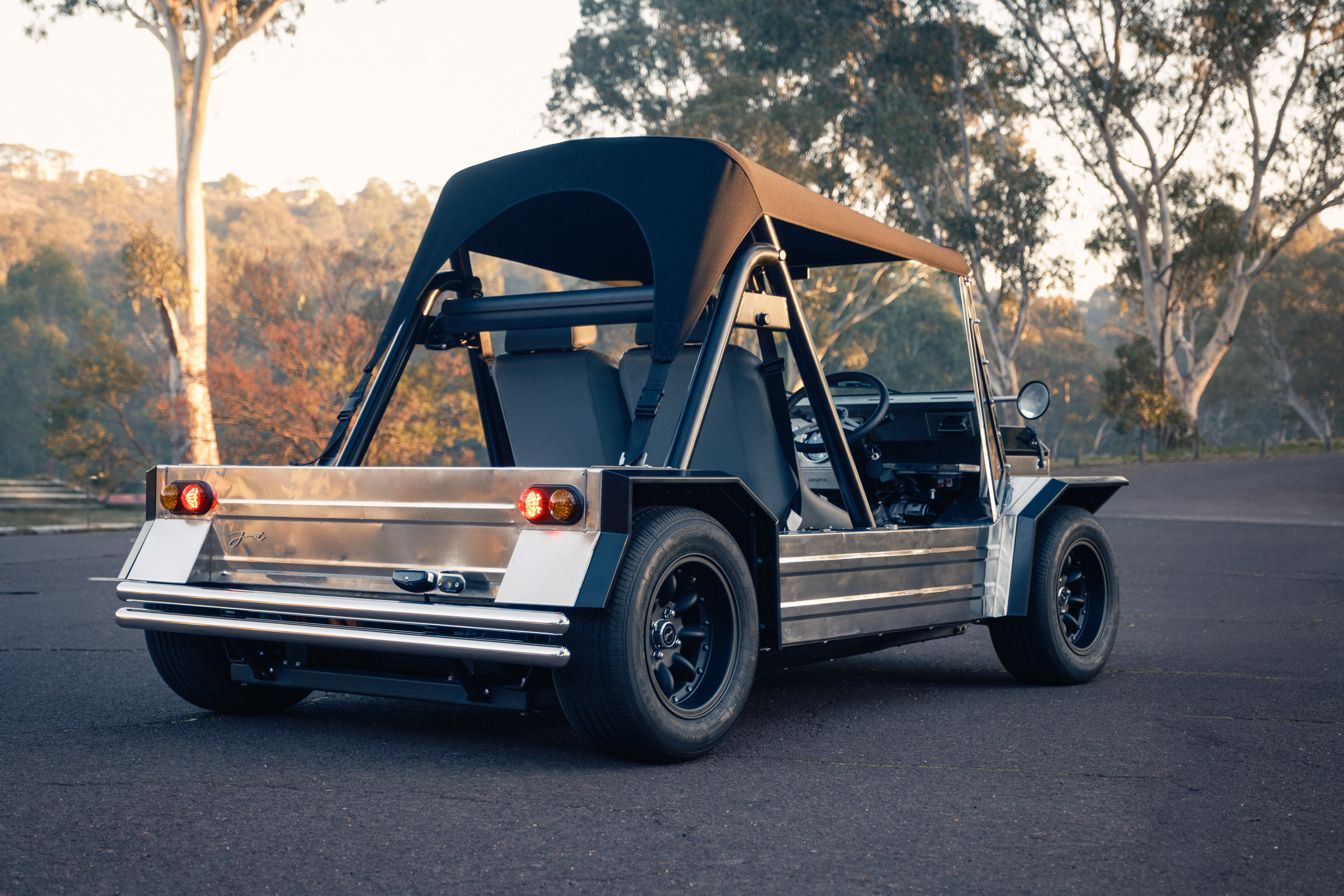
Three-quarter rear view of the Moke on a bush road at golden hour, taillights lit, with a canvas bikini top up and eucalyptus canopy glowing behind.
Interior view from behind looking forward, showing cream leather seats and the perforated speaker hoop, with a eucalyptus bush setting visible through the windscreen arch.
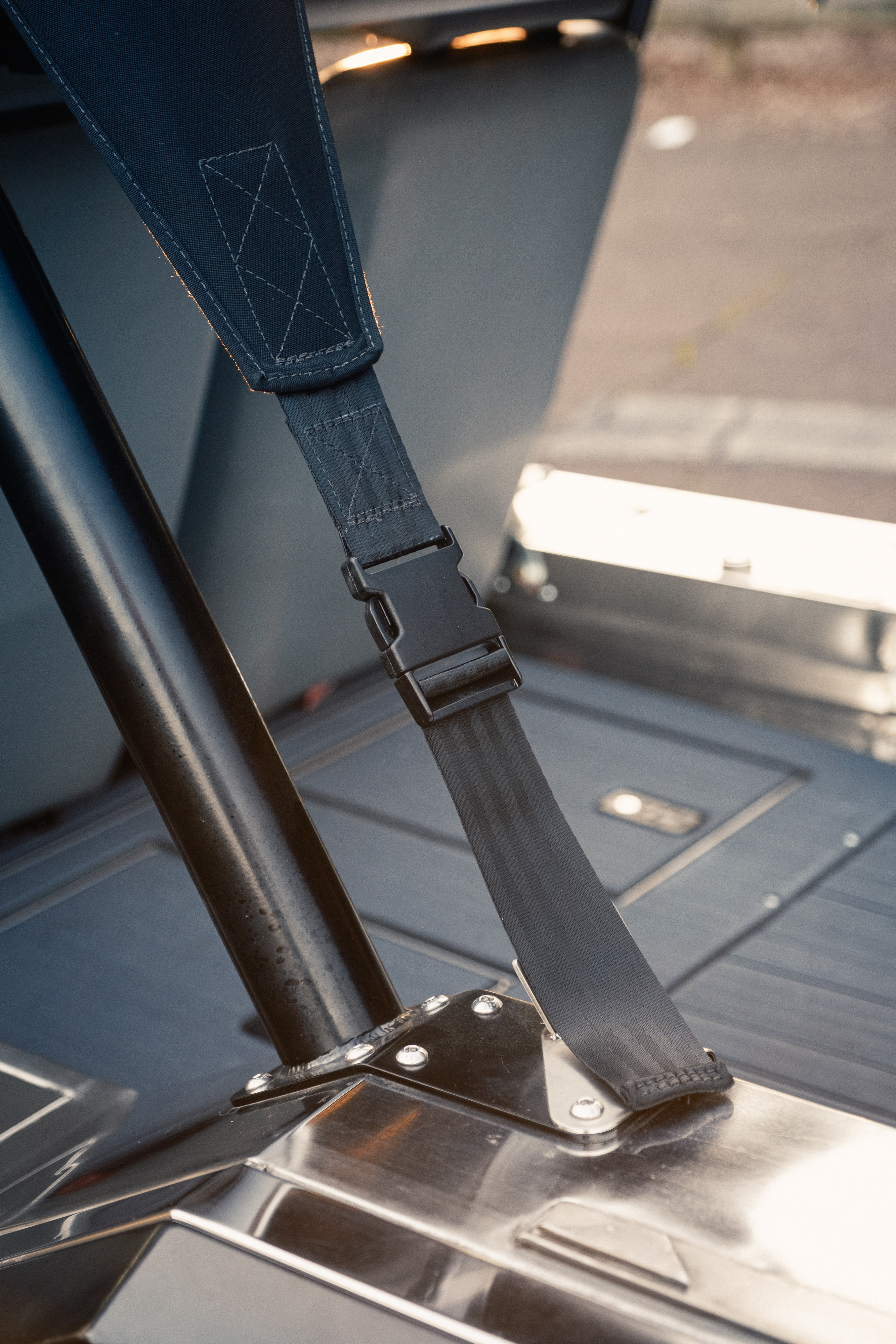
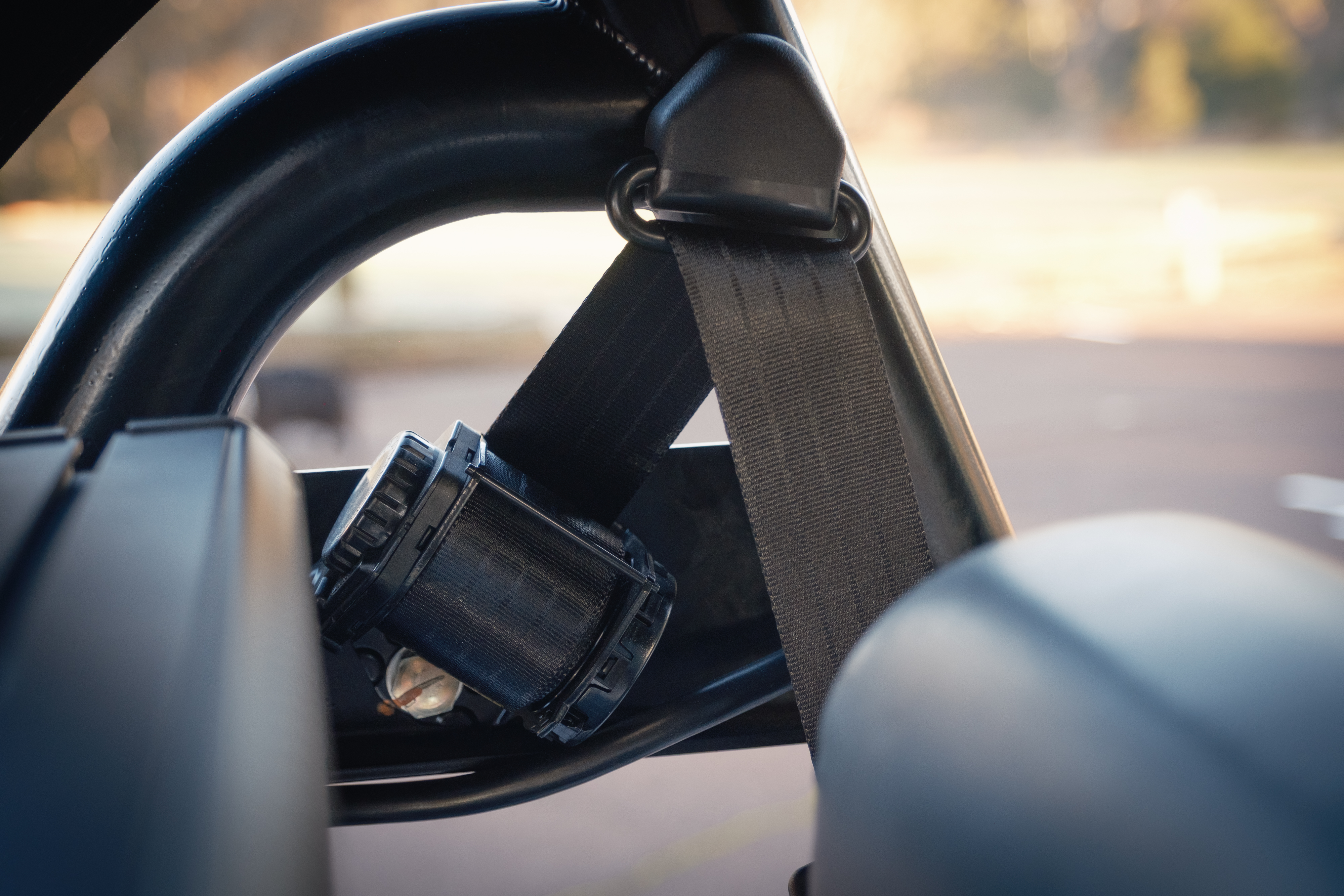
Detail of the black tubular seat-belt hoop post and retractor strap anchored to the polished stainless floor, with the rear tub and sun-lit ground visible behind.
Driver's-eye view of the brushed stainless dashboard with the Jaunt analogue speedo, Moke-branded panel, and three-spoke steering wheel with Jaunt centre badge.
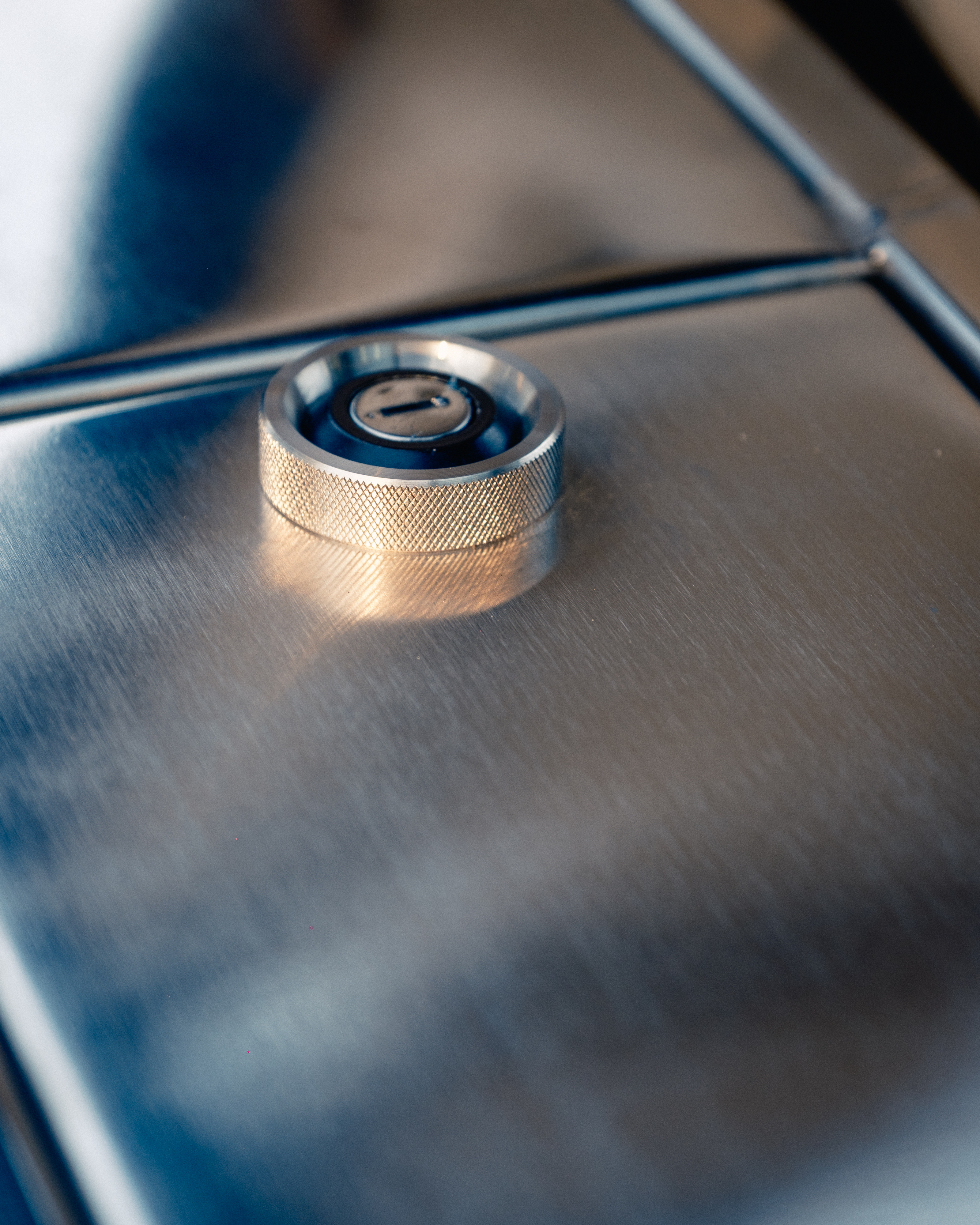
Extreme macro of the knurled stainless ignition barrel set flush into the body panel, catching directional light across its machined texture.
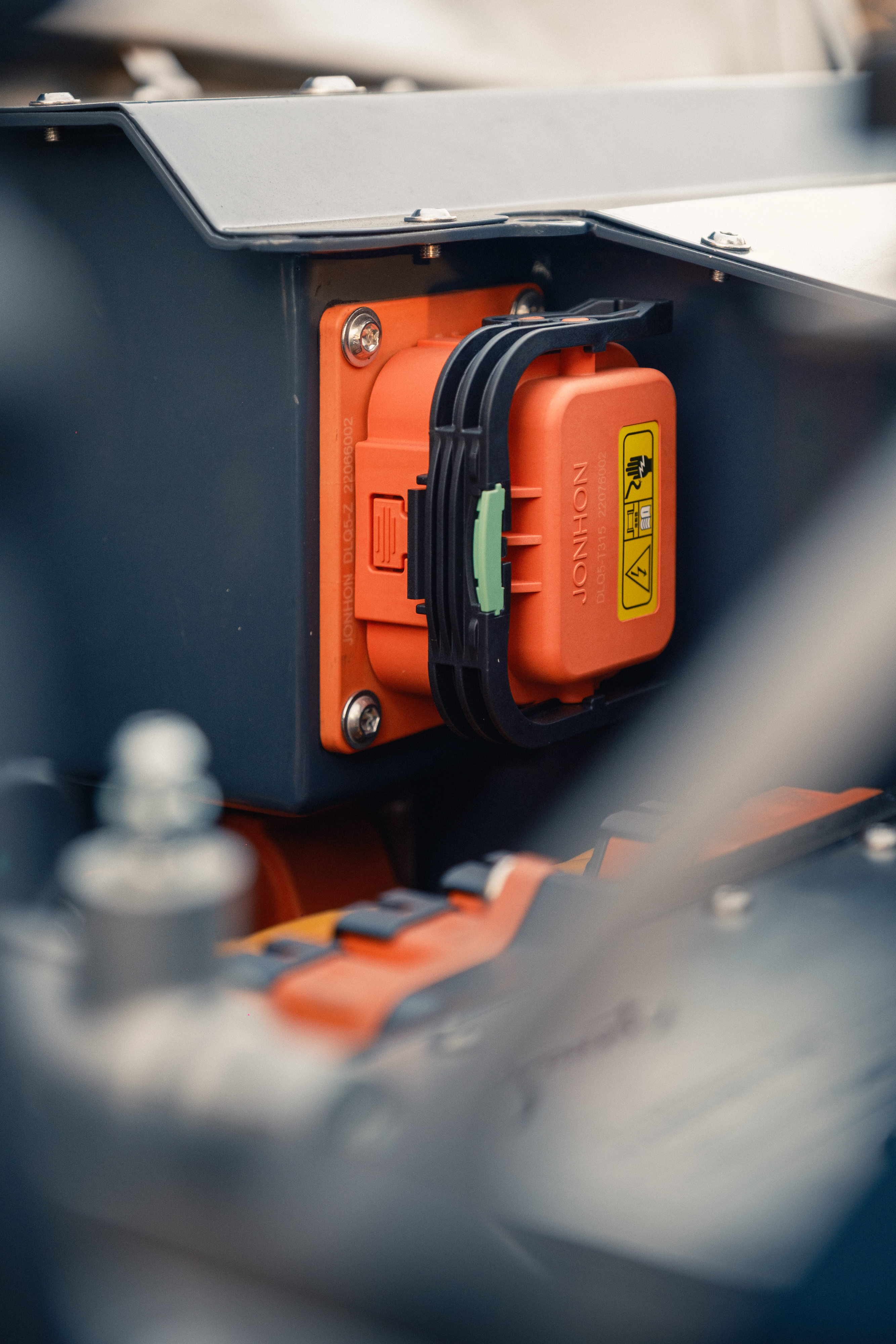
Close-up of the orange high-voltage Jonhon battery connector locked into a dark enclosure, with warning labels visible and additional orange HV cables below.
Front corner detail with the headlight on and EV bay open, revealing orange cables and the Jaunt-branded inverter bracket, with the stainless bumper tube across the bottom.
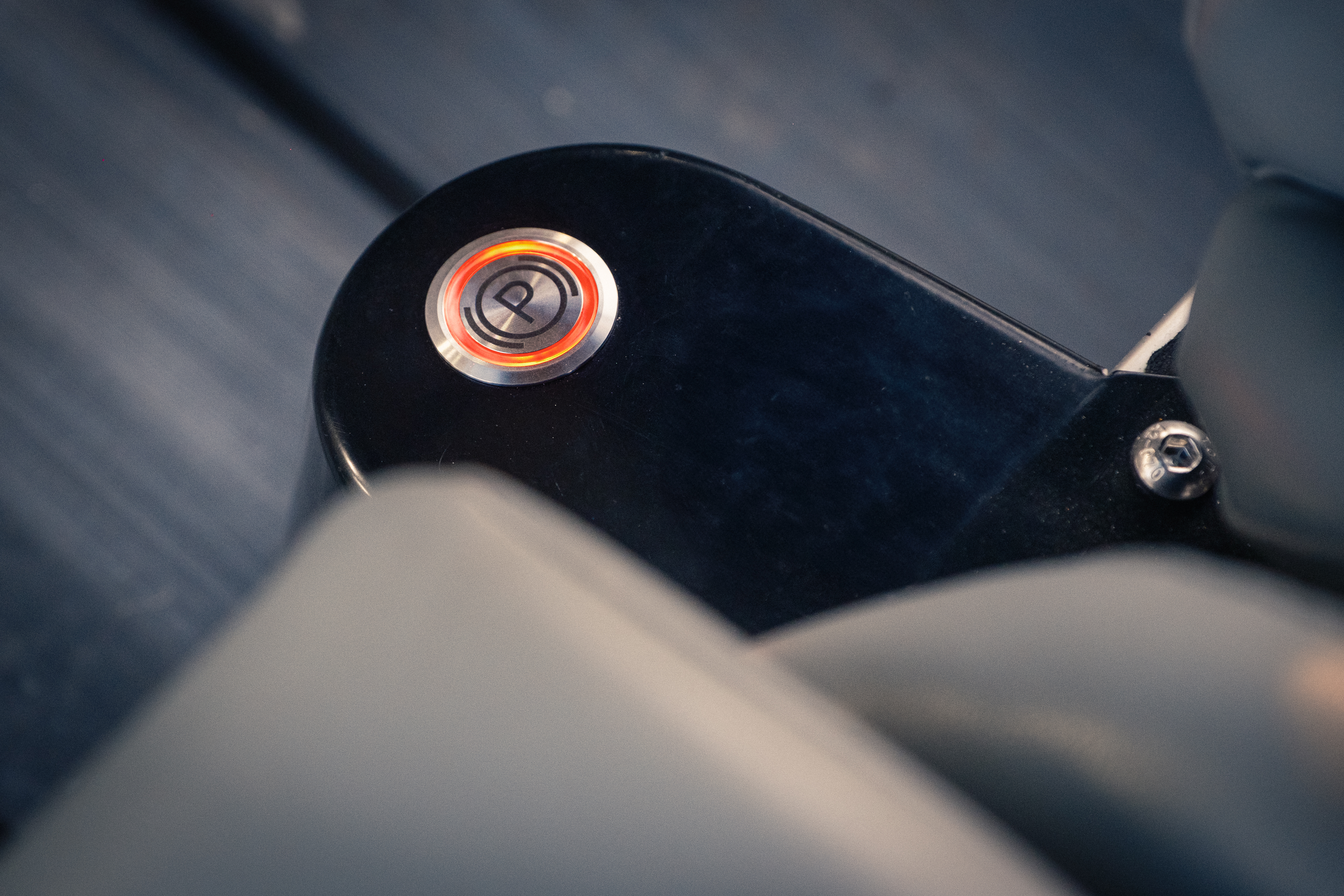
Close-up of the illuminated park button with orange ring glow, set into a black console between the leather seats on the polished stainless tunnel.
Detail of the seat-belt retractor and strap mounted on the black tubular hoop, with the integrated speaker visible and a soft morning-light bush setting behind.
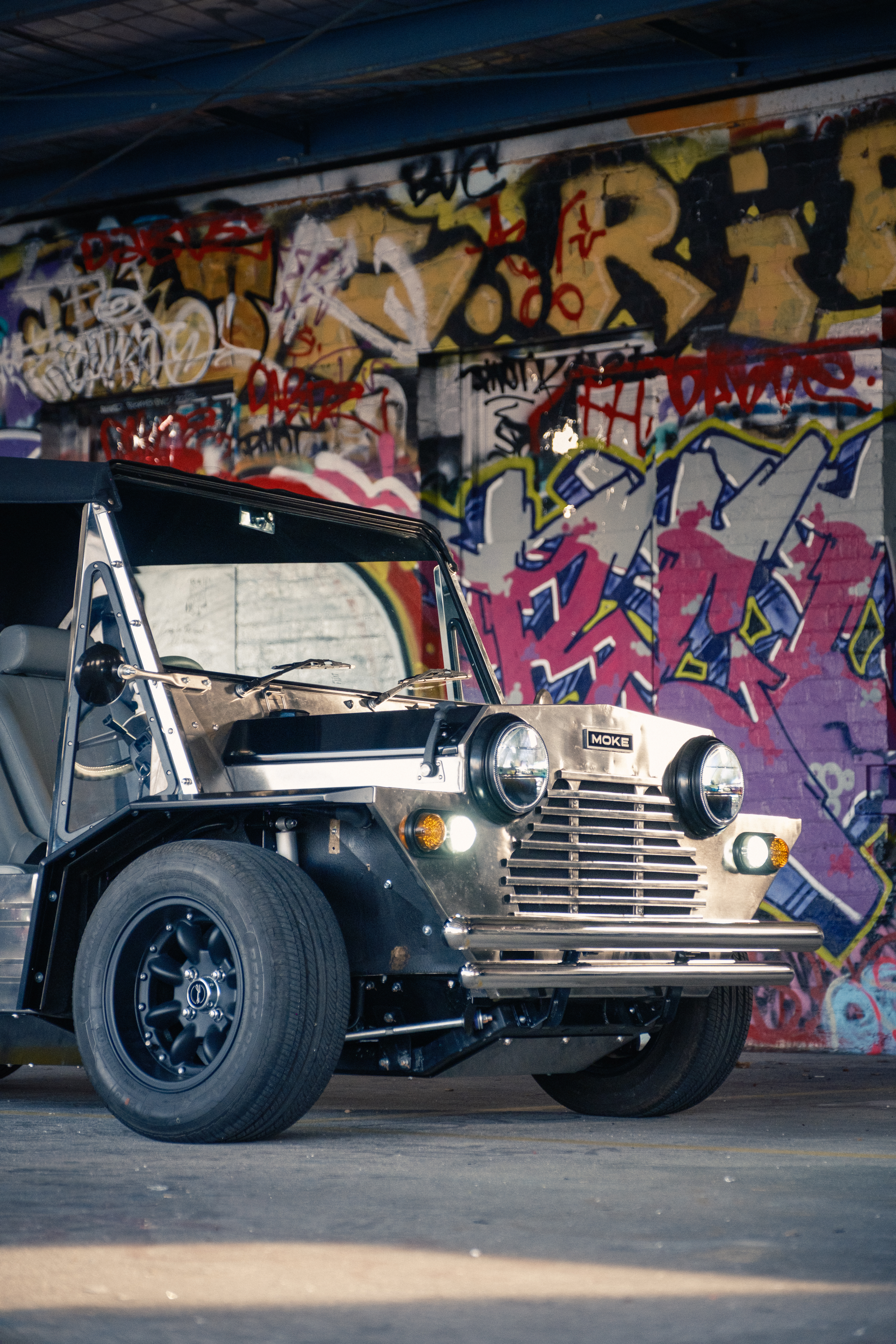
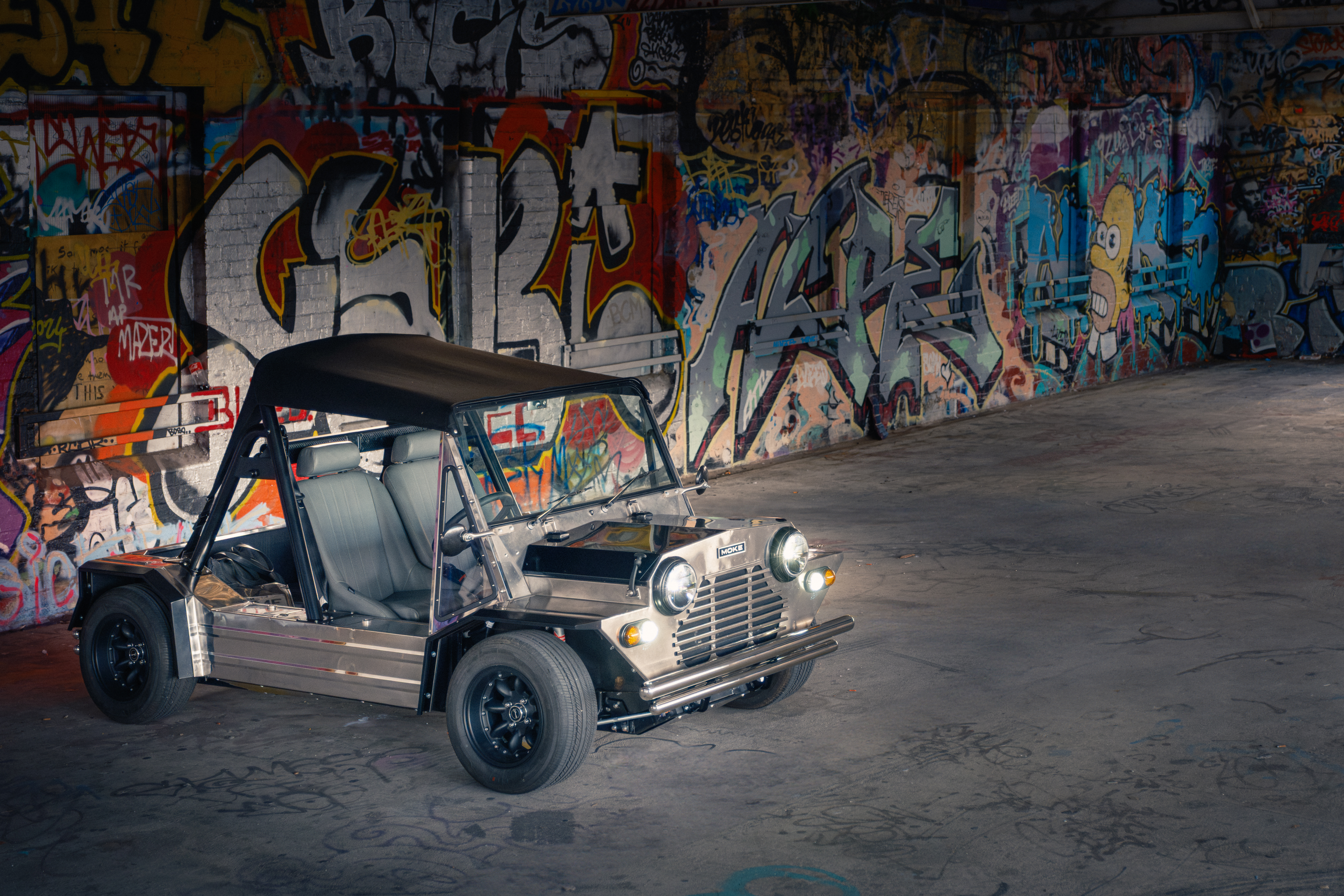
Three-quarter front view of the stainless Moke parked against a brightly painted graffiti wall in an urban setting, with colourful lettering filling the background.
CHAPTER 07
On the street. Outhandling expectations.
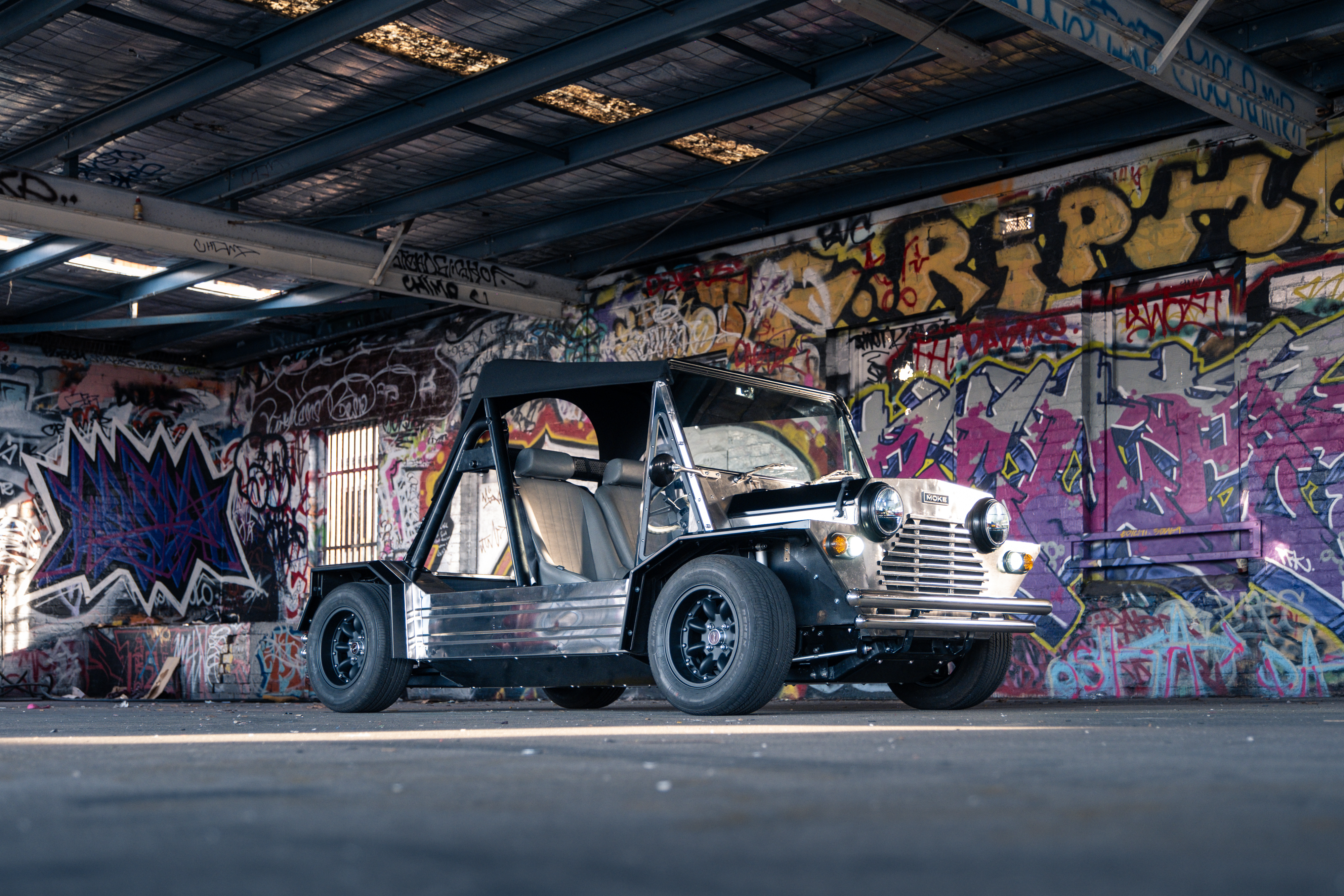
In its natural urban context. A small, very shiny, open-top object with the torque-to-weight of cars that cost five times what people think this is worth. The cognitive dissonance is part of the joy.
Reel · Hero shoot
Freeway Intro
// Three variants exist (16:9, 9:16)
Three-quarter front view of the stainless Moke parked against a brightly painted graffiti wall in an urban setting, with colourful lettering filling the background.
Full side profile of the Moke inside an undercover graffiti hall, polished body contrasting sharply with the multi-coloured tags and murals covering every surface.
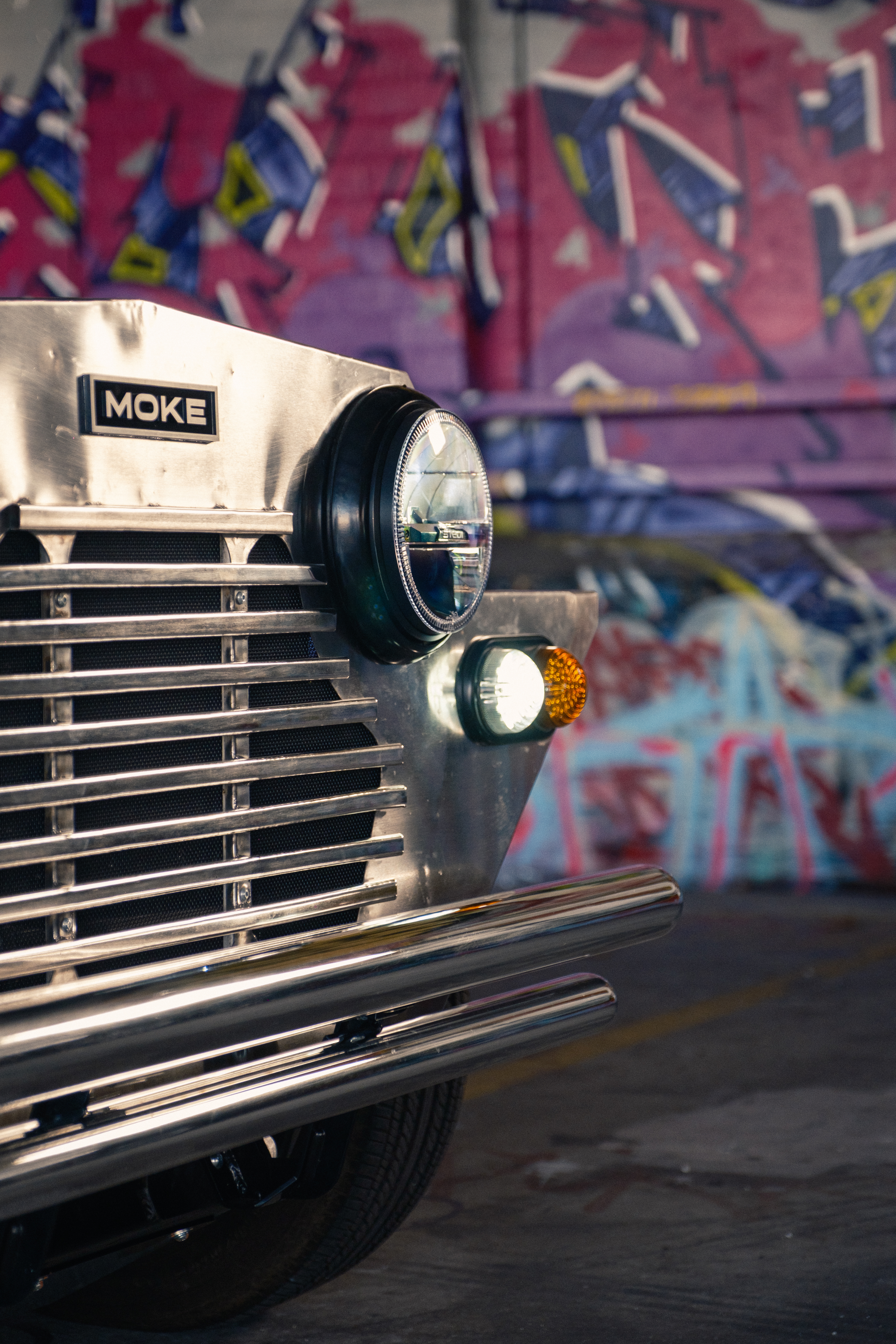
Close detail of the polished stainless front grille with the MOKE badge and round headlight, a pink-and-blue graffiti mural filling the background.
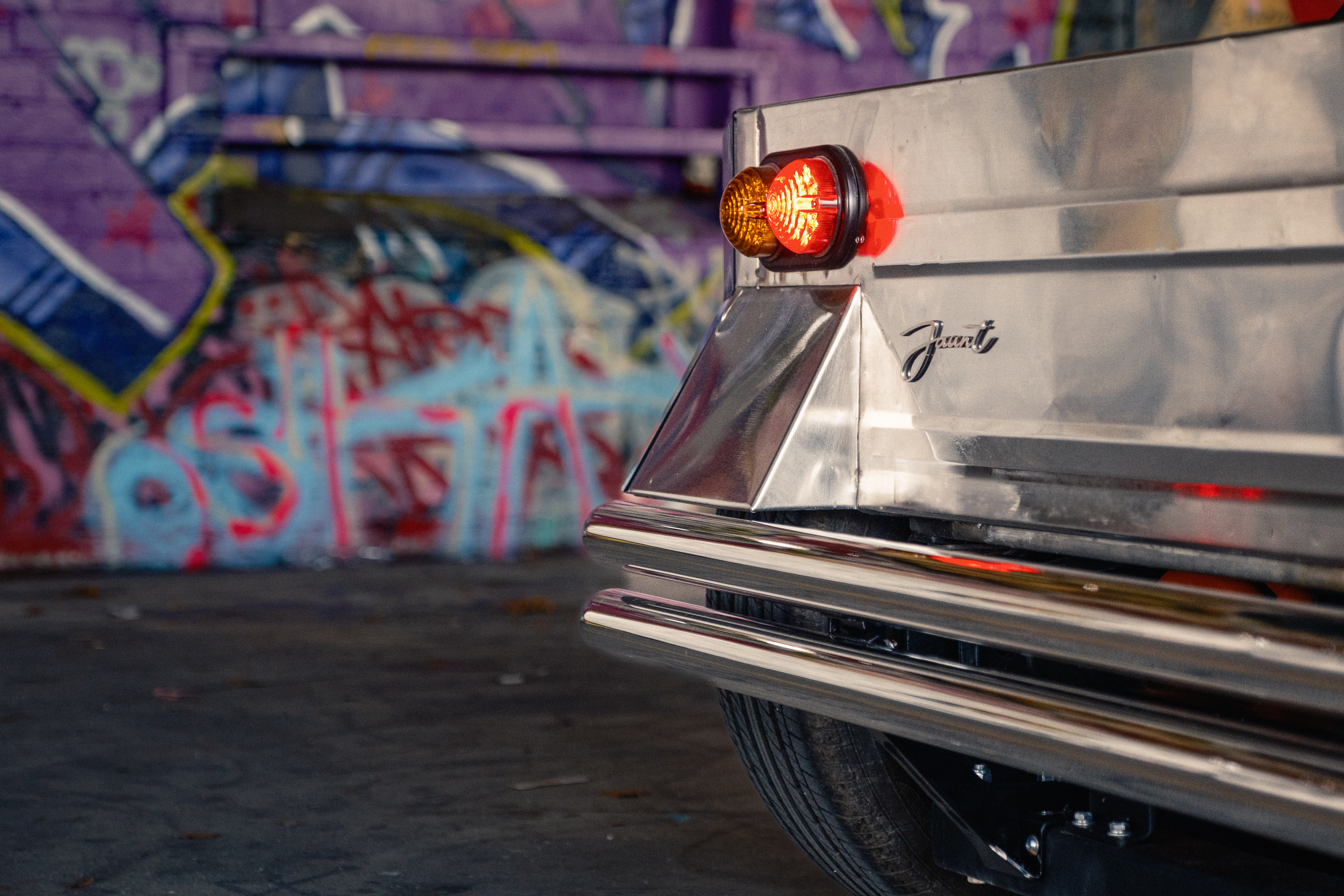
Rear detail showing the illuminated red taillight beside the Jaunt script badge on the polished body, with a blue-and-purple graffiti wall behind.
Top-down detail of the open side-pod storage lid revealing the CCS2 charge port below, with a leather key fob and keys resting on the brushed stainless lid surface.
Front three-quarter angle inside the graffiti hall with headlights illuminated, the polished stainless body picking up the surrounding colourful murals as reflections.
CHAPTER 08
Pull up to the charging station. Show off.
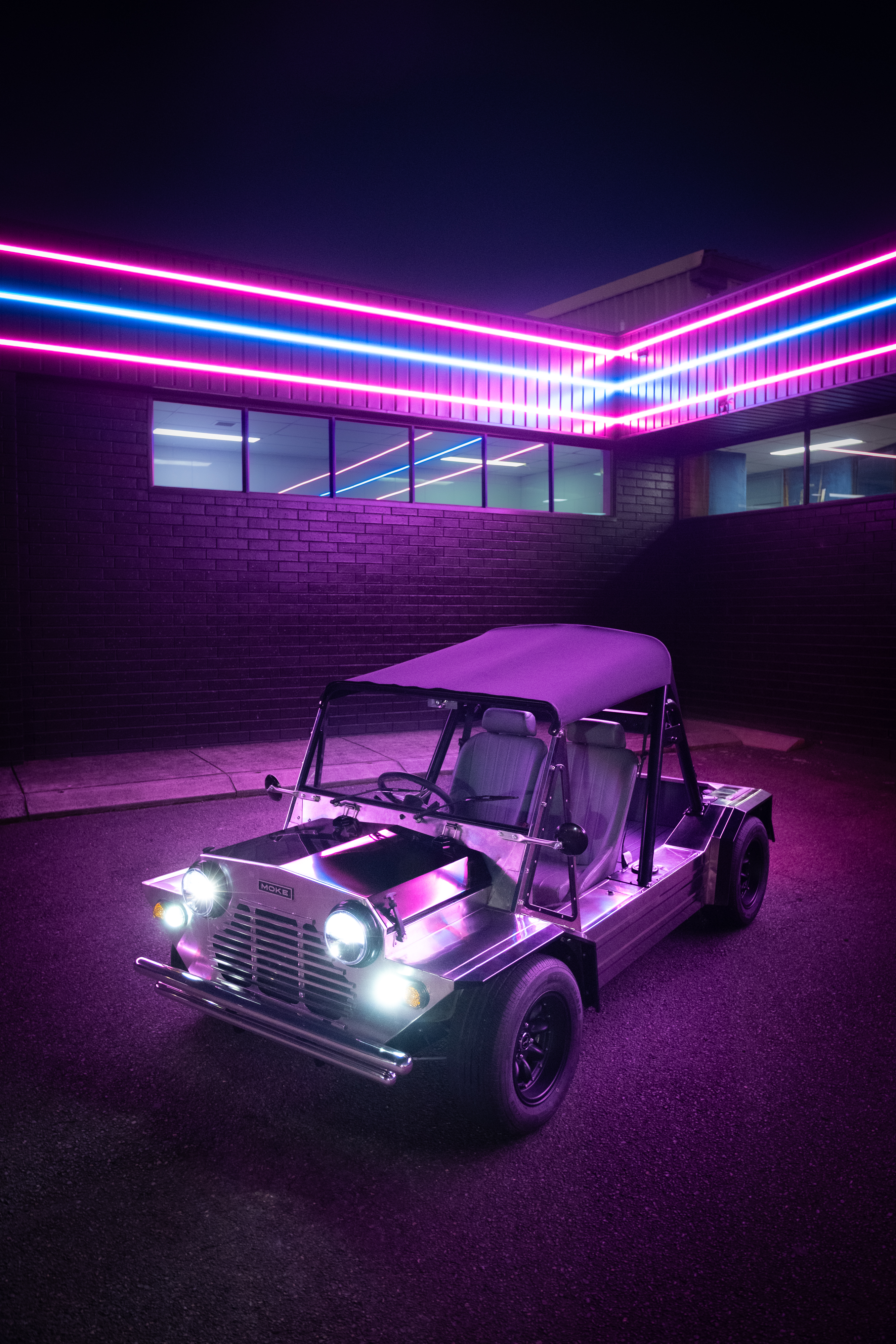
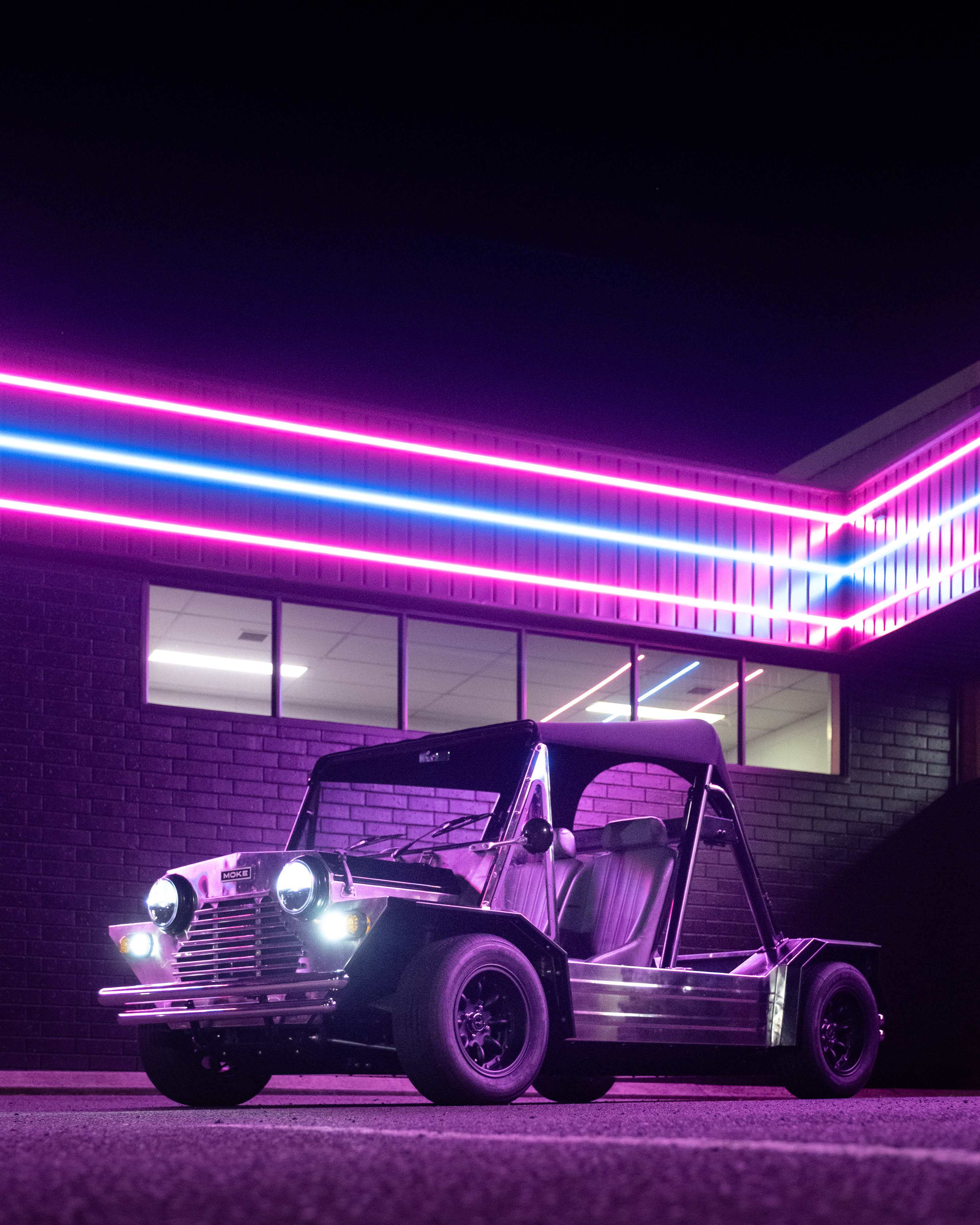
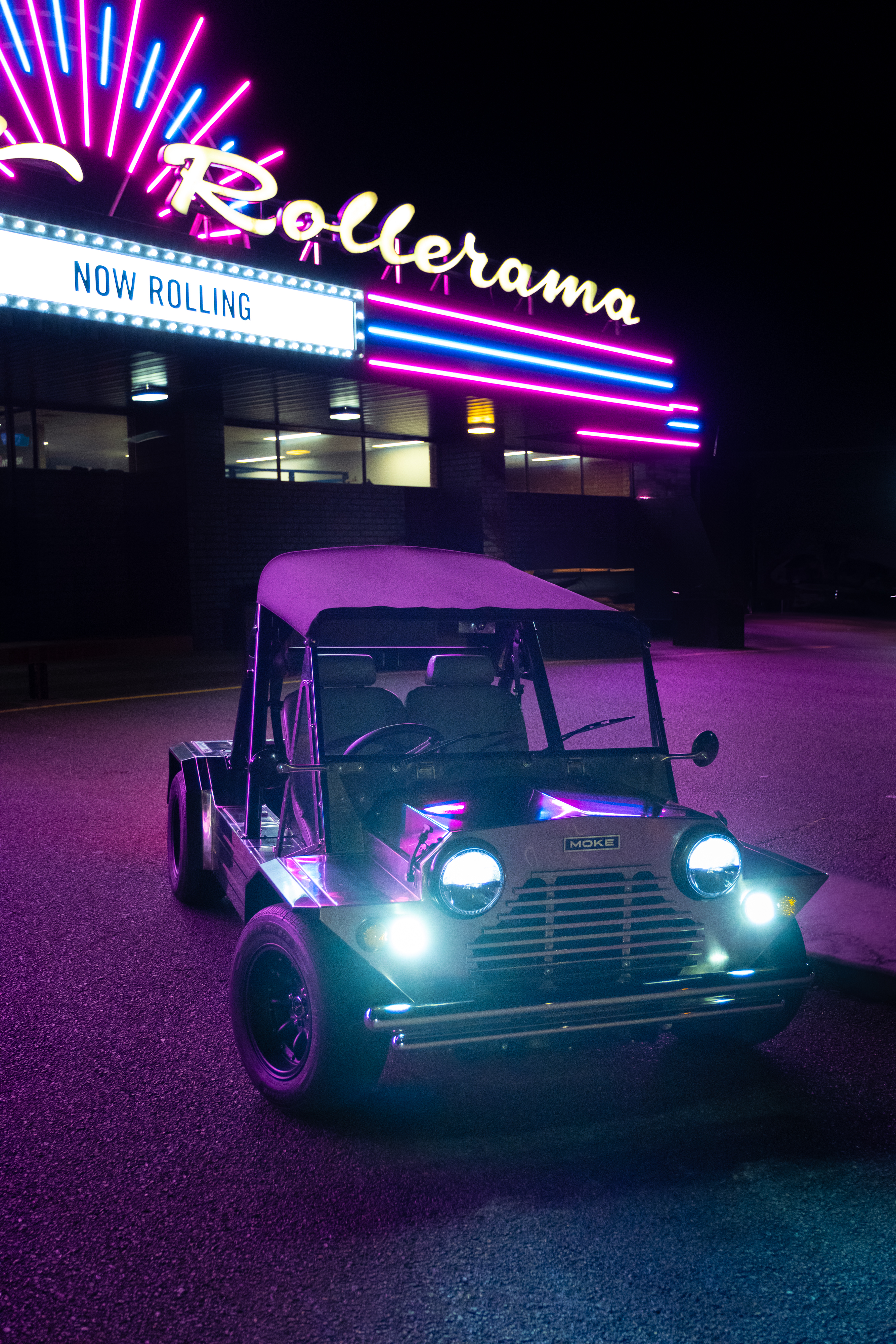
A polished stainless body becomes whatever light it's standing in. Park it under neon and the car disappears into colour.
Part of having a unique classic car that is electric is to pull up to a charging station and kind of show off. Not that that's the point you build them for. But it's one of the perks.
Dave Budge · MOKE 08 · Back Together
Reel · Hero shoot
Neon Beat Fast
// Cuts on beat, neon set
Reel · Hero shoot
Neon Drive Off
// Slow pull-out, taillight reveal
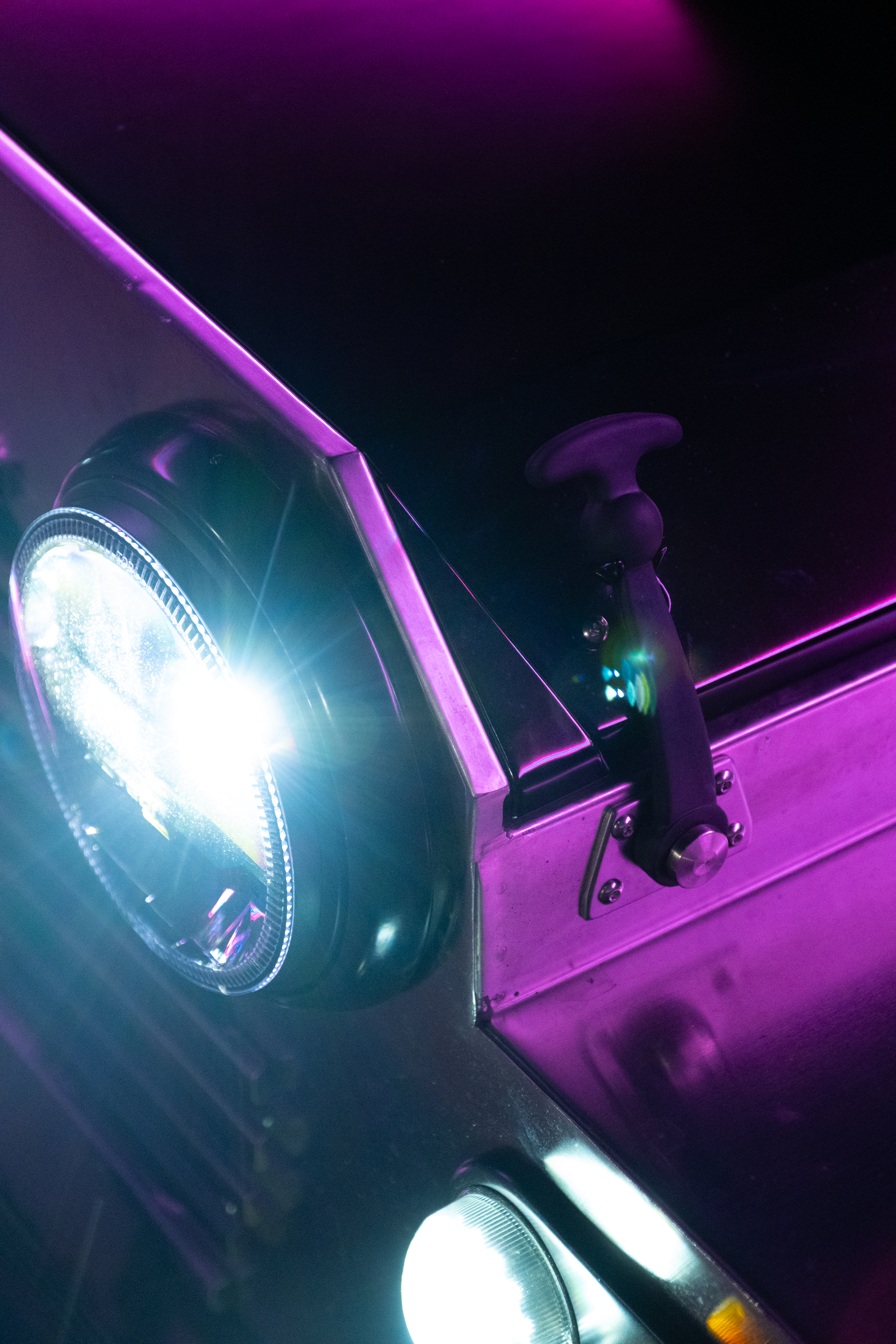
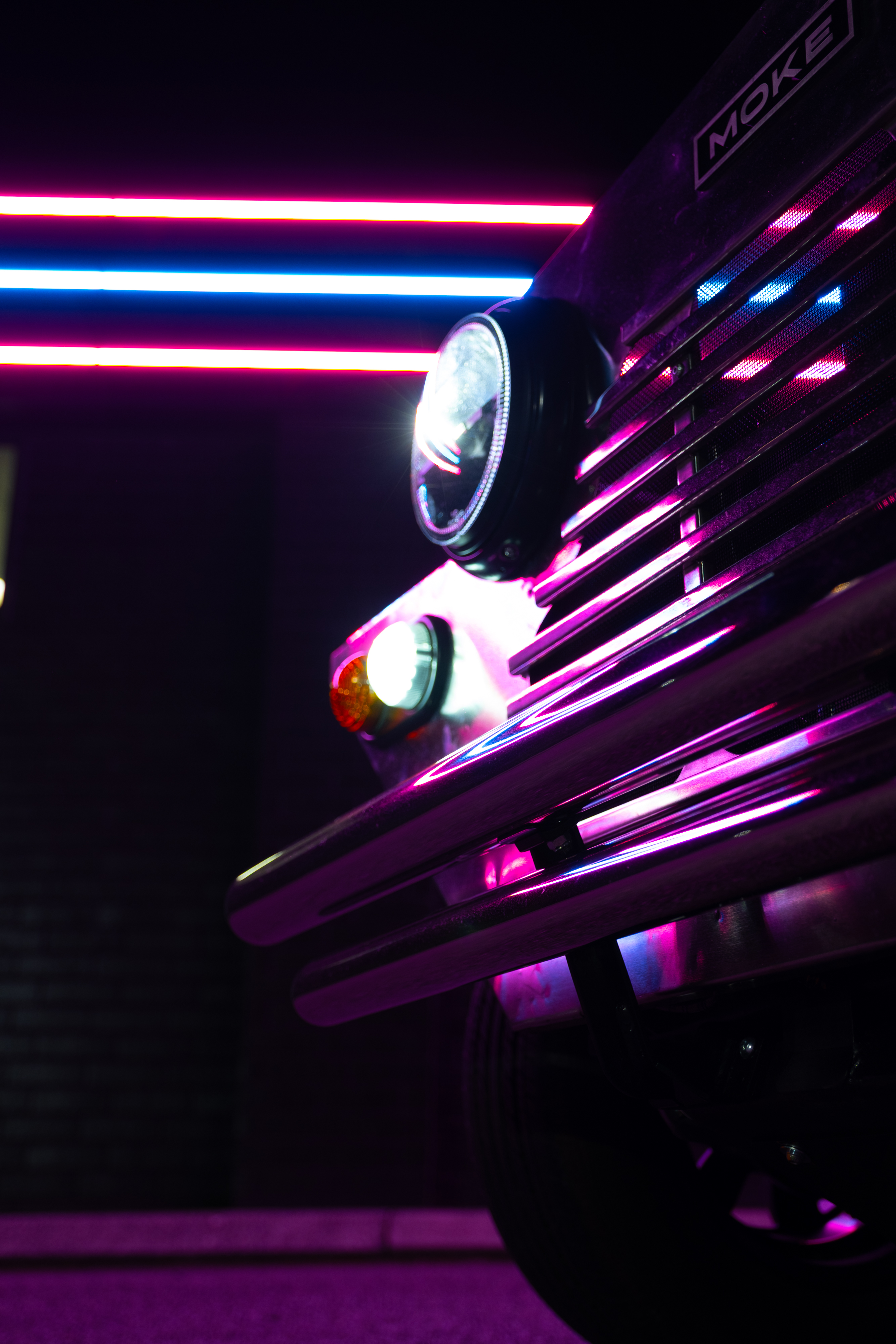
Low upward angle of the headlight blazing white against a magenta-bathed stainless panel at night, with a cyan-pink neon tube visible in the upper background.
Three-quarter front view of the Moke at night under a building wrapped with parallel pink and blue LED strips, the polished body glowing magenta.
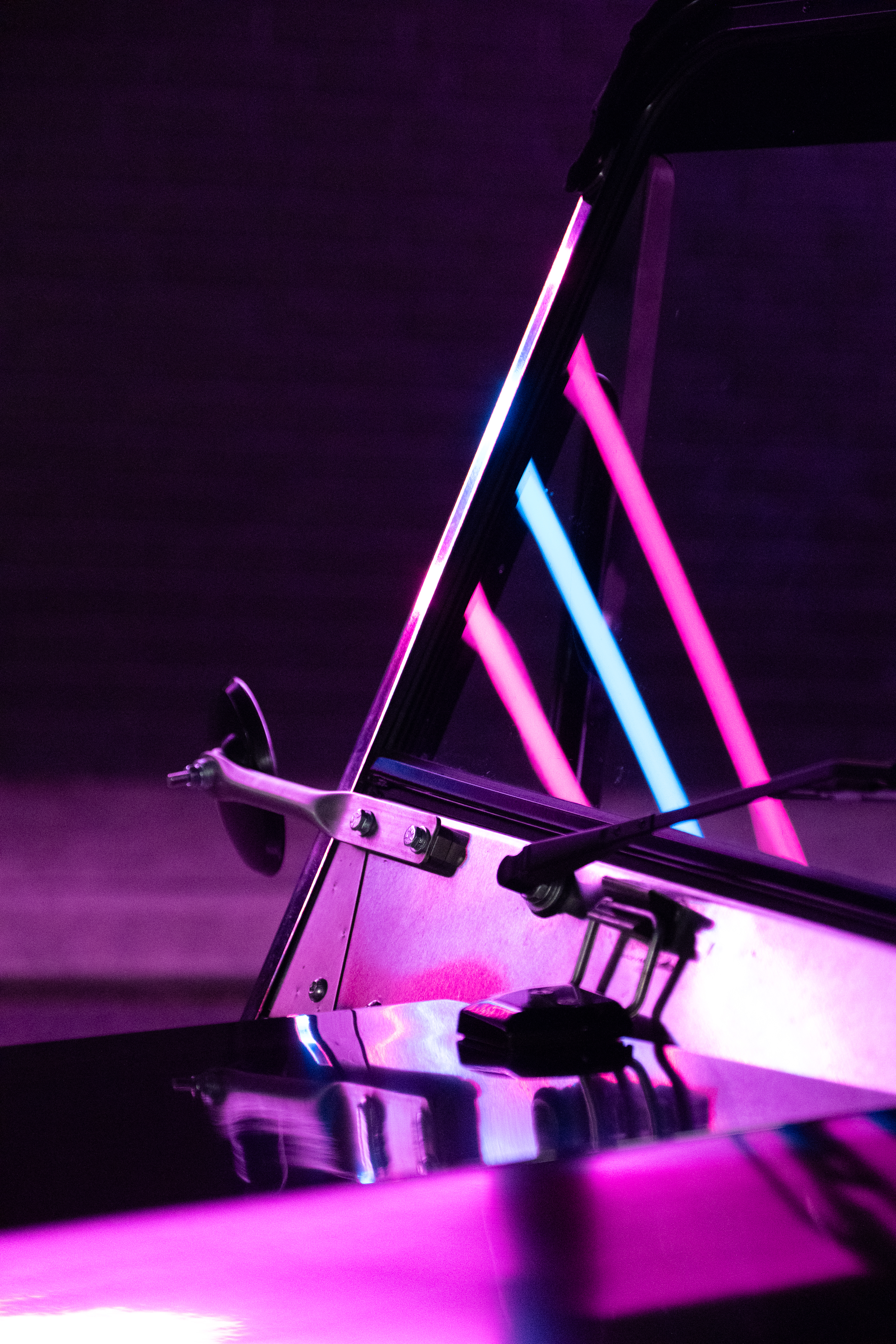
Side detail of the windscreen frame and seat-belt hoop reflecting pink and cyan neon strips at night, the polished stainless body acting as a mirror below.
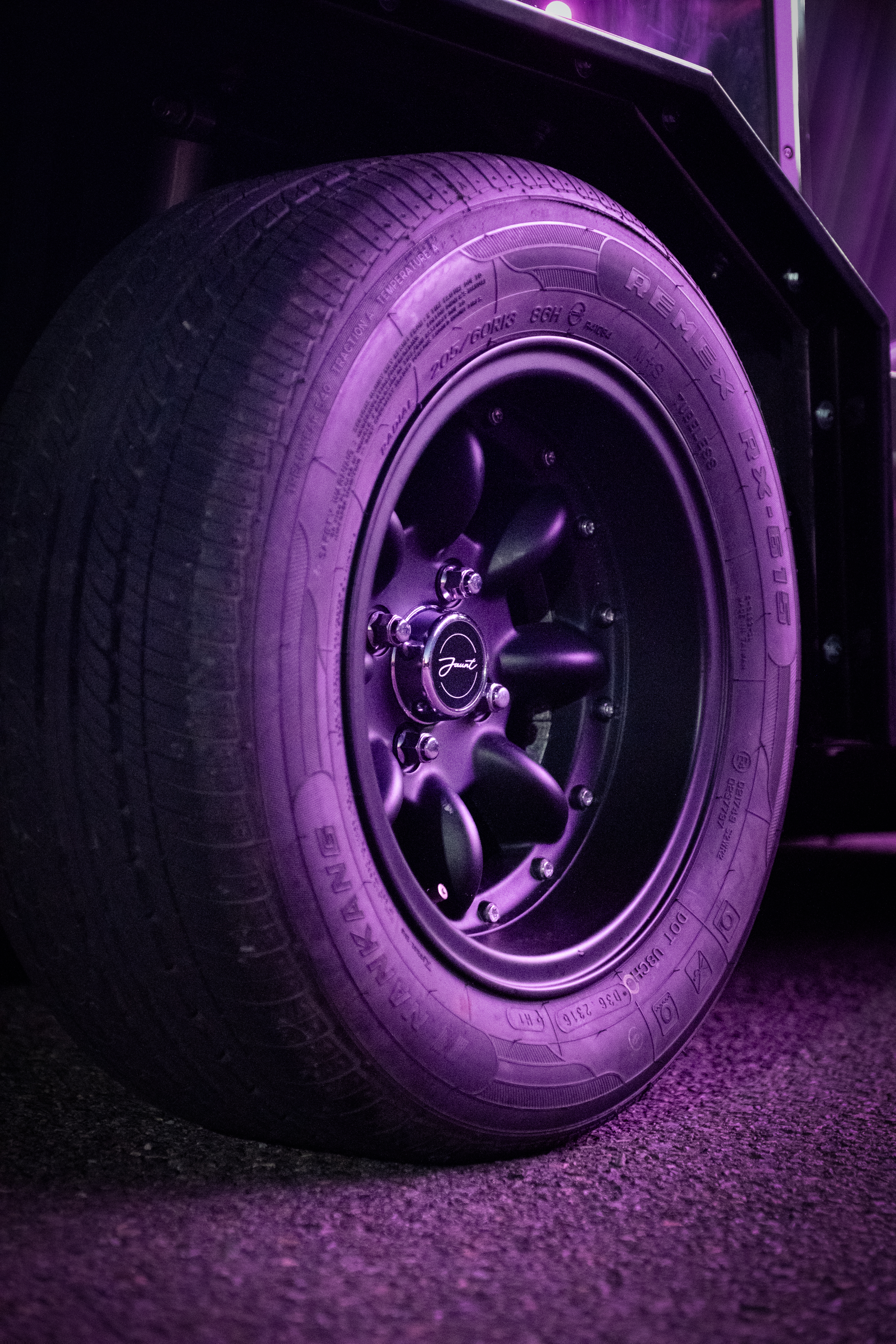
Close-up of the black alloy wheel with the Jaunt script centre cap, bathed in deep magenta neon light against a dark background.
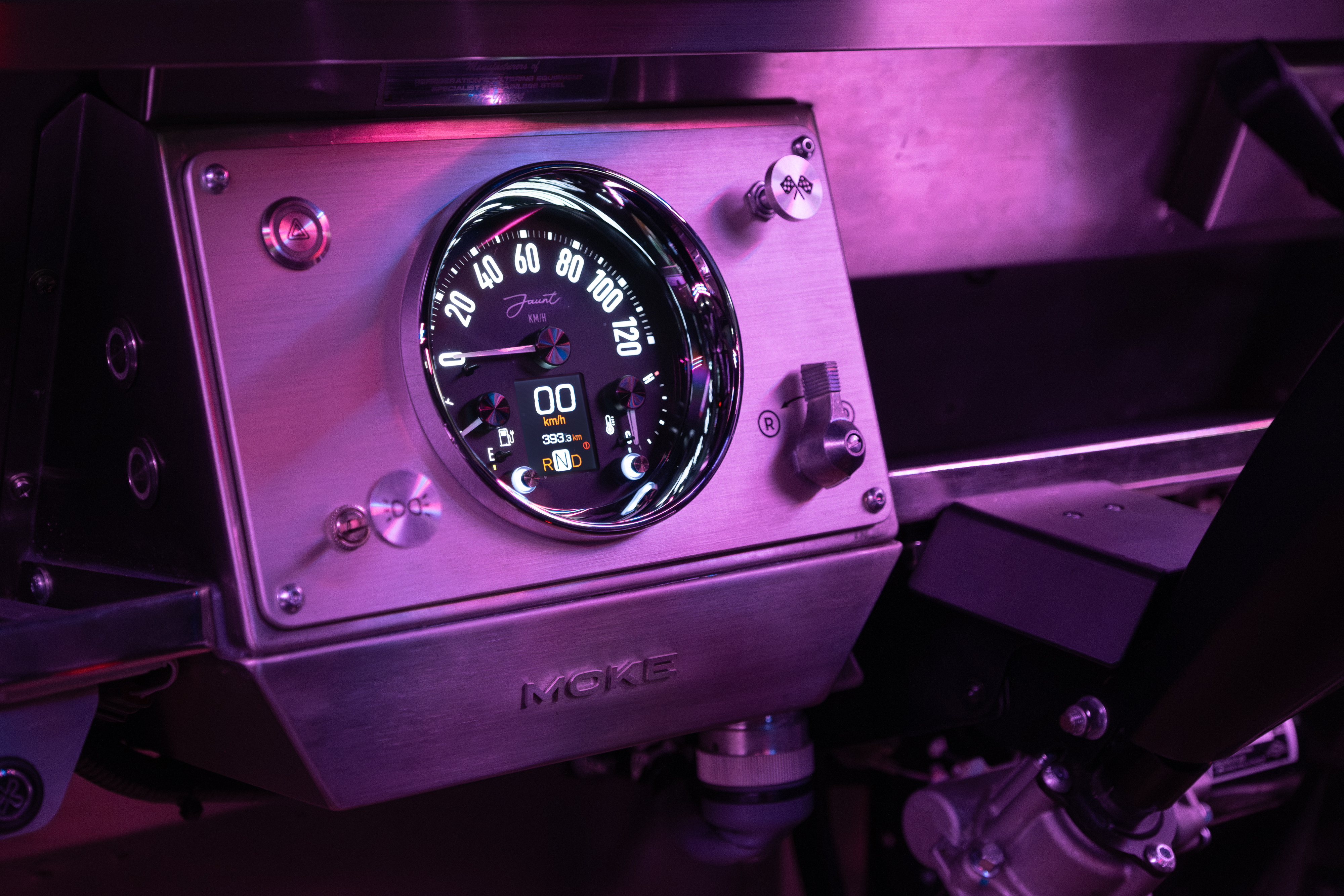
The brushed stainless dashboard with the Jaunt speedometer cluster lit up under pink ambient neon, the digital display showing RND and 393km odometer.
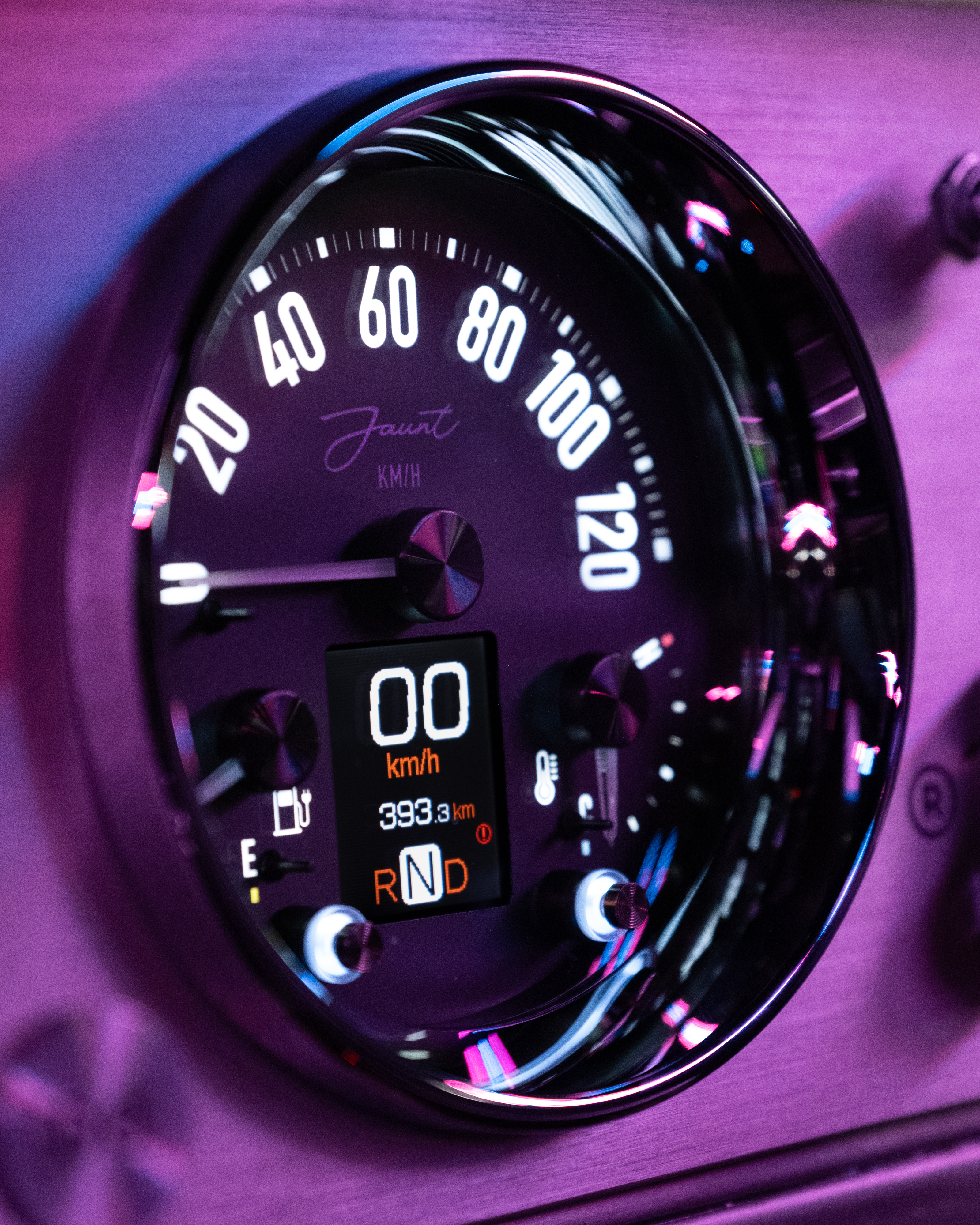
Extreme macro of the Jaunt analogue speedo face under pink neon, the chrome bezel reflecting surrounding lights and the digital display clearly showing RND mode.
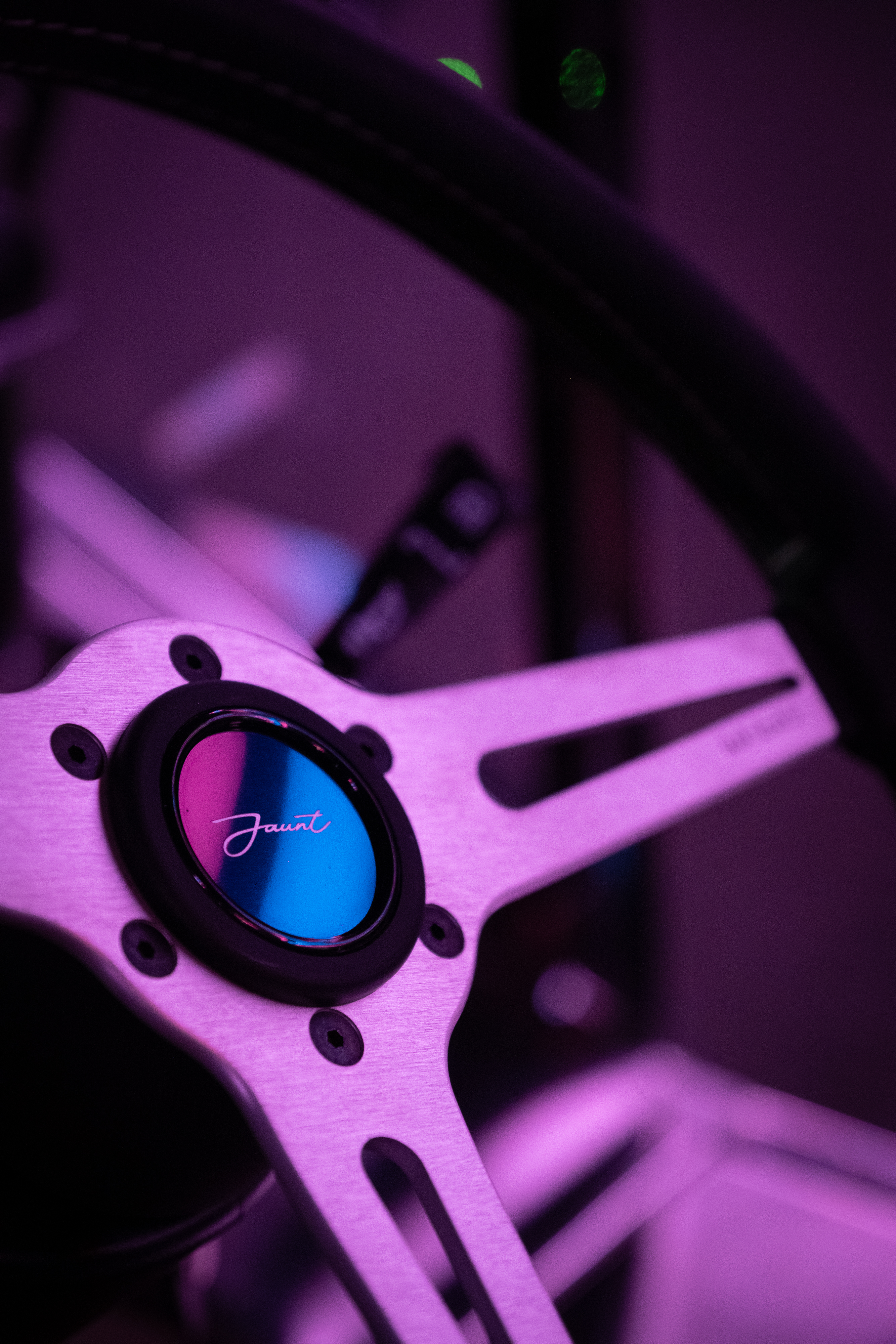
Close-up of the three-spoke brushed steering wheel and Jaunt centre badge under magenta neon, the badge face catching pink and blue reflections.
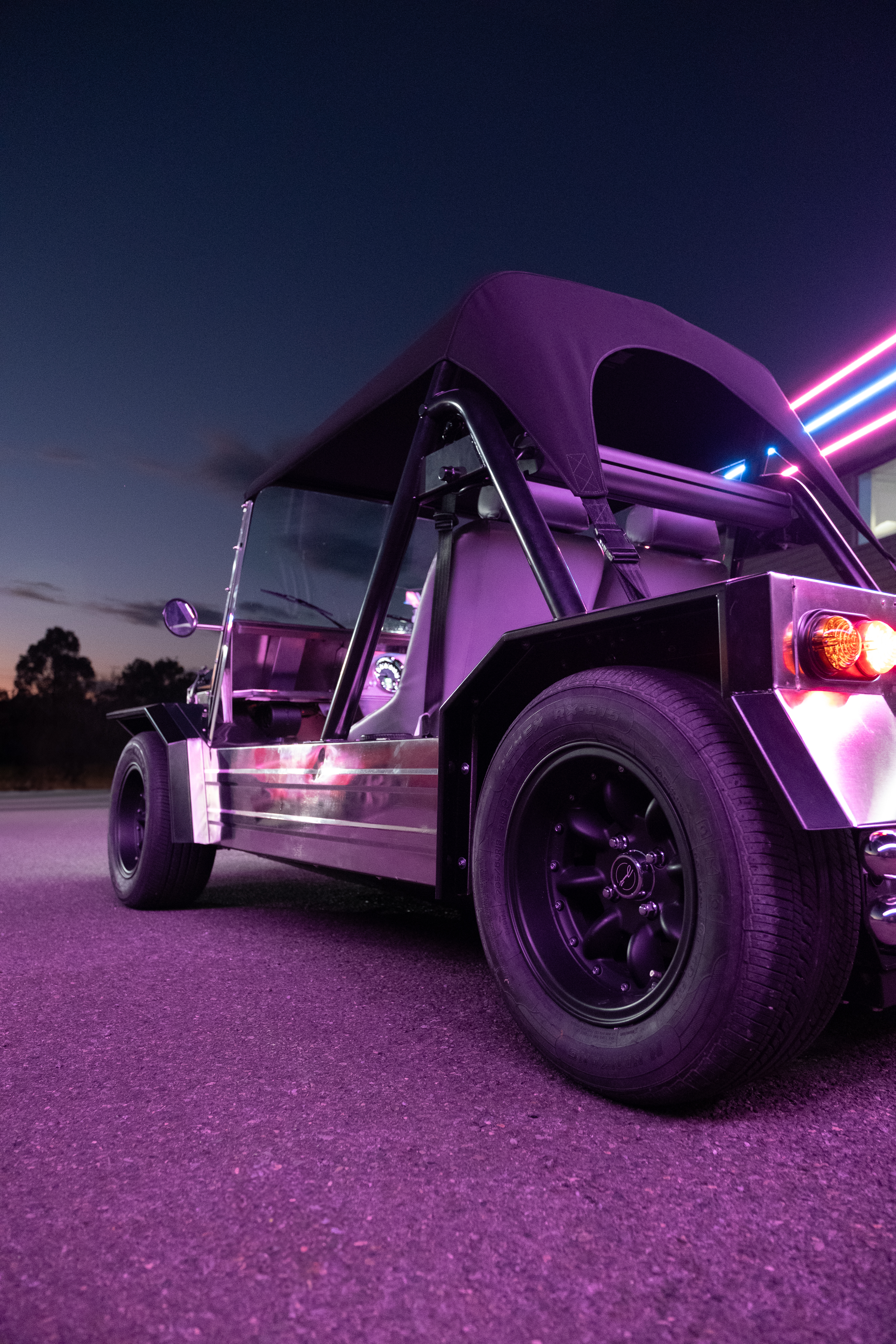
Rear three-quarter view at dusk with the deep blue twilight sky above and a pink neon strip running along the building roofline behind the Moke.
Low front three-quarter view at night with headlights blazing and pink-blue LED strips above on a brick building, the body glowing deep violet from the ambient neon.
CCS2 charge port revealed in the open side-pod under deep magenta neon, with the glowing charge indicator LED below the socket and the speedometer visible in the background.
Dark low-angle shot of the front grille and headlight at night with parallel pink and blue neon strips running diagonally across the brick wall behind.
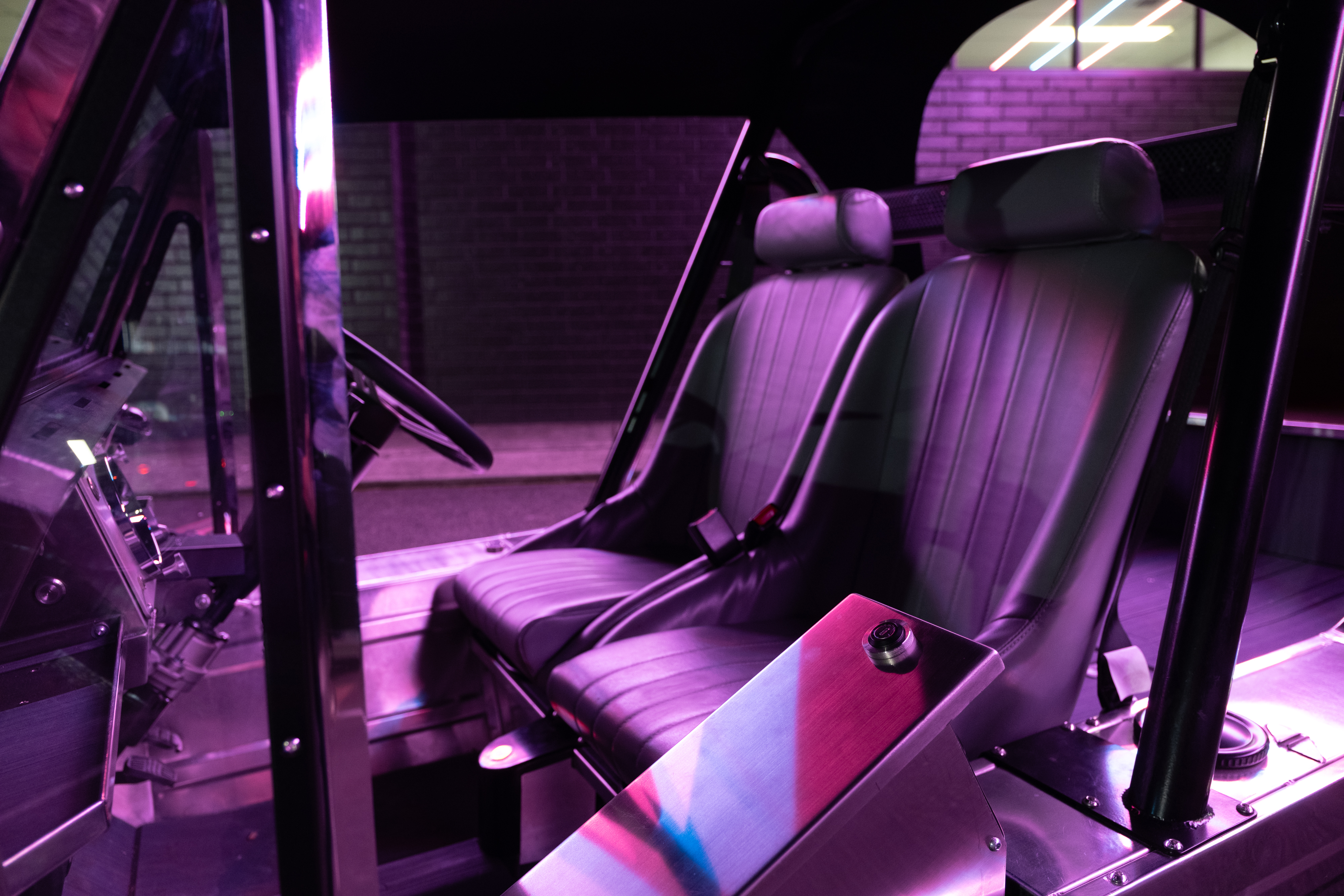
Interior view looking across the seats and console under pink neon ambient light, showing the leather upholstery and the brushed stainless tunnel console with power button.
Front view of the Moke at night parked in front of the Rollerama roller-skating venue sign with its pink neon starburst and blue-and-pink LED roof strips.
CHAPTER 09
The details visitors find on a second look.

Some of these only land once you have lived with the car for a week. Others you might never notice at all. They're in here anyway, because the team wanted them to be.

The hidden charge port. Behind one of the original side-pod storage lids. Gas struts hold it open while you plug in. Closed, it disappears into the body line. Open, it telegraphs that this is something other than a 1980s Moke without ever putting a hole in the panel.

The soundbar in the seat-belt hoop. A weatherproof off-road buggy speaker mounted inside the tubular hoop and run off Bluetooth. The hoop is structural and acoustic at the same time. At a stop or a slow roll, you can hear it. Past about 80 km/h, the wind takes over and the music belongs only to you.

The Moke wordmark with a lightning bolt. CNC-machined from aluminium, anodised black, then the top surface is milled back to bare metal and clear-coated. Catches different light at different angles. Subtle, until it isn't.

The Electric Moke #1 plaque. Under the bonnet, where you only see it when you have a reason to look. VIN, output, build number. We made one. There won't be another quite like this.

The wing-pod can storage. The original Super S had storage pockets either side. We dimensioned ours to take a 375 mm tinnie tray. Specifically. A car you'd take to the beach should be able to hold what you take to the beach.

The C-Deck underfloor. The same slip-resistant foam decking used on small boats. Bonded to the underside of the floor pan. Practical, weather-resistant, and quiet over rough surfaces.

The rubber-cone suspension. Mokes inherit their suspension from the original Mini. Instead of metal coils or leaves, the springs are rubber cones. When this car was tested on the Boulevard in East Ivanhoe, which is famously the worst public road in Melbourne, it didn't just survive. It handled.


It's a pretty ingenious solution. The travel is so tiny, you don't have a lot of space. But you need to provide something that's both comfortable and handles well. Maybe something that's naturally kind of hard and squishy. Like a ball of rubber.
Dave Budge · MOKE · Bumpy Roads
Reel · Standalone
Under Floor Storage
// Wing-pod tinnie tray
Reel · Episode 17
Sound Bar
// Hoop speaker reveal
Reel · Standalone
ID Plaque
// Lightning-bolt badge close-up
Reel · Standalone
Bumpy Roads
// Boulevard, East Ivanhoe
Reel · Standalone
Bi-directional Charge
// 240V, 15A V2L output
Reel · Episode 18
Bash Guards
// Underfloor protection
What a car to take down the beach.
Dave Budge · MOKE 17 · Sound Bar